Fix Tripped Circuit Breaker Fast with Safe Reset Guide
- 时间:
- 浏览:56
- 来源:Easy Home Repair & DIY Guides
H2: Why Your Breaker Trips—and Why You Shouldn’t Just Flip It Back On
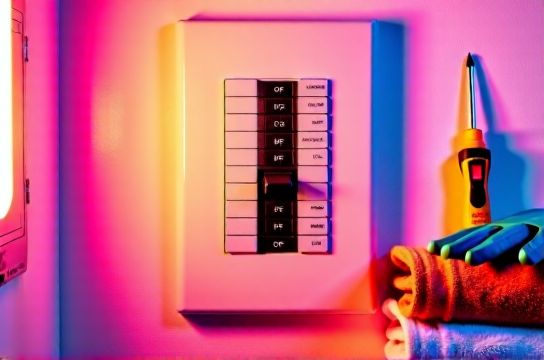
A tripped circuit breaker isn’t a glitch—it’s your home’s emergency shutoff doing its job. When current exceeds the breaker’s rated capacity (typically 15A or 20A for standard circuits), internal thermal-magnetic mechanisms trip to prevent overheating wires, insulation damage, or fire. According to the U.S. Fire Administration, faulty wiring and overloaded circuits cause ~47,000 home fires annually (Updated: April 2026). Simply resetting without diagnosing the root cause risks repeat trips—or worse.
Common triggers include: • Overloaded outlets (e.g., space heater + vacuum + LED strip on same 15A circuit) • Short circuits (exposed wire contact, damaged cord insulation) • Ground faults (moisture intrusion in outdoor fixtures or bathroom GFCI zones) • Aging breakers (thermal fatigue after 20+ years; UL-certified units typically last 30–40 years but degrade faster in high-heat panels)
Crucially: If the breaker trips *immediately* upon reset—even with all loads disconnected—it signals a hard fault (e.g., staple-nicked cable behind drywall or failing junction box). That’s not a DIY fix. Stop and call a licensed electrician.
H2: Safe, Step-by-Step Breaker Reset Procedure
✅ Do this *every time*—no exceptions:
1. **Unplug or turn OFF all devices on the affected circuit.** Don’t just flip switches—unplug lamps, chargers, and appliances. For lighting circuits, switch off wall controls *and* remove bulbs if possible (especially older halogens that draw surge current at startup).
2. **Locate your main service panel.** Usually in garages, basements, or utility closets. Panels built after 2008 have labeled circuits; pre-2000 panels often lack clear labeling—use a circuit tracer tool ($25–$45) to verify which breaker serves your ceiling light replacement zone or smart switch wiring area.
3. **Identify the tripped breaker.** It’s not always obvious. Look for: • A handle physically sitting between ON and OFF (mid-position) • A red or orange indicator window (on newer Square D QO or Siemens PL series) • A subtle “click” when gently nudging the handle—tripped units feel loose
4. **Fully OFF before ON.** Push the handle firmly to the full OFF position (past the middle detent). This resets the internal latch. Then move it decisively to ON. Hesitation or partial movement won’t engage the mechanism.
5. **Wait 2–3 seconds before restoring load.** Let the breaker stabilize. Then plug in one device at a time. If it trips again *with only one item connected*, that device is likely faulty (e.g., a failing LED driver in a low-voltage lamp strip or corroded contacts in an old socket panel swap).
⚠️ Never bypass a breaker with tape, coins, or “breaker locks.” This voids UL listing, violates NEC Article 110.3(B), and invalidates home insurance.
H2: When Resetting Fails—What to Check Next
If the breaker holds after reset but lights flicker, dim, or buzz: • **Check connections at the fixture:** Loose neutrals in ceiling boxes cause arcing and voltage drop—common after DIY吸顶灯更换安装 (ceiling light replacement) where wire nuts weren’t torqued to 18–22 in-lbs per NEC 110.14(D). • **Test for shared neutrals:** Older homes wired with multi-wire branch circuits (MWBCs) can overload the neutral if breakers aren’t handle-tied. Use a multimeter to verify voltage between hots (240V) and each hot-to-neutral (120V). Imbalance >5V suggests neutral issues. • **Inspect GFCI/AFCI upstream:** A tripped GFCI outlet (e.g., in a kitchen or garage) can kill power downstream—including to your吊扇固定安装 (ceiling fan) or低压灯带安装 (low-voltage LED strip). Press TEST then RESET on every GFCI in the house.
H2: Preventing Repeat Trips—Practical Upgrades That Pay Off
Prevention beats troubleshooting. These code-compliant upgrades reduce strain on circuits and eliminate common trip causes:
• **Swap incandescent/halogen bulbs for ENERGY STAR–certified LEDs:** A 60W-equivalent LED draws just 8.5W (vs. 60W). Replacing ten 60W bulbs saves ~500W per hour—enough to keep a 15A circuit stable under load (Updated: April 2026). Prioritize led节能灯升级 in high-use areas: kitchens, living rooms, hallways.
• **Install dedicated circuits for high-draw devices:** Space heaters, air conditioners, and EV chargers need their own 20A+ breakers. Never daisy-chain via power strips—NEC 210.21(B)(1) limits receptacle ratings to match breaker amperage.
• **Replace outdated outlets and switches:** Worn插座面板替换 (outlet panel swaps) with back-stabbed wires cause intermittent faults. Use screw-terminal outlets (Leviton Decora or Hubbell) and torque to spec. For调光开关布线 (dimmer switch wiring), match load type: trailing-edge dimmers for LEDs, leading-edge for incandescents. Mismatches cause buzzing and premature breaker trips.
• **Upgrade to smart switches with load monitoring:** Devices like Lutron Caseta or Leviton DW6HD report real-time wattage. Spot a 1,800W draw on a 15A/1800W circuit? That’s 100% capacity—no margin for surge. These help diagnose hidden loads (e.g., a malfunctioning HVAC blower motor drawing excess current).
H2: When to Call a Pro—Not Just a Preference, But Code
NEC Article 404.8(A) requires switches installed within sight of the equipment they control—unless part of a listed system (e.g., smart home hubs). That means your智能开关接线 (smart switch wiring) must meet local AHJ requirements for neutral wire presence, box fill, and arc-fault protection. In bedrooms, dining rooms, and hallways, AFCI breakers are mandatory per NEC 210.12(A)—and retrofitting them into older panels often requires load calculations and panel evaluation.
Red flags demanding licensed help: • Breaker feels warm to touch • Burning smell near panel or outlets • Aluminum wiring (pre-1974 homes)—requires COPALUM crimps, not wire nuts • Panel labels showing Federal Pacific (FPE) or Zinsco—both recalled due to failure-to-trip defects • Any work involving the main lugs, meter base, or service entrance
H2: Related Lighting & Power Tasks—Done Right the First Time
Many breaker trips trace back to poorly executed lighting upgrades. Here’s how to avoid pitfalls:
• **Ceiling light replacement:** Turn OFF the correct breaker—not just the wall switch. Verify with a non-contact voltage tester *at the fixture wires*, not just the switch. Old houses often have switched neutrals (illegal post-1999)—if the white wire is hot, stop and consult a pro.
• **Smart switch installation:** Most require a neutral wire in the box. If absent, options are limited: use a neutral-free switch (Lutron PD-6ANS) or run new cable (not DIY-friendly). Never cap the neutral and ignore it—creates shock hazard.
• **LED strip installation:** Low-voltage灯带 (12V/24V) needs proper gauge wire and fused power supplies. A 5m strip drawing 2A at 24V requires 18 AWG wire max. Undersized wire causes voltage drop → driver overcompensation → thermal shutdown → breaker nuisance trips.
• **Plug adapter usage:** 插头转换器使用 (plug converters) like EU-to-US adapters lack surge protection and often exceed outlet rating. Plug a 1,500W hair dryer into a 15A outlet via converter? That’s 12.5A—leaving only 2.5A margin. Better: install a dedicated 20A circuit with NEMA 5-20 receptacles.
• **Tenant-friendly upgrades:** 租客灯具改造 (renter lighting mods) should be non-permanent. Use plug-in smart bulbs (Philips Hue, Nanoleaf) instead of hardwired switches. Avoid drilling into ceilings—opt for adhesive-backed LED puck lights. Document all changes with photos for landlord approval.
H2: Quick-Reference Troubleshooting Table
| Issue | Most Likely Cause | Safe DIY Fix | When to Call Electrician |
|---|---|---|---|
| Breaker trips immediately on reset | Short circuit or ground fault | Unplug all devices; inspect cords for cuts/burns | Trips with zero load—cable damage behind walls |
| Breaker holds, but lights flicker | Loose connection or failing LED driver | Tighten wire nuts; replace bulb/driver | Flickering across multiple circuits—panel bus issue |
| Only trips with AC/heater on | Circuit overload | Move appliance to dedicated circuit | No spare breaker slots—panel upgrade needed |
| Breaker trips after rain | Moisture in outdoor fixture or GFCI | Dry fixture; press GFCI RESET | Water ingress in junction box—sealant failure |
H2: Final Safety Reminders—Non-Negotiable
• Always use insulated tools rated for 1000V (e.g., Klein Tools 55001 series). Standard hardware-store screwdrivers lack dielectric coating.
• Test *before* touching: Non-contact testers (Fluke 1ACII) detect voltage—but false negatives occur near metal conduit. Confirm with a multimeter (set to AC voltage) between hot and ground.
• Never work alone on live panels. Have someone nearby who knows how to shut off main power and perform CPR.
• Keep your panel accessible: No stored boxes, holiday decorations, or furniture blocking access. NEC 110.26(A)(1) mandates 36-inch clearance in front.
H2: Putting It All Together
Fixing a tripped breaker isn’t about speed—it’s about methodical verification. Start with load reduction, confirm no physical damage, reset correctly, then validate stability under realistic conditions. Every ceiling light replacement, smart switch wiring job, or LED upgrade you do safely reduces future risk. And if uncertainty arises? Pause. Review the full resource hub for deeper guidance on code updates, product specs, and inspection checklists—because safe electricity isn’t optional. It’s foundational.
For comprehensive planning—including load calculations, compatible dimmer pairings, and step-by-step videos for every task mentioned here—visit our complete setup guide at /.