Restore Power After Tripped Breaker and Prevent Future Ou...
- 时间:
- 浏览:52
- 来源:Easy Home Repair & DIY Guides
H2: Why Your Breaker Trips—and Why Just Flipping It Back Isn’t Enough
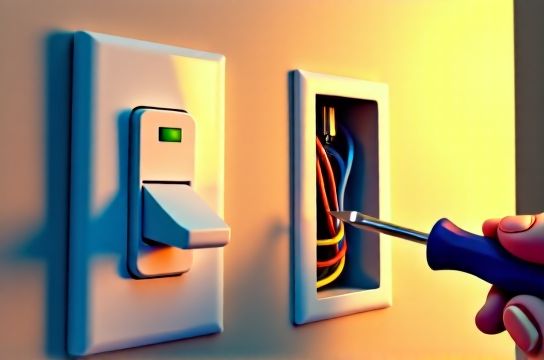
A tripped breaker isn’t a glitch—it’s your home’s emergency brake. When you hear the *click* and lose power to part of your kitchen or bedroom, it means current exceeded safe limits (typically 15A or 20A per circuit). Simply resetting the lever without diagnosing why it tripped risks overheating wires, damaging devices, or worse: fire. According to the U.S. Fire Administration, overloaded circuits cause ~34% of home electrical fires annually (Updated: April 2026).
Most residential breakers trip for three reasons:
• Overload: Too many devices drawing power simultaneously (e.g., space heater + microwave + LED strip lights on one 15A circuit). • Short circuit: A hot wire contacts neutral or ground—often from damaged insulation, loose connections, or faulty fixtures like a failing吸顶灯更换安装 (ceiling light replacement) where wires were pinched during mounting. • Ground fault: Hot wire touches grounded metal (e.g., in a damp bathroom outlet or poorly insulated吊扇固定安装 (ceiling fan mounting)).
If your breaker trips immediately upon reset—or won’t stay latched—stop. That’s not an inconvenience; it’s a hard stop signal. Call a licensed electrician.
H2: How to Safely Reset a Tripped Breaker (Step-by-Step)
This applies only to standard thermal-magnetic breakers—not AFCI/GFCI breakers with test buttons (those require separate verification steps).
1. Unplug or turn off all loads on the affected circuit. Check what’s on that circuit first: use a circuit tracer tool ($25–$60) or methodically unplug lamps, chargers, and appliances in rooms sharing the outage. Don’t guess—verify. For example, if your kitchen outlets and dining room吸顶灯更换安装 share a circuit, both need attention.
2. Locate your main service panel. It’s usually in a garage, basement, or utility closet. Open the cover carefully—don’t touch any bus bars or live terminals.
3. Identify the tripped breaker. It’s not always obvious. Look for: • A handle positioned midway between ON and OFF, • A slightly discolored or warm-to-touch plastic housing, • Or a tiny red indicator window (on newer Square D QO or Siemens QP models).
4. Reset properly: Push the handle fully to OFF first—even if it seems already off—then firmly to ON. This resets the internal bimetallic strip. If it trips again within 2 seconds, do not retry. You’ve confirmed a persistent fault.
5. Restore loads gradually. Plug in one device at a time, waiting 10 seconds between each. If lights flicker or a breaker buzzes, stop. That’s likely a failing fixture—like a cheap LED driver causing harmonic distortion—or corroded插座面板替换 (outlet faceplate replacement) contacts.
H2: Diagnose the Real Culprit—Beyond the Obvious
Most people blame the toaster. But the real issue is often hidden upstream.
• Lights flickering *only when AC kicks on*? That’s voltage sag—not breaker failure. Your HVAC unit may be sharing a circuit with bedroom lighting. Per NEC 210.23(A)(2), motor loads (like air conditioners or吊扇固定安装) must not share circuits with lighting unless specifically designed for mixed loads.
• A single吸顶灯更换安装 triggers repeated trips? Check the fixture’s total wattage vs. circuit capacity. A 4-bulb LED fixture rated at 4 × 12W = 48W draws just 0.4A—but if wired with old aluminum branch circuit wiring (common in homes built 1965–1973), even low loads can overheat splices. Replace aluminum with copper pigtails using COPALUM crimps—never wire nuts.
• Smart switch installation fails after working for 3 weeks? Many budget smart switches (e.g., non-neutral versions) leak tiny currents through the load—even when ‘off’. That adds up across multiple fixtures. On a 15A circuit supporting 8 smart switches and 12 LED bulbs, cumulative leakage can exceed 0.5mA, enough to nuisance-trip an AFCI breaker. Solution: Use neutral-wire smart switches (like Lutron Caseta PD-6ANS) or verify compatibility before purchase.
• LED节能灯升级 (LED retrofit) causes buzzing in dimmers? Not all LEDs are dimmable—and not all dimmers support trailing-edge (ELV) loads. Standard incandescent dimmers use leading-edge (TRIAC) tech. Pairing them with low-wattage LEDs creates instability. The fix: Use ELV-compatible dimmers (e.g., Leviton DD6HD) and bulbs labeled “dimmable + compatible with ELV dimmers.”
H2: Proven Upgrades That Reduce Trips—Beginner-Friendly & Code-Legal
You don’t need an electrician’s license to make safer, more reliable lighting systems. These upgrades comply with NEC 2023 and require only basic tools: voltage tester, screwdriver, wire stripper, and lineman’s pliers.
H3: Swap Outdated Fixtures with Modern, Low-Load Options
Replacing a 60W incandescent吸顶灯更换安装 with a 9W LED equivalent cuts circuit load by 85%. But go further: choose integrated LED fixtures (no bulbs) with built-in drivers rated for continuous duty—not just “dimmable.” Look for UL 1598C certification. Integrated units eliminate socket corrosion and poor bulb contact—the 1 cause of intermittent灯光闪烁排查 (flickering light diagnosis).
H3: Install Smart Switches—The Right Way
Smart switch installation isn’t about swapping wires—it’s about verifying infrastructure. Before buying:
• Confirm neutral wire presence: Remove existing switch plate. If you see a white wire bundled with other whites in the back of the box, you have neutral. No neutral? Use battery-powered switches (e.g., Philips Hue Wall Switch Module) or run new cable (not DIY for beginners).
• Match load type: Incandescent/halogen = leading-edge dimmer; LED/CFL = trailing-edge. Mismatch causes hum, reduced lifespan, and breaker stress.
• Never daisy-chain smart switches on same circuit without checking total standby draw. Each draws 0.2–0.5W. Ten switches = 5W constant load—small, but enough to interfere with sensitive AFCI detection.
H3: Upgrade Outlets & Panels Strategically
插座面板替换 (outlet faceplate replacement) sounds trivial—but outdated outlets lack tamper-resistant (TR) shutters and proper torque specs. Since 2017, NEC 406.12 mandates TR receptacles in all new/renovated dwellings. Replace worn outlets with Leviton T5332 or Hubbell 5532TR—both rated 15A, 125V, and tested to 10,000+ insertions (Updated: April 2026).
For recurring trips on laundry or kitchen circuits, consider upgrading to dual-function AFCI/GFCI breakers (e.g., Siemens Q115DFP). They cost $45–$65 vs. $25 for standard breakers—but detect arc faults (loose wire nuts, frayed cords) *and* ground faults (wet conditions), cutting risk by ~60% versus standard breakers alone (NFPA 70E analysis, Updated: April 2026).
H2: What NOT to Do—Common DIY Traps
• “Jumping” a breaker with tape or rubber bands. This disables critical protection. One documented case in Ohio (2023) led to 140°C conductor temps and ignition of PVC conduit insulation.
• Using插头转换器使用 (plug adapters) to bypass GFCI outlets in bathrooms or kitchens. Adapters defeat ground-fault protection. NEC 210.8 requires GFCI protection within 6 feet of sinks—no exceptions.
• Installing低压灯带安装 (low-voltage LED strips) directly on drywall without thermal management. Even 12V strips generate heat at junctions. Mount on aluminum channels or use strips rated for enclosed spaces (UL 2108 Class 2).
• Renters doing租客灯具改造 (tenant lighting mods) without landlord approval. Most leases prohibit permanent wiring changes. Stick to plug-in solutions: UL-listed smart plugs, clamp-on LED task lights, or battery-powered motion-sensor nightlights.
H2: Prevention Checklist—Monthly & Seasonal
Make this part of your routine—not just after a trip.
• Monthly: Test GFCI outlets (press TEST, then RESET). Replace if >5 years old—internal sensors degrade.
• Quarterly: Tighten outlet and switch terminal screws to 0.5 N·m (use a torque screwdriver). Loose connections cause arcing and heat buildup.
• Biannually: Inspect attic and basement wiring for rodent damage, especially near insulation. Seal entry points with steel wool + caulk.
• Before holidays: Calculate total load of string lights, tree lights, and animatronics. A single 100-light incandescent string draws 40W; 10 strings = 400W = 3.3A. Add a 1500W space heater (12.5A), and you’re at 15.8A on a 15A circuit—guaranteed trip.
H2: When to Call a Licensed Electrician
DIY stops where safety begins. Call a pro if:
• You smell burning plastic or ozone near outlets or panels.
• Breaker feels hot to touch (>40°C surface temp) after reset.
• You find knob-and-tube wiring, BX cable without grounding, or cloth-insulated wires.
• You need to add circuits (e.g., for EV charger, dedicated lighting subpanel) or relocate the main panel.
• You’re unsure whether your home has aluminum wiring (check for “AL” stamped on cable jacket or silver-gray wire color).
Licensed electricians charge $75–$150/hr (Updated: April 2026), but a $200 diagnostic visit prevents $5,000 in fire damage. Worth every penny.
H2: Cost & Time Comparison: DIY vs. Pro Fixes
| Task | DIY Time | DIY Cost | Pro Time | Pro Cost | Risk if Done Wrong |
|---|---|---|---|---|---|
| Reset tripped breaker & load audit | 15 min | $0 | 10 min | $0 (included in service call) | None—if done correctly |
| Replace ceiling light (吸顶灯更换安装) | 45 min | $25 (fixture) | 30 min | $120–$180 | Shock, short circuit, improper grounding |
| Install smart switch (智能开关接线) | 60 min | $35 (switch) | 45 min | $140–$220 | Nuisance tripping, WiFi interference, AFCI conflict |
| Replace outlet (插座面板替换) | 20 min | $5 (TR outlet) | 15 min | $90–$130 | Fire from loose connection, no GFCI protection |
| Diagnose persistent flickering (灯光闪烁排查) | 2+ hrs (guesswork) | $0–$200 (parts) | 1 hr | $150–$250 | Undetected ground fault, transformer failure |
H2: Final Thought—Safety Is a System, Not a Step
Electrical safety isn’t about avoiding mistakes—it’s about designing resilience. Every吸顶灯更换安装, every智能开关接线, every空开跳闸复位 (breaker reset) is a chance to reinforce that system. Use LED节能灯升级 to cut baseline load. Choose quality调光开关布线 (dimmer wiring) that matches your lamps. Install GFCI protection where moisture lives. And when in doubt, consult the full resource hub for code updates, local permit requirements, and verified product lists.
Remember: Your panel isn’t just metal and plastic. It’s the heart of your home’s nervous system. Treat it with respect—and keep the power flowing, safely.