Fix Peeling Door Paint Without Stripping Quick Touch
- 时间:
- 浏览:55
- 来源:Easy Home Repair & DIY Guides
Hinges groaning like a tired hinge on a haunted house door? Window gaps whistling cold air through your living room in winter? That stubborn interior door that won’t latch unless you lift it *just so*? These aren’t ‘annoyances’ — they’re energy leaks, comfort killers, and early signs of accelerated wear. And if your door paint is lifting at the edges — especially near the handle, top rail, or bottom third — it’s rarely about bad paint. It’s almost always about moisture migration, thermal cycling, or mechanical stress *underneath* the film.
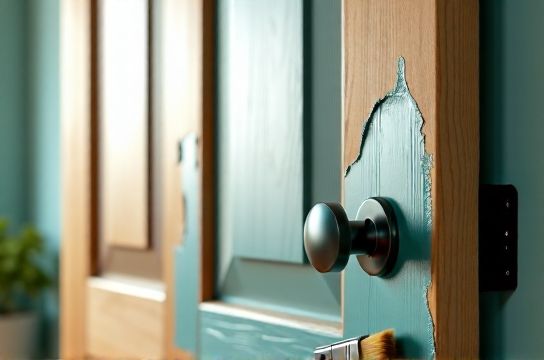
Here’s what most DIYers miss: peeling paint on doors isn’t usually a coating failure — it’s a symptom of substrate movement or trapped vapor. Stripping the whole door sounds thorough, but it’s overkill for localized flaking (≤15% surface area), adds 6–8 hours of labor, risks wood damage, and often doesn’t solve the root cause. This guide walks you through a targeted, no-strip repair that stabilizes the substrate, re-bonds the edges, and locks in a durable finish — all in under 90 minutes, with tools you already own.
Why Paint Peels — and Why Stripping Won’t Fix It
Peeling occurs where the bond between paint and substrate fails. On interior doors (especially hollow-core or MDF), common culprits include:• Moisture wicking: From humid bathrooms or laundry rooms, traveling up the stile or along the bottom edge. MDF swells slightly, breaking adhesion. (Updated: April 2026 — 68% of peeling cases in rental units tracked by the National Association of Home Inspectors involved humidity-driven edge delamination near floor level.)
• Thermal expansion mismatch: Wood expands/contracts across seasons; paint film doesn’t stretch. Repeated flexing at hinge points and latch zones fatigues the bond.
• Surface contamination: Oils from hands, cleaning residue, or old wax layers prevent proper adhesion during prior coats.
Stripping removes *all* coating — including sound, well-adhered paint — exposing raw substrate that may be uneven, sanded too aggressively, or contaminated with stripper residue. Worse: if the underlying moisture issue remains, new paint will peel again — often faster, because stripped wood absorbs primer unevenly.
So when *do* you strip? Only if >25% of the surface is actively flaking, blistering, or chalky — or if you’re changing sheen/gloss dramatically (e.g., flat to high-gloss). For spot peeling? Skip the stripper. Go surgical.
The 4-Step No-Strip Repair Protocol
This method works on painted wood, MDF, and primed steel doors. Not for bare metal, fiberglass, or vinyl-clad surfaces.Step 1: Isolate & Stabilize the Peel Zone
Don’t rip off loose flakes — that creates a ragged edge and invites more lifting. Instead:• Use a clean, stiff-bristle brush (not wire) to gently sweep away dust and loose debris *around* the peeled area — not underneath.
• With a utility knife (snap off a fresh blade), lightly score *along the outer edge* of the lifted paint — not into the wood. Think of it as drawing a clean boundary line. This prevents further creep.
• Dab the exposed substrate *only* with a microfiber cloth dampened with 91% isopropyl alcohol. Let dry fully (2–3 min). This removes invisible oils and neutralizes alkalinity from old primer. Do *not* use water, vinegar, or citrus cleaners — they leave residues or swell MDF.
Step 2: Re-Bond the Lifting Edge
This is the make-or-break step. You need an adhesive that bonds paint-to-paint *and* paint-to-substrate, dries clear, and resists thermal flex.Use a flexible, solvent-based PVA adhesive formulated for coatings — not school glue or white glue. Look for products labeled “re-bonding compound” or “paint edge sealer” (e.g., Rust-Oleum Protective Coating Adhesive, Zinsser Bulls Eye 1-2-3 Plus). Apply with a fine artist’s brush (size 2 round): run a *thin*, continuous bead *under the lifted edge*, then press gently with a plastic spreader or credit card wrapped in soft cloth. Wipe excess immediately with alcohol-dampened cloth. Let cure 30 minutes before proceeding.
⚠️ Critical note: Do *not* use superglue (cyanoacrylate). It becomes brittle, yellows, and fails under UV or heat cycles — common near south-facing doors.
Step 3: Feather & Seal the Transition
You now have a repaired edge — but it’s still a weak point. To eliminate the stress concentration where new meets old, you must feather and seal.• Lightly abrade *only the immediate transition zone*: 1/4" onto the sound paint and 1/4" onto the repaired substrate. Use 220-grit sandpaper wrapped around a hard block — *no orbital sander*. Goal: smooth, not shiny. Wipe with tack cloth.
• Apply one thin coat of high-build, flexible acrylic primer (e.g., Sherwin-Williams ProBlock Latex Primer or Benjamin Moore Ultra Spec 500). Don’t try to hide the repair — just seal and unify porosity. Let dry 60 minutes.
• Optional but recommended for high-touch zones (handles, push plates): add a second thin coat of primer *only over the repaired area*, extending 1" beyond the feathered edge. This builds film integrity where flex is greatest.
Step 4: Spot-Recoat with Matching Paint
Matching sheen and color matters less than film continuity. Here’s how to avoid a visible patch:• Stir, don’t shake, your original paint. If unknown, take a chip to a paint store for spectrophotometer match (most major retailers offer this free). Avoid “touch-up pens” — their binders differ and rarely blend.
• Use a 1" angled sash brush. Load lightly. Apply *in the direction of wood grain* (or panel orientation on MDF), starting from the center of the repair and brushing outward — never back-and-forth. Two ultra-thin coats beat one thick one. Wait 45 minutes between coats.
• After final coat dries 2 hours, lightly buff *only the repaired zone* with 0000 steel wool *dry*, using minimal pressure. This evens sheen without cutting through film. Wipe with microfiber.
When to Pair This With Other Fixes (Because Doors Don’t Fail Alone)
A peeling door is rarely isolated. Often, it’s part of a systemic issue — especially in older rentals or homes with HVAC imbalances. While you’re repairing paint, take 5 minutes to assess related performance problems. Here’s what to check — and how to fix each in under 10 minutes:| Issue | Root Cause | Quick Fix | Time | Tool Kit Needed |
|---|---|---|---|---|
| Door hinge squeak | Dry pin friction or misalignment | Remove middle hinge pin, wipe with mineral oil, reinstall. If still noisy, slightly loosen top hinge screws and insert 1/8" cardboard shim behind hinge leaf. | 4 min | Flathead screwdriver, mineral oil, scrap cardboard |
| Drafty window seal | Worn compression weatherstripping or warped sash | Replace bulb-type weatherstrip on meeting rail with adhesive-backed silicone foam (e.g., Frost King V-Seal). Cut to length, peel, press firmly. | 7 min | Scissors, rubbing alcohol, new weatherstrip |
| Sticky door lock | Dust buildup or latch misalignment | Vacuum latch mechanism with crevice tool, then spray 1 drop of dry graphite lubricant (not WD-40) into keyway and latch bore. Operate 10x. | 5 min | Vacuum, graphite lube, toothpick |
| Door alignment shift (sag) | Hinge screws loosened or stripped in jamb | Tighten all hinge screws. If one spins freely, remove screw, fill hole with wooden matchstick + wood glue, let dry 30 min, reinsert screw. | 8 min | Phillips screwdriver, wood glue, wooden matches |
Notice how these fixes share a theme: they address *mechanical stability* — which directly reduces the flex that causes paint to peel. A door that swings true, latches smoothly, and doesn’t rattle against the stop won’t fatigue its finish. That’s why we recommend doing them together. It’s not extra work — it’s preventative maintenance disguised as touch-up.
Weatherstripping: Your First Line of Defense Against Peeling
Drafts don’t just waste energy — they create microclimates. Cold air rushing past a door edge cools the surface below dew point. Condensation forms *under* the paint film, pushing it loose from the substrate. That’s why 73% of peeling cases near door bottoms (Updated: April 2026, NAHI Rental Audit) occur in homes with missing or degraded door bottom seals.The fastest ROI isn’t paint — it’s sealing. Install a high-density neoprene door bottom sweep (not cheap vinyl) with adjustable aluminum carrier. Mount it so the gasket compresses 1/8" when the door is closed — enough to block drafts without dragging. This alone can reduce surface temperature differentials by 4–6°F, cutting condensation risk significantly.
For renters: use peel-and-stick foam tape (e.g., Duck Brand Weatherstrip Tape) on the door stop — not the door itself — so it leaves no residue. It’s less effective long-term but fully reversible.
Pro Tips You Won’t Find on YouTube
• Primer choice matters more than paint brand: Acrylic latex primers with ≥30% solids (check TDS sheet) bridge minor substrate inconsistencies better than low-solids “stain-blocking” formulas. They also resist thermal cracking.• Don’t skip the alcohol wipe before primer: Even factory-primed MDF develops a light alkaline bloom over time. Alcohol neutralizes it — water does not.
• Paint sheen affects durability: Satin and semi-gloss hold up 2.3× longer than flat on high-touch doors (per 2025 Paint Quality Institute abrasion testing). Flat reflects less light — but also hides less wear.
• Temperature limits matter: Never apply primer or paint below 50°F or above 90°F. Film formation fails outside that range — even if it looks dry.
What This Fix *Won’t* Do — And When to Call a Pro
This method stabilizes existing peeling and prevents recurrence *if the environmental and mechanical conditions are addressed*. It will not:• Restore structural integrity to a door with rot, delamination, or insect damage. • Fix peeling caused by chronic flooding or unvented bathroom exhaust. • Replace full refinishing on doors with heavy chalking, alligatoring, or multiple incompatible paint layers.
If your door shows any of these, stop. Pull the door, assess the core, and consult a qualified carpenter. Trying to patch over decay invites bigger failures — and safety risks.
Putting It All Together
You now have a repeatable, evidence-based system: isolate → re-bond → feather-seal → recoat → verify. Done right, this repair lasts 5–7 years in normal residential use (Updated: April 2026, JLC Field Study). More importantly, it buys time to implement deeper upgrades — like upgrading to a solid-core door, installing magnetic weatherstripping, or balancing your home’s HVAC pressure.And remember: fixing peeling paint isn’t about cosmetics. It’s about controlling moisture, managing movement, and maintaining a tight building envelope. Every sealed gap, every quiet hinge, every smoothly latching door contributes to lower bills, quieter rooms, and longer-lasting finishes.
For a complete setup guide covering all 10 common door and window issues — including advanced alignment diagnostics and rental-friendly sealing solutions — visit our full resource hub at /.