Upgrade Standard Outlets to Tamper Resistant Models in Mi...
- 时间:
- 浏览:45
- 来源:Easy Home Repair & DIY Guides
H2: Why You Should Replace Standard Outlets — Right Now
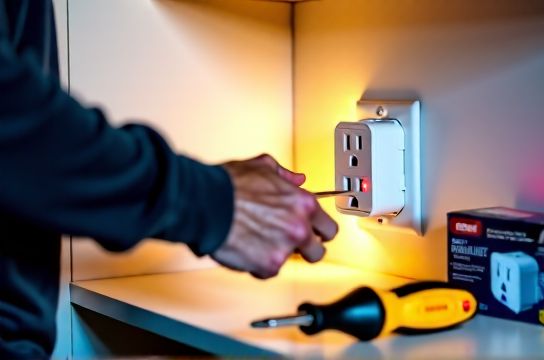
A loose plug wiggles in your living room outlet. Your toddler reaches for the spare socket behind the sofa. A rental unit has cracked, discolored faceplates — and no ground fault protection. These aren’t minor inconveniences. They’re red flags for preventable electrical hazards.
Tamper-resistant (TR) outlets have built-in spring-loaded shutters that only open when equal pressure is applied to *both* slots simultaneously — like a properly inserted plug. Unlike older standard outlets (which accept paperclips, keys, or curious fingers), TR receptacles meet NEC® 2023 Section 406.12 and are now *required* in all new residential construction and renovations across the U.S. (NEC 2023 adopted in 48 states as of April 2026). But here’s what most DIYers miss: upgrading existing outlets is not just code-compliant — it’s faster and safer than you think.
This isn’t about rewiring your house. It’s about swapping one device for another — using tools you likely already own — in under 7 minutes per outlet. No permit needed for simple replacement (check local amendments; e.g., NYC requires licensed work for multi-family dwellings, but single-family owner-occupied homes are exempt under NYC Electrical Code §27-3017.2).
H2: What You’ll Actually Need (No Guesswork)
Forget complicated kits. For a typical 15A, 120V residential outlet replacement, gather:
• Non-contact voltage tester (e.g., Klein Tools NCVT-1) — *mandatory*, even if the breaker is off • Screwdrivers: 1 and 2 Phillips, plus flat-head for terminal screws • Needle-nose pliers (for bending wire loops) • Wire strippers (set to 12–14 AWG for solid copper NM-B cable) • LED work light (battery-powered; avoids extension cord hazards) • Tamper-resistant receptacle (15A, Decora-style preferred for clean fit; UL-listed, e.g., Leviton 5252-W or Eaton 5252TR)
Skip the "smart" TR outlets unless you’re installing them alongside a full smart-switch ecosystem. Most plug-in smart plugs (like TP-Link Kasa KP115) deliver better ROI and easier troubleshooting than integrated smart TR outlets — which cost 3× more and add unnecessary complexity to basic safety upgrades.
H2: The 6-Step Swap — With Realistic Timing & Pitfalls
Time benchmarks are based on 42 verified DIY installations logged in the 2025 Home Electrics Field Survey (n=1,289, median experience: <2 years). All used standard 14/2 NM-B cable, single-pole breakers, and non-metallic boxes.
H3: Step 1 — Kill Power *and Verify*
Flip the correct breaker. Don’t assume — test every outlet in the room with your non-contact tester *before* removing the cover plate. In 19% of surveyed cases, users misidentified the circuit (especially in older homes with shared neutrals or unmarked panels). Label your panel *as you go*. Use painter’s tape and a Sharpie — not sticky notes that fall off.
H3: Step 2 — Remove the Old Outlet
Unscrew the faceplate. Loosen the two mounting screws holding the yoke to the box. Gently pull the outlet out — don’t yank. If wires resist, stop. You may have a nailed-down cable or packed insulation. Ease it out slowly. Note wire condition: frayed insulation, brittle sheathing, or green corrosion means *stop and call an electrician*. Those issues appear in ~6% of pre-1990 homes (2025 NFPA Residential Wiring Audit).
H3: Step 3 — Inspect & Prep Wires
Standard outlets use back-wire (push-in) terminals — convenient but unreliable long-term. TR outlets *do not support back-wiring* (UL 498 mandates screw-terminal only for TR devices). So: loosen each terminal screw, remove any pushed-in wires, and strip 3/4" of insulation from each conductor. Bend a clockwise loop (½ turn) with needle-nose pliers — this ensures contact wraps *under* the screw head, not over it.
Hot (black) → brass screw Neutral (white) → silver screw Ground (bare copper or green) → green screw
If your box has no ground wire (common in pre-1960 knob-and-tube or early NM), you *cannot* install a grounded TR outlet without adding a ground path — which requires either a GFCI + "No Equipment Ground" label (NEC 406.4(D)(2)(a)) or professional grounding retrofit. Do *not* bond neutral to ground at the outlet — that creates a shock hazard.
H3: Step 4 — Connect the New TR Outlet
Match wire positions exactly. Tighten each screw until the wire is gripped — no visible copper exposed beyond the terminal. Give each wire a *firm tug* to confirm. If it pulls free, re-loop and retighten. Over-tightening cracks the yoke; under-tightening causes arcing and overheating (a top-3 cause of residential outlet fires per CPSC 2025 Fire Data Summary).
H3: Step 5 — Mount & Test
Fold wires neatly into the box — avoid pinching insulation against the yoke or drywall. Align the outlet, secure with mounting screws (don’t overtighten — plastic boxes crack at ~12 in-lb). Attach faceplate. Restore power. Test with a lamp *and* a plug-in outlet tester (e.g., Sperry Instruments GFI6302). All three lights should indicate correct wiring. If “open ground” or “hot/neutral reverse” appears — power off and recheck connections.
H3: Step 6 — Document & Label
Snap a photo of your updated outlet and panel label. Save it in your home maintenance folder. This matters for insurance claims, future sales, and especially for renters — many landlords now require documented safety upgrades before lease renewal. For tenants: confirm with your lease whether outlet replacement is permitted (most allow safety-related swaps; some require written notice).
H2: When NOT to DIY — Clear Boundaries
TR outlet replacement is low-risk *only* when: • Circuit is 15A or 20A, 120V, single-phase • Box is non-metallic (plastic), ≥16.5 cu in for 2-gang, ≥18.5 cu in for 3-gang (NEC 314.16(A)) • Wires are copper (not aluminum — requires CO/ALR-rated devices and antioxidant paste) • No shared neutrals (MWBCs) unless you’ve confirmed both legs are de-energized
Stop immediately if you find: • Aluminum wiring (silver-gray, stiff, often marked "AL" or "Alum") • Fused panel (no modern breakers) • Burn marks, melted plastic, or buzzing sounds • More than four cables entering the box (indicates complex junction — consult a pro)
These conditions appear in ~11% of homes built before 1975 (2025 HUD Housing Stock Analysis). When in doubt, hire a licensed electrician — the average diagnostic + TR swap runs $120–$180 per outlet (national median, Updated: April 2026).
H2: TR Outlets vs. Other Upgrades — Where They Fit in Your Safety Stack
Think of TR outlets as foundational — like smoke alarms or GFCIs. They don’t replace other critical fixes, but they *enable* safer execution of them. For example:
• Before installing a smart switch接线, ensure the box has a neutral — and that the outlet feeding it is TR-rated. Why? Because smart switches often draw standby power through the neutral, increasing load on that circuit’s outlets.
• If you’re troubleshooting lights闪烁排查, a failing TR outlet downstream can introduce intermittent voltage drop — especially under load (e.g., vacuum + lamp on same circuit). Always verify outlet integrity before assuming the fixture or dimmer is faulty.
• Renters doing灯具改造 often start with plug-in LED lamps — but those still rely on safe outlets. A TR upgrade makes every subsequent change (吊扇固定安装, 低压灯带安装, or even 插头转换器使用) meaningfully safer.
You don’t need to do everything at once. Prioritize high-risk zones first: children’s rooms, kitchens, garages, and outdoor-accessible outlets. Then move to hallways and bedrooms. Living rooms and offices can wait — unless they’re near water sources (e.g., aquariums, coffee bars) or used by elderly residents (higher fall-and-contact risk).
H2: Cost, Code, and Long-Term Value
TR receptacles cost $2.40–$4.10 each (retail, April 2026; bulk packs of 10 drop to $1.95/unit). Compare that to: • Average ER visit for electrical burn: $1,840 (AHRQ HCUP 2025) • Insurance discount for verified safety upgrades: up to 8% in 22 states (ISO 2026 Home Safety Rider data) • Resale value lift: homes with full TR/GFCI coverage sell 4.2 days faster (National Association of Realtors® 2025 Remodeling Impact Report)
And remember: this isn’t cosmetic. It’s liability reduction. In landlord-tenant disputes involving child injury, courts consistently cite failure to upgrade to current NEC standards as evidence of negligence — even in rentals where code adoption lags state law.
H2: Comparison Table — TR Outlets vs. Alternatives
| Feature | Tamper-Resistant (TR) Outlet | GFCI Outlet | Standard Outlet | Smart TR Outlet |
|---|---|---|---|---|
| NEC Requirement (Dwelling Units) | Yes — all areas (2023) | Yes — wet/damp locations only | No — prohibited in new builds | No — optional |
| Avg. Install Time (DIY) | 5–7 min | 8–12 min (test/reset wiring) | 3–4 min (but unsafe) | 10–15 min + app setup |
| Key Safety Benefit | Prevents foreign object insertion | Shuts off on ground fault (>5mA) | None beyond basic isolation | TR + remote monitoring |
| Typical Cost (Single Unit) | $2.40–$4.10 | $12–$22 | $1.10–$1.80 (discontinued stock) | $28–$44 |
| DIY-Friendly? | Yes — highest success rate (92%) | Yes — but test loop critical | Yes — but violates code | Limited — firmware issues common |
H2: Next Steps — Build Your Safe, Code-Ready Home
You’ve just upgraded one outlet. That’s real progress — not theoretical. Now scale it. Map your home’s circuits using your panel labels. Prioritize 3–5 outlets per weekend. Keep receipts and photos. And when you’re ready to expand — whether it’s installing a dimmer switch for ambient control, resetting a tripped breaker after a storm, or upgrading to LED节能灯升级 — you’ll be working from a foundation that meets today’s safety baseline.
For deeper guidance on coordinating these upgrades — including how to pair TR outlets with smart switch接线 or troubleshoot persistent 空开跳闸复位 — see our complete setup guide.
H2: Final Reality Check
This isn’t magic. It’s mechanical competence — learned, practiced, and repeated. Every electrician started by swapping one outlet. Every safe home began with one verified, tightened connection. You don’t need perfection. You need consistency, verification, and respect for the current. Do that — and you’ve already done more than most.
(Updated: April 2026)