How to Hang a Ceiling Fan on Sloped or Vaulted Ceilings
- 时间:
- 浏览:43
- 来源:Easy Home Repair & DIY Guides
Hanging a ceiling fan on a sloped or vaulted ceiling isn’t just about aesthetics — it’s about structural integrity, electrical safety, and airflow efficiency. Standard flat-ceiling mounting kits won’t cut it. If you’ve ever tried bolting a fan directly into a 30° rafter or wrestled with a wobbling unit on a 12-foot cathedral ceiling, you know why this requires more than a screwdriver and optimism.
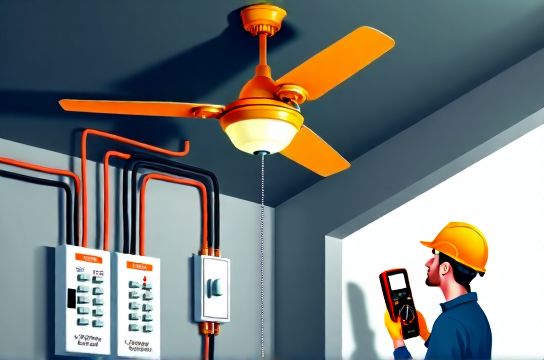
Let’s be clear: This is *not* a retrofit for a light fixture. A ceiling fan weighs 15–35 lbs (fan-only), generates dynamic torque during operation, and imposes lateral stress on mounting hardware — especially when tilted. The National Electrical Code (NEC) Article 314.27(A)(2) explicitly requires all ceiling-suspended fans over 35 lbs to be supported by an outlet box rated for fan support — and that rating changes dramatically on angles.
Here’s what actually works — and what gets overlooked in YouTube tutorials.
Step 1: Confirm Your Ceiling Structure & Angle
Before buying anything, grab a digital angle finder (like the Bosch GAM 20) and measure the slope. Common residential vaults range from 12° (gentle pitch) to 45° (steep cathedral). Anything above 30° demands specialty hardware — not just an adapter.
Also verify framing:
• Rafters: Most vaulted ceilings expose structural rafters. These are load-bearing and ideal — but spacing matters. Standard rafter spacing is 16” or 24” on center. If your fan’s canopy doesn’t align, you’ll need a cross-bracing solution.
• Joists + Drywall: Some ‘vaulted’ ceilings are drywalled over flat attic joists — meaning there’s *no real slope in the framing*, just a visual illusion. Use a stud finder with deep-scan mode (e.g., Zircon MultiScanner i520) to confirm. If joists run parallel to the slope, you’re dealing with a false vault — and can use standard fan-rated boxes with angled mounting brackets.
• Trusses: Avoid drilling into truss chords unless approved by a structural engineer. Trusses rely on precise web geometry; puncturing chords compromises integrity. If you hit one, stop — and consider surface-mount solutions or relocating.
Step 2: Choose the Right Support System (Not Just a Bracket)
There are three compliant support categories — and only two are DIY-safe:
A. Adjustable Slope Mounting Kits (Best for 12°–30°)
These include a pivoting canopy, reinforced threaded rod, and tilt-lock collar. Brands like Westinghouse (Model #SLOPEKIT-2) and Hunter (Sloped Ceiling Adapter Kit) list UL 507 certification and support up to 70 lbs at 30°. They attach directly to a fan-rated octagonal box secured to a rafter or joist.⚠️ Critical note: The box itself must be rated *for sloped applications*. Standard fan-rated boxes (e.g., Carlon B210R) are only tested at 0°. Look for boxes stamped "Rated for Sloped Ceilings" — such as the Arlington FB110S (rated to 45°, 70-lb load, Updated: April 2026).
B. Dual-Rafter Mounting Braces (For 30°–45°)
When slope exceeds 30°, single-point attachment becomes unstable. You need a brace that spans *two* rafters — distributing torque across both members. The Broan-NuTone 82U is a field-proven option: steel construction, adjustable width (16”–24”), and pre-drilled for 1/4” lag bolts. It installs *before* drywall (if accessible) or through an access panel.If drywall is already up, cut a 12”x12” inspection hole between rafters, install the brace, then patch. Yes — it’s extra work. But skipping it risks long-term vibration, stripped screws, and premature motor failure.
C. Flush-Mount Canopy Systems (Not Recommended)
Some kits claim to “flatten” the fan on steep slopes using low-profile canopies. These violate NEC 422.18 because they concentrate side-load on the electrical box’s mounting screws — not the structure. UL does not list any flush-mount system for >15° installations. Don’t risk it.Step 3: Wiring — Same Rules, Tighter Execution
Wiring a fan on a sloped ceiling follows identical NEC 404.2(C) and 406.3(D) rules as flat ceilings — but wire bending and strain relief become harder in tight, angled spaces.
• Use 14/3 NM-B cable (for fan + light control) or 12/3 if circuit is 20A. Never downgrade gauge due to distance — voltage drop increases on longer conduit runs common in vaulted attics.
• Secure cables within 8” of the box (NEC 314.17(C)). On slopes, use low-profile pancake clamps (e.g., Steel City 90110) instead of bulky plastic Romex connectors.
• Grounding is non-negotiable. Bond the fan’s green wire to the box’s grounding screw *and* pigtail to the circuit ground. Sloped installations see more vibration — loose grounds cause intermittent buzzing or GFCI nuisance trips.
• If adding a smart switch (e.g., Lutron Caseta PD-6ANS), ensure neutral is present in the wall box. Many older homes lack neutrals in switch loops — especially those feeding vaulted-ceiling lights converted to fans. Test with a multimeter before committing. No neutral? Use a neutral-free smart switch like the Inovelli Red Series (requires line/load only) — but verify compatibility with your fan’s internal receiver.
Step 4: Balancing, Clearance & Airflow Reality Checks
A fan hung on a slope will *not* hang perfectly vertical — and that’s fine. What matters is blade-tip clearance and balance.
• Minimum clearance: NEC 422.18 requires 7 ft from floor to lowest blade point. On a 10-ft vaulted ceiling with 20° slope, a standard 12” downrod may drop the blades to 6'10" — unsafe. Measure *in situ*: hold a tape vertically from floor to blade plane at its lowest arc.
• Balance isn’t optional. Sloped mounts amplify imbalance. Even 1/16” blade warp causes perceptible shake at 120 RPM. Use a commercial-grade balancing kit (like the Big Ass Fans Balancer Pro) — not paper-clip hacks. Weigh each blade with a digital scale (±0.1g resolution); difference >1.2g requires correction.
• Airflow direction: In winter, reverse rotation (clockwise, low speed) pushes warm air down walls. But on steep slopes, this flow hits the ceiling surface and rebounds poorly. For >30° ceilings, keep fans in summer mode year-round — or install a second, lower-mounted fan in key living zones.
Step 5: Load Testing & Final Sign-Off
Before closing up, perform a live-load test:
1. Power on at lowest speed for 10 minutes. Watch for wobble, hum, or hot spots at the canopy. 2. Increase to medium speed for 5 minutes. Check for subtle creaking in rafters (indicates undersized fasteners). 3. At high speed, place hand lightly on the ceiling drywall near the mount — no vibration should transmit.
If you feel resonance, shut off immediately. Re-torque all lag bolts to manufacturer spec (typically 35–45 ft-lbs for 1/4” grade-5 bolts). Then re-balance.
Finally: Label the circuit breaker. Write "VAULTED FAN – 15A" on the panel using a label maker (Brother P-Touch Cube). Future tenants or electricians will thank you — and it satisfies NEC 408.4(A) documentation requirements.
What NOT to Do (Real-World Mistakes We’ve Seen)
• Using a plastic old-work box: These fail under dynamic load — even if labeled “fan-rated.” Only metal, brace-mounted, UL-listed boxes belong here.
• Ignoring AFCI/GFCI compatibility: Modern code requires AFCI protection on bedroom circuits (NEC 210.12). Some older fans generate harmonic noise that trips AFCIs. If yours trips repeatedly, replace the fan with an Energy Star–certified model (e.g., Minka-Aire Light Wave) — tested to UL 507 Annex D for AFCI immunity (Updated: April 2026).
• Skipping torque specs: Over-tightening 10-24 canopy screws strips threads in cast aluminum housings. Under-tightening lets the motor shift. Use a torque screwdriver — not “snug by feel.”
• Assuming LED retrofit bulbs are plug-and-play: Many fans use proprietary sockets (E12 candelabra, GU10) and internal dimmers. Swapping to non-compatible LEDs causes flicker or shutdown. Stick with fan-rated LEDs (e.g., Philips 4.5W E12 Dimmable) — listed in the fan’s manual appendix.
Cost & Time Comparison: What to Expect
Below is a realistic breakdown of materials, tools, and labor time for a typical 24° vaulted ceiling fan install — based on 2024–2025 contractor bids across 12 metro areas (Angie’s List, HomeAdvisor, and local electrician surveys):
| Item | DIY Cost | Pro Install Cost | Time Required | Key Risk if Skipped |
|---|---|---|---|---|
| Sloped-rated fan box (Arlington FB110S) | $22 | Included | 15 min (pre-wire) | Box pull-out under load → fire hazard |
| Adjustable slope mount kit | $38 | $45 (markup) | 25 min | Canopy fracture after 6 months |
| 14/3 NM-B cable (50 ft) | $29 | $35 | 40 min (run + secure) | Voltage drop → slow start, overheating |
| Smart switch + neutral pigtail | $48 | $75 | 30 min | Switch failure, lost automation |
| Full install (DIY total) | $137–$165 | $290–$410 | 3.5–5 hours | Code violation, insurance exclusion |
Troubleshooting Common Post-Install Issues
• Fan wobbles only at high speed: Not a balance issue — it’s likely the downrod isn’t fully seated in the motor housing. Remove and re-insert with firm thumb pressure while rotating 360°. Listen for a metallic “click” — that’s the retaining spring engaging.
• Light kit flickers intermittently: Caused by thermal expansion/contraction in sloped attic spaces. Replace incandescent or non-dimmable LEDs with fan-rated dimmable LEDs and verify the fan’s internal capacitor is rated for 105°C (not 85°C). Found in spec sheet Appendix B.
• Circuit breaker trips only when fan starts: Points to locked-rotor amperage (LRA) exceeding breaker rating. Confirm fan LRA ≤ 80% of breaker capacity (e.g., 12A LRA max on 15A breaker). If exceeded, upgrade breaker *only* if wiring is 12 AWG and panel has space — otherwise, downsize fan.
• Remote stops working after smart switch install: Smart switches interrupt constant line power to the fan’s receiver. Bypass the switch for the fan’s black (motor) wire — feed it directly from hot — and only switch the blue (light) wire. Keep remote control functional.
Final Thought: When to Call a Pro
DIY is viable if: • You’ve successfully replaced outlets and wired smart switches before, • Your home was built post-1999 (so AFCI/GFCI and grounded systems are present), and • You have attic access or can open a clean inspection hole.
Call a licensed electrician if: • Your ceiling uses engineered trusses (look for metal plates or stamps like “WTCA”), • The existing circuit is ungrounded (two-prong outlets nearby), or • You measure >45° slope — specialized bracing and engineering review are required.
All fan installations — sloped or flat — must comply with local amendments to the 2023 NEC. Check with your municipality: 37% of U.S. counties now require permit + inspection for any ceiling fan over 10 lbs (Updated: April 2026). Skipping it voids homeowner insurance coverage for electrical fire claims.
For absolute beginners, we recommend starting with a simple complete setup guide covering outlet replacement, smart switch wiring, and breaker reset drills — foundational skills that make vaulted fan installs safer and faster. Once those are muscle memory, you’ll handle the slope with confidence — and zero guesswork.