LED Bulb Retrofit Guide for Traditional Light Fixtures
- 时间:
- 浏览:29
- 来源:Easy Home Repair & DIY Guides
H2: Why Retrofitting Beats Full Fixture Replacement
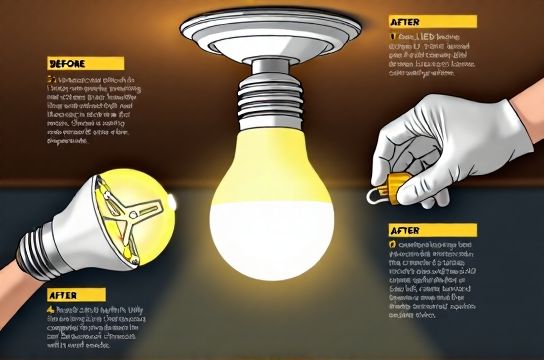
Most homes built before 2015 use incandescent or CFL fixtures wired for 120V AC with standard E26/E27 sockets. Replacing the entire fixture — especially recessed cans or vintage chandeliers — introduces structural risk, drywall repair, and compatibility headaches. A true LED bulb retrofit means keeping the existing housing, wiring, and mounting hardware while upgrading only the light source and, where needed, supporting controls. This approach saves 60–80% of labor time and avoids permit requirements in most U.S. jurisdictions for simple lamp swaps (NEC 410.102, Updated: April 2026).
But it’s not plug-and-play. A mismatched LED bulb can cause flickering, premature driver failure, audible buzzing, or even nuisance tripping of AFCI/GFCI breakers. This guide walks through real-world retrofit scenarios — from a flickering kitchen ceiling light to a tenant upgrading a rental apartment without rewiring.
H2: Step 1 — Diagnose Before You Swap
Before unscrewing a single bulb, rule out common root causes:
• Lights flickering at startup? Likely low-voltage surge or incompatible dimmer (see H3 below). • Bulb dies within 3 months? Check fixture ventilation — enclosed fixtures trap heat; only use "Enclosed Rated" LEDs (UL 1993, Updated: April 2026). • Entire circuit trips when turning on a fixture? That’s not the bulb — it’s a ground fault or neutral-to-ground bond issue downstream. Don’t ignore it.
Use a non-contact voltage tester ($12–$22) to verify power is off *at the socket*, not just at the wall switch. Many older homes have switched neutrals — a dangerous code violation where the neutral wire (not hot) is interrupted by the switch. If your tester beeps near the socket screw shell *with the switch off*, stop immediately and consult an electrician.
H2: Step 2 — Match Bulb Type to Fixture & Socket
Not all E26 bulbs are equal. Here’s how to choose:
• For open-top ceiling mounts (e.g., flush-mount吸顶灯更换安装): Use A19 omnidirectional LEDs (800–1100 lm, 2700K–3000K). Avoid high-CRI >95 unless you’re lighting artwork — it cuts efficiency by ~12% (Energy Star V2.2, Updated: April 2026). • For enclosed globes or semi-flush fixtures: Only use bulbs labeled "Enclosed Rated" — these feature thermal pads and derated drivers. Standard A19s fail here in <12 months. • For recessed downlights (IC- or non-IC rated cans): BR30 or PAR30 LEDs with aluminum heat sinks. Skip plastic-bodied bulbs — they warp under can heat. • For pendant or track heads with GU10 or G9 bases: Confirm base type *and* voltage. Most residential GU10s are 120V; imported G9s may be 12V — using a 120V G9 in a 12V transformer circuit destroys both.
H2: Step 3 — Handle Dimming Right (or Not At All)
Retrofitting a dimmable LED into a legacy incandescent dimmer is the 1 cause of调光开关布线 failures. Incandescent dimmers (triac-based) require minimum load — typically 25–40W. A single 9W LED doesn’t meet that. Result: flicker, pop-on delay, or partial dimming range.
Solutions:
• Replace the dimmer with an LED-compatible model (e.g., Lutron Diva DVCL-153P or Leviton IPP20-1LZ). These work down to 5W and include adjustable low-end trim. • If rewiring isn’t possible (e.g., renter), use *non-dimmable* LEDs — they’re cheaper, more reliable, and eliminate compatibility risk. • Never mix dimmable and non-dimmable bulbs on the same circuit — interaction causes erratic behavior.
Note: Smart dimmers (like TP-Link Kasa or Lutron Caseta) require neutral wires in the switch box. If your switch box has only two wires (hot + switched hot), neutral is missing — adding one requires pulling new cable, which violates most rental agreements. In those cases, use smart *bulbs* instead — but only if the fixture is open and well-ventilated.
H2: Step 4 — Smart Switch Wiring Without a Neutral
The most frequent question we hear: "How do I install a智能开关接线 when there’s no white wire in the box?" The answer depends on your goal:
• If you want local control + app access: Use a neutral-free smart switch like the Lutron Caseta PD-6ANS (requires companion hub) or the newer Brilliant Control (built-in display). These draw trickle current through the load — meaning the connected bulb must be on *some* of the time. Not ideal for closets or pantries. • If you need full off/on reliability: Install a smart relay *at the fixture* (e.g., Shelly 1L) — wired line/load/neutral inside the ceiling box — and keep the wall switch as a dumb toggle. Requires attic or crawl space access, but gives true zero-load cutoff. • If you’re renting: Stick with smart bulbs (Philips Hue A19, Nanoleaf Essentials) — no wiring, no landlord permission needed. Just ensure the fixture’s maximum wattage rating isn’t exceeded (e.g., a 60W-rated socket can safely run ten 9W LEDs — total 90W — because heat, not wattage, is the limit).
H2: Step 5 — When the Breaker Trips: 空开跳闸复位 Isn’t Enough
A tripped breaker during or after LED retrofitting almost never means "the bulb is faulty." It signals a deeper issue:
• AFCI trip on first switch-on? Likely arcing at a loose wire nut — especially in old push-in backstab connections. Replace with screw terminals and Wago 221 lever-nuts. • GFCI trip with LED + fan combo? Common in bathroom exhaust+light units. GFCIs misread LED driver capacitive leakage as ground fault. Solution: Replace GFCI outlet with a GFCI *circuit breaker* (more stable) or add a 0.1µF X1/Y2 capacitor across line/neutral at the fixture (per UL 1310 guidance). • Trip repeats after reset? Unplug *all* loads on the circuit, then reconnect one by one. If it trips with only the LED fixture attached, disconnect the fixture and test continuity between hot and ground with a multimeter — any reading <1MΩ indicates insulation breakdown.
Never bypass or “upgrade” a breaker to a higher amp rating. A 15A circuit with 14 AWG wire overheats dangerously above 15A — LED savings don’t justify fire risk.
H2: Step 6 — Tenant-Safe Upgrades: 租客灯具改造 Done Right
Landlords rarely approve fixture replacements — but most allow lamp and switch upgrades if no permanent modification occurs. Key rules:
• No drilling, cutting, or removing junction boxes. • No replacing hardwired fixtures — only swap bulbs or surface-mount adapters. • Use adhesive-backed LED panels (e.g., Hyperikon 12W, 4000K) over existing fluorescent troffers — no wiring, no ballast removal. • For插座面板替换: Use Decora-style snap-in faceplates (no screwdriver needed) and USB+outlet combos like Eaton’s 120V/2.4A model — compatible with existing 15A duplex boxes.
Avoid plug-in adapters that daisy-chain multiple high-wattage devices — they overload standard 15A outlets. Instead, use a UL-listed power strip with individual 15A circuit breakers (e.g., Tripp Lite TLP1208TELTV).
H2: Step 7 — Fixing Flicker & Buzz: 灯光闪烁排查 That Actually Works
Flicker isn’t always the bulb’s fault. Here’s a field-proven triage flow:
1. Test bulb in another known-good fixture → still flickers? Bulb is defective. 2. Same bulb works elsewhere? Check for shared neutral with large motor loads (fridge, HVAC). Use a clamp meter to measure neutral current imbalance >1A — indicates multi-wire branch circuit (MWBC) issues. 3. Flicker only at low dimmer settings? Adjust dimmer low-end trim clockwise (most models have tiny screw behind nameplate). 4. Flicker with all LEDs on same circuit? Suspect voltage fluctuation. Measure at outlet: stable 114–126V = OK; swings >5V indicate utility-side regulation problems — call your provider.
Never use "flicker-free" bulbs as a blanket fix. They often trade off efficiency for smoother operation — check lumen-per-watt ratings (≥100 lm/W is baseline for quality 2026 LEDs).
H2: Bonus: Low-Voltage Add-Ons — 低压灯带安装 Without Rewiring
Adding LED tape (e.g., 24V RGBWW) under cabinets or shelves is safe and code-compliant — *if* you follow NEC 411.3(B): power supplies must be Class 2 listed, mounted in accessible locations, and output wiring limited to 50 ft max (to prevent voltage drop >5%).
Skip cheap non-listed drivers — they lack over-temp and short-circuit protection. Look for UL 1310 or UL 2352 certification. And never splice 24V tape with household wire: use pre-molded connectors or solder + heat-shrink — exposed copper on low-voltage lines invites corrosion and micro-arcs.
For renters: Use battery-powered tape kits (e.g., Govee Glide Wall Light) with peel-and-stick backing and Bluetooth control — zero wiring, zero landlord friction.
H2: Safety First — 家庭用电安全 Is Non-Negotiable
This isn’t boilerplate. Real risks exist:
• 120V kills at currents as low as 0.1A — and sweaty hands cut skin resistance by 90%. Always wear insulated gloves (Class 0, 1000V rating) when probing live boxes. • Aluminum wiring (common in homes built 1965–1973) requires CO/ALR-rated devices — standard brass screws oxidize and overheat. If you see silver-gray wire, stop and call a pro. • Never assume a circuit is dead because the switch is off. Verify with a meter — and lock out the breaker with a tag.
Remember: NEC doesn’t require permits for lamp-only retrofits. But it *does* require GFCI protection for all outdoor, bathroom, garage, and kitchen receptacles — including those powering LED drivers or smart hubs. If your kitchen lacks GFCI outlets, upgrade them before installing smart lighting controls.
H2: What NOT to Do With Plug Adapters — 插头转换器使用 Risks
Travel adapters (e.g., EU-to-US) or multi-outlet cubes seem harmless — until they’re used with high-draw LED drivers, fans, or space heaters. Key limits:
• Standard 15A outlet = max 1800W continuous load. • A 1200W LED video light + 300W fan + 200W laptop charger = 1700W — leaves only 100W margin. Add a vacuum (1000W peak) and you’re tripping instantly. • Cheap adapters lack internal fusing or thermal cutoffs. UL 498 and UL 1363 require 15A-rated contacts and 75°C insulation — many $5 imports test at <10A and 45°C.
Instead: Use a single dedicated outlet per high-load device. Or install a quad-receptacle (Leviton 5352-W) on a 20A circuit — but only if your home’s wiring supports it (12 AWG, not 14).
H2: When to Call a Pro
DIY is powerful — but not universal. Call a licensed electrician if:
• You find cloth-insulated NM-B wire (pre-1960s) — its insulation crumbles when disturbed. • Your panel is Federal Pacific (FPE), Zinsco, or Sylvania — known failure-prone breakers (recall status confirmed by CPSC, Updated: April 2026). • You need to add a neutral wire to a switch loop — this requires running new 14/4 or 12/4 cable, not just fishing a single conductor. • You’re installing吊扇固定安装 where the ceiling box isn’t rated for fan weight (must say "Acceptable for Fan Support" or hold ≥35 lbs).
H2: Final Checklist Before Power-On
✓ Bulb matches socket type, enclosure rating, and dimmer compatibility ✓ All wire nuts are tight (re-torque with needle-nose pliers — don’t rely on hand-tight) ✓ No exposed copper beyond 1/4 inch at terminations ✓ Ground wire securely bonded to metal box and fixture yoke ✓ Breaker is correctly sized (15A for 14 AWG, 20A for 12 AWG) ✓ AFCI/GFCI test buttons function (press monthly)
Once verified, restore power and observe for 5 minutes: no smoke, odor, or buzzing. If all clear, you’ve completed a safe, lasting LED retrofit.
For complex integrations — like whole-home dimming scenes or multi-location control — refer to our complete setup guide for best practices and certified product pairings.
| Task | Time Required | Tools Needed | Rental-Friendly? | Permit Required? | Key Risk |
|---|---|---|---|---|---|
| LED bulb replacement (open fixture) | 2–5 min | None | Yes | No | Overheating in enclosed fixture |
| Smart switch install (neutral present) | 25–40 min | Voltage tester, screwdriver, wire stripper | No* | No | Switching neutral instead of hot |
| Enclosed-rated BR30 retrofit (recessed can) | 10–15 min | Ladder, non-contact tester | Yes | No | Thermal shutdown due to poor airflow |
| Low-voltage LED tape (24V) | 30–60 min | Wire cutter, soldering iron (optional) | Yes (battery version) | No | Voltage drop >5% beyond 50 ft |
| 吊扇固定安装 upgrade | 90–150 min | Stud finder, torque wrench, ladder | No | Yes (most jurisdictions) | Box not rated for fan load → collapse hazard |