Install 12V LED Tape Lights with Proper Transformer Setup
- 时间:
- 浏览:33
- 来源:Easy Home Repair & DIY Guides
H2: Why 12V LED Tape Lights Fail — Before You Even Plug Them In
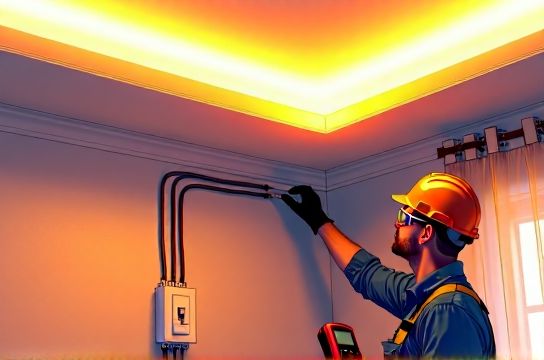
Most DIYers blow up their first 12V LED tape project—not from bad LEDs, but from mismatched transformers, undersized wiring, or ignoring voltage drop. A typical 5-meter roll of high-density (60-LED/m) warm-white tape draws ~24W/m (Updated: April 2026), meaning that roll alone pulls nearly 120W at full brightness. That’s not a USB charger load—it’s like running a small desktop fan *continuously* on a low-voltage circuit.
And yet, you’ll find $12 ‘universal’ 12V adapters online rated for 3A (36W) being sold alongside 5m tape kits. That setup will overheat the transformer within 90 minutes—and may cause flickering, color shift, or premature LED failure. Worse: if wired directly to mains without isolation, it violates NEC Article 411 and voids your home insurance in many jurisdictions.
This guide walks you through a safe, code-aware, beginner-tested installation—no electrician license required, but zero shortcuts taken.
H2: The Non-Negotiable: Transformer Selection & Sizing
Your transformer isn’t just a power supply—it’s the heart of the system. It must: • Isolate 120V AC input from 12V DC output (UL Class 2 listed) • Deliver *continuous* current—not peak or surge ratings • Include short-circuit and thermal overload protection • Be mounted in ventilated, non-combustible locations (no inside ceiling joist cavities unless rated for enclosed use)
Here’s how to size it correctly:
1. Calculate total wattage: Multiply tape length (m) × wattage per meter (check spec sheet—don’t assume). Example: 7m × 14.4W/m = 100.8W. 2. Add 20% headroom: 100.8W × 1.2 = 121W minimum transformer rating. 3. Convert to amps: 121W ÷ 12V = 10.1A → round up to next standard size: 12A (144W) transformer.
Never daisy-chain multiple tape rolls off one transformer beyond its rated capacity—even if voltage *seems* stable at the source. Voltage drop kills uniformity.
H2: Wiring Layout: Avoid the 1 Mistake (Voltage Drop)
Voltage drop isn’t theoretical—it’s visible. At 3% drop (0.36V), white LEDs shift noticeably cooler; at 5% (0.6V), brightness drops ~15% and color rendering index (CRI) degrades measurably (Updated: April 2026). With 12V systems, even 3 meters of 18 AWG wire can drop 0.8V under 8A load.
Solution: Use parallel feed architecture—not daisy chain.
✅ Correct: Run separate 12V+ and 12V− wires from transformer to *each* 2–3m segment. Use soldered or screw-terminal connections—not spring-clamp tape connectors alone. ❌ Wrong: Connect Roll 1 → Roll 2 → Roll 3 off one pair of wires. End-of-chain segments will be dim and pinkish.
Use this wire gauge reference for max recommended run lengths at 12V DC (based on <3% drop):
| Wire Gauge | Max Load (A) | Max Run (One Way) for 3% Drop at 8A | Typical Use Case | Pros/Cons |
|---|---|---|---|---|
| 16 AWG | 10A | 4.2 m | Under-cabinet lighting (single run ≤3m) | Easy to bend; sufficient for most kitchen runs. Not for >5m continuous feeds. |
| 14 AWG | 15A | 6.7 m | Perimeter cove lighting (multi-segment) | Balances flexibility and performance. Best all-around choice for DIYers. |
| 12 AWG | 20A | 10.5 m | Whole-room accent lighting (e.g., behind bed headboard + wall niche) | Stiffer, harder to route in tight spaces—but eliminates drop concerns up to 8m total feed. |
Always measure *wire length*, not tape length. If your transformer mounts in a garage junction box and feeds tape under a kitchen island, count the full path—including vertical drops and horizontal sweeps.
H2: Mounting & Thermal Management: Where Tape Goes—and Where It Absolutely Shouldn’t
LED tape is not fireproof tape. Its adhesive backing fails above 45°C ambient—and sustained operation above 60°C cuts lifespan by 50% per 10°C rise (LM-80 data, Updated: April 2026).
Avoid: • Direct contact with insulated ceiling joists (traps heat) • Enclosed aluminum channels without ventilation gaps • Behind thick drapery or upholstered headboards (no airflow)
Prefer: • Aluminum mounting channels with open-bottom design (lets heat rise and escape) • Surface-mount on painted drywall with thermal-transfer tape (3M VHB 4952 recommended) • Under-shelf lighting where air circulates freely beneath
Pro tip: For cabinet interiors, mount tape *on the underside of the shelf lip*, not flush against the back panel—creates natural convection.
H2: Dimming Compatibility: Don’t Assume Your Existing Dimmer Works
Most household leading-edge (TRIAC) dimmers are designed for 120V incandescent loads. They fail catastrophically with 12V DC LED tape—even when paired with a compatible transformer.
Why? Because they chop AC waveform *before* the transformer. But your transformer expects clean 120V sine wave input to regulate stable 12V DC output. Chop the input, and you get unstable DC, buzzing, and premature capacitor failure.
✅ Correct dimming paths: • Low-voltage PWM dimmer *after* the transformer (e.g., Lutron DVSTV-153P, wired between transformer and tape) • 0–10V dimming system (requires compatible transformer + controller) • DALI or Caseta-compatible 12V drivers (for whole-home integration)
If you’re upgrading from incandescent puck lights to tape, replace both the dimmer *and* the transformer—not just one.
H2: Transformer Mounting & Enclosure: Safety First, Always
Transformers generate heat. A 144W unit can reach 75°C surface temp in still air. NEC 411.3(B) requires Class 2 power supplies to be installed “in accordance with manufacturer instructions”—which almost always means: • Minimum 50mm (2″) clearance on all sides • No insulation piled directly against housing • Mounting to non-combustible surface (metal junction box, concrete wall, ceramic tile backer)
Do *not* mount inside plastic retrofit housings or behind drywall without an access panel. UL 1310-listed units require visible labeling and service access.
We recommend mounting in a dedicated 4″ square metal junction box with knockouts—then running 12V cables through flexible metal conduit (FMC) or liquid-tight flex where exposed. It looks pro, passes inspection, and prevents accidental nail-through damage during future wall work.
H2: Step-by-Step Installation Walkthrough
You’ll need: • UL-listed 12V Class 2 transformer (sized per earlier calc) • 14 AWG stranded copper wire (THHN or MTW rated) • Wire strippers, crimping tool, screwdrivers • Aluminum mounting channel (with diffuser lens, optional) • Multimeter (for continuity & voltage verification) • Non-contact voltage tester
Step 1: Turn OFF power at the breaker. Verify with tester at intended line-voltage source (e.g., switched ceiling box or receptacle).
Step 2: Mount transformer in accessible, ventilated location. Secure with machine screws—not drywall anchors.
Step 3: Run 120V feed to transformer line terminals. Use wire nuts rated for the conductor size (e.g., Ideal 454 for 14 AWG). Torque to spec (usually 15–20 in-lbs).
Step 4: Plan low-voltage routing. Mark tape cut points (only at designated copper pads—never mid-LED). Measure and cut 14 AWG wires for each segment, leaving 150mm slack at ends.
Step 5: Strip 6mm of insulation. Crimp ferrules (recommended) or twist tightly. Terminate at transformer 12V+ and 12V− screw terminals—tighten fully.
Step 6: Mount aluminum channel. Peel tape backing *only after* positioning—press firmly for 30 seconds per 30cm.
Step 7: Insert tape into channel. Connect wires to tape using solder or IP67-rated Wago 221 lever-nuts (not wire nuts—too bulky for channel ends).
Step 8: Power up transformer *without* tape connected. Verify 12.0–12.4V DC at output terminals with multimeter.
Step 9: Connect tape. Re-check voltage *at the farthest LED segment*. Should be ≥11.6V. If lower, shorten wire runs or upsize wire gauge.
Step 10: Restore power. Test operation. If flickering occurs, check for loose connections—not transformer failure.
H2: Troubleshooting Common Failures
• Flickering at startup: Usually caused by inrush current tripping transformer protection. Solution: Use soft-start transformer (e.g., Mean Well HLG-120H-12A) or add NTC thermistor on input.
• One segment bright, next dim: Classic voltage drop. Confirm parallel wiring—not daisy chain. Measure voltage at start and end of each segment.
• Transformer hot to touch (>65°C): Check ambient temp, ventilation, and loading. If loaded at >90% capacity continuously, downsize tape or upsize transformer.
• Lights turn on/off randomly: Likely shared neutral issue or induced voltage from nearby AC lines. Separate low-V and line-V cables by ≥200mm, or cross at 90° angles only.
• Color inconsistency across tape: Caused by mixed bin batches or aging drivers. Buy full run from same reel number. Never mix reels from different orders—even same model.
H2: When to Call a Licensed Electrician
DIY stops where safety begins. Call a pro if: • You need to tap into a new circuit (i.e., no existing switched hot/neutral available) • Your panel is Federal Pacific, Zinsco, or otherwise known-defective (these trip unpredictably and pose fire risk) • You’re installing outdoors, in damp locations, or inside shower enclosures (requires GFCI + wet-location rated components) • Local code requires permit for low-voltage lighting (true in CA, NY, MA, and most municipalities with adopted 2023 NEC)
Remember: “Renting? Check your lease.” Many prohibit permanent electrical modifications—even low-voltage ones—without landlord approval. For renters, battery-powered tape with peel-and-stick rechargeable packs is safer and reversible. See our complete setup guide for tenant-friendly alternatives.
H2: Final Checklist Before Power-On
☐ Transformer mounted securely, ventilated, labeled ☐ All 120V connections torqued and wire-nutted properly ☐ Low-voltage wires sized and routed per table specs ☐ Tape cut only at marked solder pads ☐ Multimeter confirms 12.0–12.4V at transformer output ☐ Voltage ≥11.6V measured at farthest tape point ☐ No tape overlapped, bent sharply (<25mm radius), or covered with paint ☐ Circuit breaker label updated: “12V LED TAPE – TRANSFORMER IN ATTIC BOX B”
Low-voltage lighting is forgiving—but only when respected. Get the transformer right, manage voltage drop, and treat every connection like it carries mains voltage. Do that, and your tape lights won’t just work—they’ll last 35,000+ hours (L70 rating, Updated: April 2026), silently and evenly, for over a decade.