How to Unclog a Bathtub Drain With a Manual Drain Snake E...
- 时间:
- 浏览:38
- 来源:Easy Home Repair & DIY Guides
H2: Why Your Bathtub Drain Clogs — And Why a Manual Drain Snake Is the Smart First Move
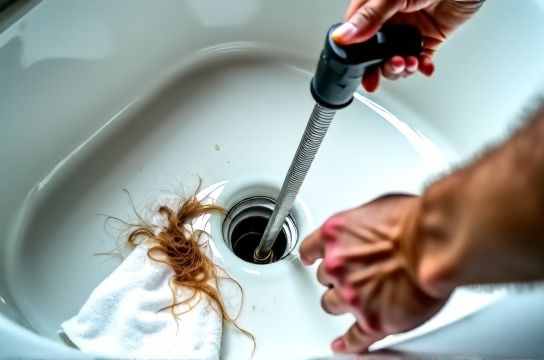
Most bathtub clogs aren’t caused by collapsed pipes or tree roots. They’re almost always shallow blockages: hair, soap scum, and shed skin accumulating just below the stopper mechanism — typically within the first 12–24 inches of the drain assembly. That’s precisely where a manual drain snake (also called a hand-crank auger or plumbing snake) excels.
Unlike chemical cleaners — which can corrode older pipes (especially galvanized steel or PVC joints), pose inhalation risks, and often fail on dense hair masses — or plunger-only attempts that rarely generate enough focused pressure in a bathtub’s low-profile overflow design, a manual drain snake delivers direct mechanical engagement. It’s also far more reliable than wet/dry vacs for this specific scenario, since bathtub drains lack the air-tight seal needed for vacuum suction to work consistently.
And crucially: it’s renter-approved. No drilling, no permanent modifications, no caustic residue. Just you, a $12–$22 tool, and ~10 minutes.
H2: What You’ll Actually Need (No Surprises)
• A manual drain snake (3–25 ft length; 1/4" or 5/16" cable diameter recommended for tubs) • A pair of nitrile gloves (non-negotiable — hair + biofilm is slippery and bacteria-laden) • An old towel or shop rag • A small container (e.g., plastic cup or yogurt tub) for collected debris • Optional but helpful: needle-nose pliers (for removing stubborn stopper assemblies)
Skip the rubber gloves — they’re too slick when handling wet cable. Skip the ‘heavy-duty’ 1/2" snakes meant for main sewer lines — they’re overkill, harder to maneuver in narrow tub traps, and risk scratching chrome finishes.
H2: Step-by-Step: Unclogging Your Bathtub Drain in Under 12 Minutes
H3: Step 1 — Remove the Overflow Plate (If Present)
Most modern bathtubs have a trip-lever drain with an overflow cover — a rectangular metal or plastic plate near the top rim. This isn’t decorative: it’s your access point to the linkage that lifts the stopper. Unscrew the center screw (usually Phillips 1 or 2). Gently pull the plate away — don’t force it. Behind it, you’ll see a brass or plastic rod connected to the stopper. Detach the rod by loosening its retaining nut or clip. Set aside safely.
Why do this first? Because trying to feed a snake down the drain opening alone often jams it against the closed stopper. Removing the overflow gives you a straight shot into the drain body — bypassing the stopper entirely.
H3: Step 2 — Feed the Snake Correctly (Not Too Far, Not Too Fast)
Uncoil 18–24 inches of cable. Insert the tip gently into the overflow opening — not the drain itself. Turn the crank handle *clockwise* while applying light forward pressure. You’ll feel resistance at ~12 inches — that’s the P-trap curve. Keep cranking *slowly*. Don’t force it. If you hit sudden slack, you’ve passed through the trap and entered the vertical drain line.
Important: Never crank counter-clockwise unless retracting. Clockwise rotation advances the coil and helps the corkscrew tip catch debris. Counter-clockwise during insertion will just wind the cable loosely and reduce grip.
H3: Step 3 — Hook, Rotate, Retrieve
Once you feel firm resistance (not just springy pushback), stop advancing. Hold the handle steady and rotate *an extra 3–5 full turns clockwise*. This winds the tip deeper into the clog and increases hooking surface area. Then, gently pull back while continuing slow clockwise rotation. You’ll feel the cable tighten — that’s the grab taking hold.
Now, withdraw steadily. You’ll likely see a thick, grayish rope of hair, soap, and biofilm coiled around the cable. Deposit it directly into your container. Repeat the feed-hook-retrieve cycle *only if needed* — most residential tub clogs yield in 1–2 passes.
H3: Step 4 — Flush & Verify Flow
Run hot (not boiling) water for 60 seconds — this melts residual soap and flushes fine particles. Check flow rate: a fully cleared tub should drain at ≥ 1.5 gallons per minute (GPM). Time it: fill the tub to the overflow level (≈ 22 gallons), then time how long it takes to empty completely. Under 15 minutes = acceptable. Under 10 minutes = optimal (Updated: May 2026).
If flow remains sluggish after two full cycles, the clog may be deeper (e.g., in the branch line behind the wall) — or you’re dealing with mineral scale buildup rather than organic debris. In that case, skip to the troubleshooting section below.
H2: When the Snake Doesn’t Bite — Troubleshooting Real Scenarios
• Scenario: Cable feeds easily but retrieves clean — no debris. Likely cause: The clog is past the reach of your snake (beyond 25 ft), or it’s a grease/scale film coating the pipe walls — not a physical plug. Try a targeted vinegar-baking soda flush (½ cup baking soda + ½ cup white vinegar, wait 15 min, then flush with 4 cups near-boiling water). Avoid commercial drain crystals — they’re ineffective on scale and hazardous in confined spaces.
• Scenario: Cable binds or won’t rotate smoothly. Stop immediately. Forcing it can kink the cable or damage pipe threads. Back out fully, inspect the tip for bent hooks or embedded debris. Clean with pliers and rag. Re-feed slower — sometimes a slight angle change (tilting the handle 5–10° upward) clears alignment issues in older cast-iron traps.
• Scenario: Water backs up into the overflow when you run the tap. That confirms the clog is *past* the overflow junction — meaning it’s in the horizontal branch line running toward the main stack. A 25-ft snake *can* reach here, but success drops sharply if the pipe has multiple 90° elbows (common in pre-1990 construction). At this point, consider calling a pro — or try a high-pressure water bladder (rentable at hardware stores) *before* resorting to chemical options.
H2: Manual Drain Snake vs. Other Common Tools — What Works Where
| Tool | Best For | Max Effective Depth | Pros | Cons | Cost Range (USD) |
|---|---|---|---|---|---|
| Manual Drain Snake (1/4" x 25 ft) | Bathtub, sink, shower clogs ≤ 25 ft deep | 25 ft | No electricity, chemical-free, precise control, renter-safe | Requires moderate hand strength, learning curve on feed technique | $12–$22 |
| Plunger (Cup-style) | Toilet clogs, flat-surface sinks | < 2 ft | Instant, zero setup, ultra-low cost | Rarely works on tubs due to overflow leakage, poor seal on curved surfaces | $5–$10 |
| Wet/Dry Vacuum | Shallow floor drain or sink clogs with tight seal | < 5 ft | Strong suction, reusable | Requires perfect air seal (nearly impossible on tub overflow), risk of water blowback | $60–$130 |
| Electric Auger (1/4" x 50 ft) | Main line clogs, recurring backups | 50 ft | Faster, less physical effort, deeper reach | Overkill for tubs, higher risk of pipe damage, not renter-friendly (requires outlet, storage) | $85–$220 |
H2: Maintenance Tips That Prevent 80% of Tub Clogs
A snake fixes today’s clog — but these habits prevent next month’s:
• Install a stainless-steel hair catcher ($4–$9) *under* the stopper, not just on top. Top-mounted screens let hair slide underneath and accumulate at the trap inlet. Look for models with 0.08" mesh spacing — fine enough to catch micro-strands, coarse enough to avoid rapid blinding.
• Rinse the drain weekly with 1 quart of hot (140°F) water mixed with 1 tbsp citric acid powder. Citric acid dissolves calcium-based soap scum without harming PVC or chrome (unlike vinegar, which is too weak for scale and too acidic for brass fittings over time).
• Every 3 months, remove the overflow plate and wipe the linkage rod with a damp rag dipped in isopropyl alcohol. Dried soap film here causes sticky stopper action — which users misinterpret as a clog and over-snake.
• Never pour cooking oil, lotion, or conditioner down any bathroom drain. These emulsify into stubborn biofilms that bind hair like glue. Use a dedicated disposal jar instead.
H2: When to Call a Pro — And What to Ask
Even with perfect technique, some situations demand professional help:
• Water backing up from *multiple fixtures* (e.g., tub + toilet + sink) — indicates a main sewer line issue.
• Foul odor persisting after snaking and cleaning — suggests biofilm colonization in pipe walls or a dry P-trap downstream.
• Visible corrosion, weeping joints, or discolored water — signs of pipe degradation beyond simple clogging.
When hiring, ask: “Do you use video inspection before quoting?” A reputable plumber will scope the line first — and many offer free diagnostics for confirmed rental units. Also confirm they carry liability insurance and provide written warranty on labor (standard is 90 days for drain clearing).
H2: Final Thoughts — It’s About Control, Not Just Clearance
Unclogging a bathtub drain with a manual snake isn’t just about restoring flow. It’s about regaining agency over your living space — especially if you’re renting. You don’t need permission to fix what’s visibly broken. You don’t need to wait for maintenance windows or pay $120+ for a service call when the root cause sits 18 inches inside your own overflow.
That said: know your limits. Snaking is powerful, but it’s not magic. If you’ve done three clean passes with full debris retrieval and flow hasn’t improved, the issue isn’t blockage — it’s likely slope loss, pipe deformation, or scale accumulation. Those require diagnostics — not brute force.
For more renter-focused plumbing solutions — including how to replace a worn faucet cartridge without shutting off the main, or how to detect hidden slab leaks using thermal imaging basics — visit our full resource hub. All guides are field-tested, tool-budget-conscious, and updated quarterly with real-world feedback from property managers and tenants (Updated: May 2026).