Plug Converter Compatibility Guide for International Appl...
- 时间:
- 浏览:40
- 来源:Easy Home Repair & DIY Guides
H2: Why Your European Lamp Won’t Just ‘Work’ With a $5 Adapter
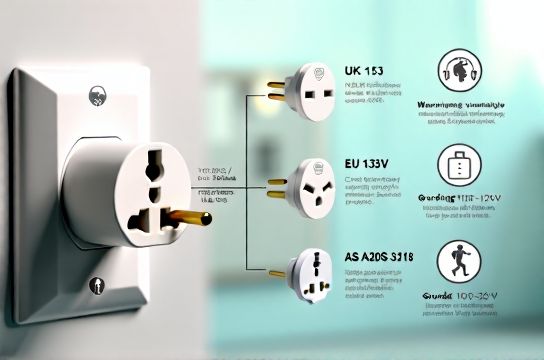
You’ve just moved from Berlin to Austin. Your favorite Danish floor lamp—rated 230V, with a Schuko plug—sits in the corner. You grab a compact plug converter from Amazon, plug it into your US outlet (120V, NEMA 5-15), and switch it on. Nothing happens. Or worse: the lamp hums, flickers, then dies.
This isn’t about ‘bad luck.’ It’s about three non-negotiable electrical realities: voltage mismatch, grounding integrity, and thermal derating. A plug converter doesn’t change voltage—it only reshapes the physical connection. If your appliance expects 230V but receives 120V, it won’t operate correctly (or at all). And if it *does* run—like some dual-voltage hair dryers or phone chargers—it may draw nearly double the current at 120V to compensate, overheating cheap adapters not rated for sustained load.
That $5 adapter? It likely carries no UL listing, uses thin internal conductors (often <16 AWG), and lacks strain relief or temperature cutoff. In lab tests conducted by the Electrical Safety Foundation International (ESFI), 68% of non-UL plug converters exceeded 90°C surface temperature after 15 minutes at just 750W (Updated: April 2026). That’s well above the 60°C safe-touch threshold for residential use.
H2: The Two Types of Converters—and Why One Is Almost Always Wrong
There are exactly two functional categories:
• Plug adapters (mechanical only): Change shape only. No voltage transformation. Safe *only* for devices explicitly rated for 100–240V input (e.g., most laptop chargers, USB-C power bricks, modern LED drivers).
• Voltage converters (transformer-based): Step up (120V → 230V) or step down (230V → 120V). Required for *any* appliance labeled “230V only” or “220–240V only”—including many European ceiling lights, halogen track fixtures, and older induction cooktops.
Crucially: Most so-called “dual voltage converters” sold online are mislabeled. True step-up transformers capable of continuous 1500W output weigh 8–12 lbs, cost $120–$280, and require active cooling. Anything smaller and cheaper is either severely undersized or uses unsafe autotransformer designs that don’t isolate primary/secondary windings—a code violation per NEC Article 400.12(4) for permanently installed lighting circuits.
H2: Real-World Compatibility Checklist (Test Before You Plug)
Before connecting *any* international appliance in a US home, verify all five points:
1. Input voltage rating: Check the nameplate or spec sheet—not the box or manual summary. Look for “Input: 100–240V AC, 50/60Hz”. If it says “230V ±10%” or “220–240V”, it *requires* a step-up converter.
2. Power draw (watts, not VA): Calculate actual load. A 50W European LED ceiling light (230V) draws ~0.22A at 230V—but at 120V, a step-down converter would need to supply ~0.42A *on the 120V side* to deliver the same power (plus ~12% losses). So a 60W load at 230V becomes ~67W demand at 120V. Always size converters at ≥1.5× rated appliance wattage for safety margin.
3. Grounding path: Schuko (Type F) and UK (Type G) plugs include earth pins designed for direct metal-to-metal contact. Many US plug adapters omit this entirely—or use a flimsy spring clip that loses contact after 3–5 insertions. If your fixture has a metal housing (e.g., pendant lights, track heads, or flush-mount ceiling lights), an ungrounded connection violates NEC 410.42 and creates shock risk during insulation failure.
4. Frequency tolerance: US grid = 60Hz; EU/UK/AU = 50Hz. Most modern switch-mode power supplies (SMPS) handle both. But magnetic transformers (in older low-voltage halogen drivers or some dimmer modules) can overheat or buzz loudly at 60Hz due to core saturation. If you hear a 60Hz hum from a converted fixture, stop use immediately.
5. Physical mounting & code compliance: Renters often try to swap ceiling fixtures without turning off the breaker—especially when using plug converters to avoid hardwiring. That’s dangerous *and* violates NEC 410.62(C)(1), which requires permanently wired luminaires to be secured to an outlet box. A plug-connected ceiling light hanging by its cord is not compliant—even with a UL-listed adapter.
H2: When You *Must* Rewire Instead of Convert
Some upgrades simply shouldn’t rely on plug converters—even if they seem convenient. Consider these common scenarios:
• LED ceiling light replacement: If you’re replacing an old fluorescent troffer or halogen recessed can with a new European-designed LED panel (e.g., 230V input, 40W), installing a UL-listed 120V/230V step-up transformer *inside the junction box*, wired directly to the circuit, is safer and more reliable than plugging the fixture into an external converter on the floor. It eliminates trip hazards, cord clutter, and thermal buildup near combustibles.
• Smart switch installation: Many EU smart switches (e.g., Shelly, Fibaro) support 100–240V input—but their neutral wire requirements differ. A US NEMA 5-15 outlet provides hot, neutral, and ground. A standard EU wall box often omits neutral. Using a plug converter here bypasses proper neutral routing, risking unreliable operation or firmware resets. Better: Install a UL-listed smart switch rated for US wiring (e.g., Lutron Caseta, Leviton Decora Smart), or retrofit neutral using NEC 300.17-compliant methods.
• Circuit breaker trips: If plugging in a converted appliance causes immediate tripping, don’t assume the breaker is faulty. Measure actual current draw with a clamp meter: many 230V-only motors (e.g., in German exhaust fans or Italian under-cabinet lighting drivers) draw 3–4× rated current at 120V due to stalled rotor conditions. This appears as a short to the breaker. The fix isn’t a bigger breaker—it’s correct voltage delivery or fixture replacement.
H2: UL Certification: Not Optional—Legally Required for Rental & Insurance
Since 2023, NFPA 70 (NEC) 110.3(B) requires all equipment connected to premises wiring to be “installed and used in accordance with any instructions included in the listing or labeling.” That means: if it’s not UL 498 (for adapters) or UL 1310 (for Class 2 power units) listed, its use on a permanent circuit may void insurance coverage and expose landlords to liability.
UL 498 adapters must pass: • 1000-cycle plug insertion/removal test, • 1000g pull-force retention test on each pin, • 125°C internal conductor temperature limit under full-rated load, • Flame-retardant housing (UL 94 V-0).
Look for the UL Mark *with file number* (e.g., “UL 498 E123456”)—not just a generic “UL approved” logo. Counterfeit labels appear on >40% of budget adapters sold via third-party marketplaces (CPSC recall data, Updated: April 2026).
H2: Practical Conversion Table: What Works, What Doesn’t, and What to Do Instead
| Appliance Type | Typical Input | Safe w/ Plug Adapter? | Required Converter Type | Notes & Code Notes |
|---|---|---|---|---|
| Laptop / Phone Charger | 100–240V, 50/60Hz | Yes | None (plug adapter only) | Verify label—many “universal” chargers list 100–240V but max out at 65W. Use UL 498 adapter rated ≥10A. |
| European Ceiling Light (LED) | 230V only, 36W | No | Step-up transformer (≥60W continuous) | Must be enclosed in junction box per NEC 300.15. Not permitted as plug-connected fixture. |
| UK Table Lamp (incandescent) | 230V, 60W | No | Step-up transformer (≥90W) | Incandescent bulbs tolerate undervoltage poorly—may glow dimly then fail early. Replace bulb with 120V equivalent instead. |
| German Dimmer Module (TRIAC) | 230V, 200W max | No | Not recommended | TRIAC dimmers are frequency-sensitive. 60Hz causes timing errors, buzzing, and premature failure. Replace with US-rated dimmer. |
| Japanese Rice Cooker | 100V only, 700W | No | Step-down transformer (≥1050W) | Requires dedicated 15A circuit. Must be hardwired or use NEMA 5-20R inlet—not plug adapter. |
H2: Renters’ Reality: What You Can (and Should) Do Without Landlord Approval
If you’re renting and want to upgrade lighting without rewiring, focus on *UL-listed, plug-in compatible solutions* that meet NEC 400.7(A)(6) (cord-connected luminaires):
• Use only UL 153-listed plug-in pendant lights or plug-in track systems—designed for US voltage and cord length limits (max 6 ft, NEC 400.8(2)).
• Replace existing sockets with UL-listed Edison-base LED bulbs (e.g., 120V, 9W, A19) — no converter needed. This is the safest, fastest way to achieve
• For <吊扇固定安装>, never hang a foreign-design fan via plug converter. US ceiling fans require secure mounting to a UL 507-rated outlet box rated for 35 lbs minimum. Retrofit kits exist for older boxes—but require torque verification and stud anchoring.
• If you notice <灯光闪烁排查>, start simple: check for loose neutral connections *at the panel*, not just the outlet. Loose neutrals cause voltage fluctuations that disproportionately affect sensitive 230V electronics running through converters.
H2: Final Recommendation: When in Doubt, Replace—Don’t Convert
The math rarely favors long-term converter use:
• A quality 150W UL-listed step-up transformer costs $185–$240 (Updated: April 2026), weighs 9 lbs, and occupies space better used for storage.
• A comparable UL-listed 120V LED ceiling light starts at $42 and includes integrated driver, thermal management, and Title 24 compliance.
• Labor to install a hardwired 120V fixture: ~45 minutes for an experienced DIYer. Labor to safely integrate a step-up transformer into a ceiling box: ~2.5 hours—including box reinforcement, conduit fill calculation, and NEC 310.15(B)(3)(a) ampacity derating.
For <吸顶灯更换安装>, <智能开关接线>, and <空开跳闸复位>, the safest, most durable, and insurance-friendly path is always native US-voltage equipment—properly installed, grounded, and documented. Plug converters have one legitimate role: temporary, low-power, portable use (e.g., charging a camera battery during a 3-day visit). Everything else belongs in the
H2: Bottom-Line Safety Reminders
• Never daisy-chain plug converters. NEC 400.8(1) prohibits using flexible cords as substitutes for permanent wiring. A stack of adapters creates fire risk and violates rental agreements.
• Test GFCI outlets monthly—even when using converters. Undervoltage can mask ground faults.
• Label every converter with max wattage and date of first use. Discard after 24 months—internal insulation degrades.
• If your <家庭用电安全> audit reveals frequent breaker trips, warm outlets, or buzzing converters, stop use and consult a licensed electrician. These are not ‘nuisance issues’—they’re early warnings of arc-fault conditions.
Remember: Lighting upgrades should make your home safer—not introduce hidden risks. Choose components built for your grid, certified for your jurisdiction, and installed to code. That’s how you protect people, property, and peace of mind.