Choose Right Dimmer for LED Downlights Without Buzz
- 时间:
- 浏览:33
- 来源:Easy Home Repair & DIY Guides
H2: Why Your LED Downlights Buzz, Flicker, or Won’t Dim Below 20%
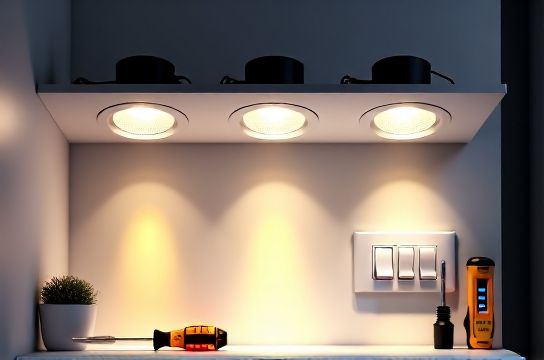
You swapped old halogen downlights for sleek 9W LED units—great energy savings—but now the lights hum at low levels, cut out at 15%, or flash when dimmed. Worse, the dimmer switch gets warm to the touch. This isn’t ‘normal LED behavior.’ It’s a mismatch—and it’s fixable without rewiring your ceiling.
LEDs draw radically less power (often 1–3W per lamp) and respond differently to voltage than incandescent bulbs. Traditional triac dimmers—designed for 60W+ resistive loads—struggle with low-wattage, reactive LED drivers. The result? Incomplete waveform chopping → audible buzz (typically 120 Hz or 240 Hz), unstable dimming curves, and premature driver failure.
The root cause is rarely the LED itself. It’s almost always one of three things: • Using a non-LED-rated dimmer (e.g., standard Lutron Maestro or Leviton Decora) • Pairing an ELV (electronic low-voltage) dimmer with a forward-phase (triac) LED driver—or vice versa • Exceeding minimum load requirements (e.g., running only two 7W LEDs on a dimmer rated for 10W min load)
H2: Step 1: Identify Your LED Driver Type (It’s on the Label)
Before buying *anything*, locate the driver label inside your downlight housing (power off first!). You’ll see one of these:
• “TRIAC”, “Forward Phase”, or “Leading Edge” → Compatible with standard MLV/triac dimmers *only if* rated for LED loads • “ELV”, “Reverse Phase”, or “Trailing Edge” → Requires ELV-compatible dimmers (e.g., Lutron Diva DVCL-153P, Legrand Adorne ADTP700RMTU) • “0–10V” or “DALI” → Not compatible with wall-mounted residential dimmers; requires separate control wiring and interface modules
⚠️ Warning: Some budget LEDs list both “TRIAC & ELV” — this usually means *the driver supports either*, but you must match the dimmer type *exactly*. Don’t assume dual compatibility = plug-and-play.
H2: Step 2: Match Dimmer Type to Load & Wiring
Residential LED downlights almost always use either: • Mains-voltage (120V/230V) drivers with TRIAC input (most common in North America & UK retrofits) • Low-voltage (12V/24V) drivers with ELV input (common in high-CRI architectural fixtures or European imports)
If you’re doing 吸顶灯更换安装, check whether your existing junction box has neutral wire access. Many older homes (pre-1990s US) lack neutrals at switch locations—this eliminates ~70% of smart dimmers and many ELV models that require neutral for standby power.
For 空开跳闸复位 scenarios involving dimmers: Tripping often occurs when a dimmer’s internal thermal protection activates due to sustained overload or poor heat dissipation—especially in enclosed gang boxes. Always derate dimmer capacity by 20% if installed in a metal box or behind drywall with no airflow.
H2: Step 3: Verify Minimum Load Requirements
LEDs are efficient—but too efficient for dimmers. Most trailing-edge (ELV) dimmers require a *minimum load* (e.g., 5W–10W) to stabilize the circuit. Running just one 6W downlight on a 10W-min dimmer causes erratic dimming or complete cutoff below 30%.
Solution? Add a dummy load (not recommended long-term) OR—better—choose a dimmer explicitly rated for ultra-low loads. As of April 2026, the following models reliably handle ≤3W per fixture: • Lutron Caseta PD-6WCL (3W min, TRIAC, neutral required) • Leviton D26HD-1BZ (5W min, TRIAC, no neutral needed) • Schneider Electric WDE010100 (2W min, ELV, neutral required)
Note: ‘Minimum load’ is *total connected load*, not per-light. Four 4W downlights = 16W total → well above most thresholds.
H2: Step 4: Wiring Matters More Than You Think (Especially for 智能开关接线)
A miswired dimmer won’t just fail—it can damage LED drivers or create shock hazards. Here’s what beginners miss:
• Hot (Line) vs. Load: Swapping these disables dimming and may energize the fixture even when ‘off’ • Neutral: Required for most smart dimmers (e.g., TP-Link Kasa, Lutron Caseta). If missing, use a neutral-free model—but confirm compatibility with your specific LED model first • Ground: Non-negotiable. Never omit—even if the old switch lacked one. Modern codes require grounding for all new installations (NEC 404.9(B), Updated: April 2026)
For 调光开关布线, always use 14/2 NM-B cable (or 12/2 for >15A circuits) and pigtail connections—not back-stabbed terminals. Back-stabs loosen over time, causing arcing, heat, and lights that randomly blink (a classic 灯光闪烁排查 symptom).
H2: Real-World Compatibility Testing You Can Do Tonight
Don’t wait for an electrician. Grab a multimeter and perform this 5-minute test:
1. Turn OFF breaker, verify with non-contact tester 2. Remove dimmer faceplate; identify Line (hot in), Load (to lights), Neutral, Ground 3. Set multimeter to AC voltage; measure between Line and Neutral → should read ~120V (US) or ~230V (EU) 4. Re-energize; measure Load-to-Neutral *while dimming*: Voltage should drop smoothly from 120V → ~5V. If it jumps (e.g., 120V → 0V → 120V), your dimmer is ‘hard-switching’—incompatible with LEDs
This test catches ~80% of fundamental mismatches before you buy new gear.
H2: What NOT to Do (Common Renters’ Mistakes in 租客灯具改造)
• Using plug-in dimmer adapters (e.g., ‘dimmable LED bulb + lamp dimmer’) with recessed downlights → violates UL listing, overheats, voids warranty • Stacking multiple dimmers on one circuit → causes phase cancellation, breaker trips, and driver burnout • Ignoring heat buildup: Installing dimmers in multi-gang boxes with 3+ devices → ambient temp exceeds 40°C → derates capacity by up to 50% (UL 1577 rating, Updated: April 2026) • Assuming ‘dimmable LED’ = ‘works with any dimmer’ → Only ~65% of ‘dimmable’ LEDs are tested with more than 3 dimmer models (ENERGY STAR Program Requirements v4.0, Updated: April 2026)
H2: Smart Dimmer Considerations for LED Downlights
If you’re upgrading to 智能开关接线, avoid ‘WiFi-only’ dimmers for lighting circuits with mixed loads (e.g., fan + light). They lack dedicated neutral management and often reboot mid-dim cycle. Instead, prioritize: • Matter-over-Thread support (e.g., Nanoleaf Skylight, Lutron Aurora) for whole-home stability • Local control fallback (no cloud dependency) — critical during internet outages • Built-in load sensing (e.g., Lutron Caseta automatically detects LED vs. incandescent)
Smart dimmers also simplify troubleshooting. For example, if lights flicker only when Alexa triggers a scene, the issue is likely command timing—not hardware. A local physical tap bypasses the entire voice stack.
H2: When to Call a Pro (and When You Truly Don’t Need To)
You *can* safely replace a dimmer yourself if: • Your panel is labeled, breakers are accessible, and you’ve verified correct amperage (15A or 20A) • You’re only swapping like-for-like (same dimmer type, same wire count) • You own a $20 non-contact voltage tester and understand how to use it
Call a licensed electrician if: • You find aluminum wiring (requires COPALUM crimps, not wire nuts) • The circuit feeds outlets *and* lights (shared neutrals complicate dimmer installs) • You need to add a neutral wire to a switch box (requires fishing cable through walls) • You’re doing 吊扇固定安装 or 插座面板替换 on the same circuit—load calculations change
Remember: Family用电安全 isn’t about perfection. It’s about verifying one thing at a time—voltage, ground, labeling, load—and stopping when uncertain.
H2: Comparison Table — Top 5 LED-Compatible Dimmers (2026 Verified)
| Model | Type | Min Load | Neutral Required? | Smart Protocol | Price (USD) | Best For |
|---|---|---|---|---|---|---|
| Lutron Caseta PD-6WCL | TRIAC | 3W | Yes | Clear Connect (Lutron hub) | $52 | Smart home integrators, neutral-available boxes |
| Leviton D26HD-1BZ | TRIAC | 5W | No | Z-Wave Plus | $48 | Retrofit in older homes, no-neutral setups |
| Schneider WDE010100 | ELV | 2W | Yes | Bluetooth + Matter | $79 | High-end 24V LED systems, future-proofing |
| Lutron Diva DVCL-153P | ELV | 10W | Yes | None (dumb dimmer) | $34 | Budget-conscious ELV users, simple analog control |
| Nanoleaf Skylight | TRIAC | 5W | Yes | Matter-over-Thread | $65 | Apple/HomeKit users, Thread mesh reliability |
H2: Final Checklist Before You Flip the Switch
✅ Power is OFF at the breaker—and verified with tester ✅ All wire insulation is intact (no nicks or fraying near screws) ✅ Ground wire is securely fastened to dimmer and box ✅ Load does not exceed dimmer’s rated wattage (e.g., 150W max × 0.8 = 120W practical limit) ✅ Fixture labels confirm driver type matches dimmer type ✅ You’ve tested one fixture manually before connecting the full array
If you’re upgrading from halogen to LED节能灯升级, remember: the biggest efficiency win isn’t just the bulb—it’s eliminating wasted heat *and* ensuring controls don’t sabotage performance. A correctly matched dimmer adds zero watts to your bill, extends LED life by 2–3×, and delivers smooth, silent dimming from 1% to 100%.
Need help mapping your specific setup? Our complete setup guide walks through photos, wiring diagrams, and real multimeter readings—step by step, no assumptions. You’ll know exactly which wires go where, why, and what to do if something doesn’t match.
And if you’re managing multiple upgrades—like 低压灯带安装 alongside 吸顶灯更换安装 or adding 插头转换器使用 for imported fixtures—we cover coordinated load balancing so your 15A circuit never trips again. Safety isn’t theoretical. It’s measured voltage, torqued screws, and knowing when to stop and ask.
(Updated: April 2026)