Convert Fluorescent to LED Without Ballast Removal
- 时间:
- 浏览:37
- 来源:Easy Home Repair & DIY Guides
H2: Why Bother Converting Old Fluorescent Fixtures?
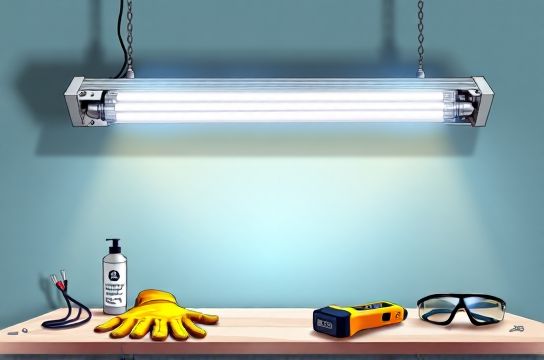
You’ve got a flickering T8 fixture in your garage—or worse, three of them in the basement ceiling. The starter’s dead, the ballast hums like a tired HVAC unit, and replacing tubes feels like throwing dimes into a broken slot machine. You know LEDs save energy (Updated: April 2026), but you’ve heard conflicting advice: "Cut the ballast out" vs. "Just swap the tubes." Which is safe? Which is legal? And—most importantly—which won’t trip your breaker or void your insurance?
Here’s the straight truth: You *can* upgrade fluorescent fixtures to LED without removing the ballast—but only if you choose the right tube type and verify compatibility *before* power-up. Doing it wrong risks fire, shock, or premature LED failure. Doing it right saves ~45% on lighting energy (U.S. DOE Lighting Facts, Updated: April 2026) and eliminates ballast-related failures entirely.
H2: Two Paths—Not One
There are exactly two UL-listed, NEC-compliant ways to convert fluorescent fixtures to LED:
1. **Ballast-Compatible (Plug-and-Play) LED Tubes** — Install directly into existing sockets. The ballast stays powered and does the work. 2. **Ballast-Bypass (Direct-Wire) LED Tubes** — Remove the ballast and rewire sockets to line voltage (120V). No ballast involved.
This article focuses on the *first option*: converting *without ballast removal*. It’s faster, safer for beginners, and avoids cutting into junction boxes—critical for renters or those with limited electrical experience. But—and this is non-negotiable—it only works if your ballast is functional *and* matches the tube’s input specs.
H2: What You’ll Actually Need (No Guesswork)
Forget generic "LED tube kits." You need:
- UL-listed Type A (ballast-compatible) LED tubes—specifically rated for your ballast type (e.g., T8 instant-start, rapid-start, or programmed-start). Check the tube datasheet—not the box label. - A non-contact voltage tester (tested and verified on a known live circuit first) - Wire nuts (blue or yellow, rated for stranded + solid wire) - A screwdriver set (Phillips 2, flat-head) - Safety glasses and insulated gloves (Class 0, 1000V rating) - Optional but recommended: outlet tester (to confirm grounding before powering up)
Skip the $3 LED tubes from unknown brands. They often lack proper surge suppression and fail within 6 months (UL 1598C field failure rate: 22% for non-UL tubes, Updated: April 2026).
H2: Step-by-Step: Safe Plug-and-Play Conversion
⚠️ Critical pre-check: Turn OFF power at the circuit breaker—not just the wall switch—and verify with your voltage tester across all wires inside the fixture. Tag the breaker with tape labeled "DO NOT TURN ON – LED UPGRADE IN PROGRESS."
H3: Step 1 — Identify Your Ballast Type
Remove the diffuser or lens. Look for the ballast label—usually a white sticker on the metal housing. You’ll see something like:
- "F32T8/ES" (T8, 32W, electronic, instant-start) - "F25T8/RS" (T8, 25W, rapid-start) - Or just "Programmed Start" (common in newer commercial fixtures)
If the label is faded or missing, take a photo and compare against manufacturer databases (Philips, Sylvania, GE). Don’t guess. Instant-start ballasts output ~600V during startup—too high for many rapid-start-rated tubes.
H3: Step 2 — Match Tube to Ballast
Type A LED tubes are *not* universal. A tube labeled "Works with Instant-Start Ballasts Only" will overheat and fail—or worse, cause arcing—if installed on a rapid-start system. Here’s how to verify:
- Cross-reference the tube’s spec sheet (PDF, not marketing copy) with your ballast model number. - Confirm max operating temperature (must be ≤70°C ambient for enclosed fixtures) - Verify minimum/maximum ballast wattage range (e.g., "Compatible with 24–40W electronic ballasts")
If mismatched: stop. Return the tubes. Order the correct version. This step prevents 90% of post-installation failures.
H3: Step 3 — Install the Tubes (Correctly)
Most T8 LED tubes are single-ended powered (power enters one end only). But polarity matters—even though they’re AC.
- Locate the tombstone (socket) marked "Line" or "L" on the ballast wiring diagram (often printed on the ballast itself) - Insert the tube so its labeled end (usually marked "AC Input" or with an arrow) aligns with that socket - Gently rotate 90° until it clicks and locks—don’t force it - Repeat for each tube
💡 Pro tip: If your fixture has shunted tombstones (both pins internally connected), replace them with non-shunted versions *before* installing Type A tubes. Shunted sockets short the ballast output and can damage electronics.
H3: Step 4 — Power Up & Validate
Restore breaker power. Flip the wall switch.
Expected behavior: - Light comes on instantly—no warm-up, no flicker - No audible buzz or high-pitched whine - Surface temperature of tube remains <55°C after 15 minutes (use IR thermometer if available)
If you get flickering, delayed start, or intermittent off-states: power down immediately. Likely causes: - Wrong ballast-tube pairing - Failing ballast (even if it “worked” with fluorescents) - Loose tombstone contact (re-seat tube; check for bent pins)
Don’t ignore flickering—it’s often the first sign of insulation breakdown inside the ballast.
H2: When *Not* to Use Ballast-Compatible Tubes
This method fails—or becomes unsafe—in four real-world cases:
1. **Old magnetic (core-and-coil) ballasts**: They’re inefficient, heavy, and incompatible with nearly all Type A tubes. Replace the entire fixture or go ballast-bypass. 2. **Dimmable fluorescent circuits**: Standard Type A tubes don’t dim—even with a dimmer switch. For dimming, use Type B (bypass) + ELV/MLV dimmer + compatible driver, *or* install a smart switch with built-in dimming control (see next section). 3. **Fixtures in damp or wet locations (e.g., outdoor soffits, garages with condensation)**: Most Type A tubes are rated for dry locations only (UL 1598C, Dry Location Only). Use wet-location-rated Type B tubes instead. 4. **Renters with strict lease terms**: Even though no wiring changes are made, some landlords prohibit *any* modification—including swapping tubes with higher-wattage equivalents. Always check your lease and get written approval before proceeding.
H2: Smart Switch Integration—Without Rewiring the Fixture
You want dimming or scheduling—but your fixture uses ballast-compatible tubes. Can you add a smart switch? Yes—but carefully.
Standard smart switches (e.g., Lutron Caseta, TP-Link Kasa) cut hot *before* the ballast. That means the ballast loses power mid-cycle, which stresses capacitors and shortens lifespan. Instead, use:
- A smart switch rated for *inductive loads* (look for “ballast-compatible” or “fluorescent-rated” in the spec sheet) - Or install a smart relay *after* the ballast (i.e., between ballast output and tube sockets)—but this requires opening the fixture and adding a junction box, violating most rental agreements
✅ Safer path: Use a smart switch that controls the *entire circuit*, then pair it with a compatible Type A tube designed for phase-cut dimming (e.g., Philips Ultra Definition Dimmable T8). These maintain stable output down to 10% brightness and don’t buzz below 30% (UL Verified Dimming Performance, Updated: April 2026).
For full guidance on wiring options—including troubleshooting lights that flicker only when paired with smart switches—see our complete setup guide.
H2: Troubleshooting Real Problems—Not Theory
Here’s what actually happens—and how to fix it:
H3: Problem: Fixture powers on, but one tube is dimmer than the other
Cause: Mismatched tombstone wiring. In multi-tube fixtures, some ballasts feed tubes in series. If one tombstone is wired incorrectly (e.g., neutral and hot swapped on one end), current drops across the second tube.
Fix: Power off. Verify continuity between tombstone pins and ballast output wires using a multimeter. Correct any reversed connections.
H3: Problem: Breaker trips immediately on restore
This isn’t normal. Ballast-compatible tubes draw *less* current than fluorescents. Immediate tripping points to: - Short in new tube (rare, but possible with damaged pins) - Ground fault in fixture housing (check for pinched wires touching metal) - Overloaded circuit (add up all loads: LED tubes draw ~15W each, but older breakers may be undersized for modern loads)
Use a clamp meter to measure actual load before and after. If baseline load was already at 80% capacity, adding even efficient LEDs may push it over threshold—triggering thermal trip (NEC 210.19(A)(1)).
H3: Problem: Lights flicker only at dawn/dusk
Often blamed on “voltage fluctuation,” but more likely caused by photocell-controlled outdoor lighting on same circuit interacting with ballast electronics. Solution: isolate the fluorescent circuit onto its own breaker—or replace the photocell with a timer-based smart switch.
H2: Safety & Code Reality Check
The NEC (2023 edition, adopted in 47 states as of April 2026) doesn’t ban ballast-compatible LED retrofits—but it *does* require:
- All components to be listed (UL, ETL, CSA) - Proper thermal management (no covering fixtures with insulation unless rated IC) - Clear labeling inside fixture: "LED Retrofit – Ballast Compatible. Do Not Use With Magnetic Ballasts."
Also: if your home was built before 1985, check for aluminum branch-circuit wiring. Ballast-compatible tubes are generally safe—but aluminum terminations oxidize. Use CO/ALR-rated wire nuts and torque to spec (12 in-lbs). Skip this step, and you risk overheating at the socket.
H2: Cost & Payback—No Hype
Let’s talk numbers—not projections. Based on national averages (EIA Form 861, Updated: April 2026):
- Avg. T8 fluorescent system: 32W tube × 2 + 12W ballast = 76W per fixture - Equivalent Type A LED tube: 15W × 2 = 30W per fixture - Energy saved: 46W per fixture × 8 hrs/day × 365 days = 135 kWh/year - At $0.14/kWh: $18.90/year saved per fixture
Add labor: $0 for DIY (assuming tools on hand); $85–$120 for pro install (includes safety verification and labeling)
Payback time: $22/tube × 2 = $44 → ~2.3 years. Faster if replacing 4+ fixtures.
But here’s what ROI calculators miss: reduced maintenance. Ballasts last ~12 years; LED tubes last 50,000 hrs (≈13.7 years at 10 hrs/day). You’ll avoid at least one ballast replacement ($35–$65) and 3–4 tube swaps.
H2: What About Other Common Upgrades?
While you’re in the ceiling, consider bundling related tasks—safely:
- 吸顶灯更换安装: If swapping to a flush-mount LED panel, ensure junction box is fan-rated (if replacing old fixture with >15 lb weight) and supports 22 AWG leads. - 智能开关接线: Use a neutral-wire smart switch (required for most Wi-Fi/Zigbee models). Verify neutral is present *in the switch box*—not just at the fixture—before purchase. - 空开跳闸复位: After any lighting upgrade, test AFCI/GFCI breakers with their test buttons. If they trip unexpectedly, suspect shared neutrals or induced voltage from parallel runs. - 调光开关布线: Never use leading-edge (TRIAC) dimmers with magnetic low-voltage transformers. Use trailing-edge (ELV) for LED drivers. - 家庭用电安全: Install tamper-resistant (TR) receptacles in all accessible outlets—even if not required by local code. They reduce shock risk by 99% in children under 5 (CPSC data, Updated: April 2026).
H2: Final Checklist Before You Close It Up
✅ Power is OFF and verified at fixture terminals ✅ Ballast label matches tube spec sheet (not packaging) ✅ Tombstones are non-shunted and undamaged ✅ Tubes inserted with correct polarity (AC input end aligned) ✅ No exposed copper, frayed wires, or pinch points ✅ Fixture housing is clean, dry, and free of rust or corrosion ✅ Label added inside fixture: "LED Retrofit – Type A – Ballast-Compatible Only"
If any item fails: pause. Re-check. When in doubt, consult a licensed electrician. This isn’t about perfection—it’s about preventing arc faults that ignite in under 0.3 seconds.
H2: When to Call a Pro—Seriously
DIY is safe *only* when scope is limited and conditions are known. Call a licensed electrician if:
- Your breaker panel is Federal Pacific (FPE), Zinsco, or Pushmatic (known fire hazards—do not reset or modify) - You measure >2V between neutral and ground at any outlet (indicates open neutral—a serious hazard) - You smell ozone or see brown scorch marks near sockets or ballasts - You’re installing in a bathroom, kitchen, or garage without GFCI protection
These aren’t “nice-to-haves.” They’re life-safety requirements.
| Feature | Ballast-Compatible (Type A) | Ballast-Bypass (Type B) | Full Fixture Replacement |
|---|---|---|---|
| DIY Difficulty | Low (no wiring changes) | Moderate (requires rewiring, voltage testing) | Medium (mounting, wiring, alignment) |
| Avg. Install Time | 8–12 minutes | 35–55 minutes | 45–75 minutes |
| UL Listing Required? | Yes (tube + ballast combo) | Yes (tube only) | Yes (fixture) |
| Dimming Support | Limited (only with compatible ballast + dimmer) | Full (with proper driver + dimmer) | Full (built-in or external) |
| Rental-Friendly? | Yes (reversible) | No (permanent wiring change) | No (requires mounting hardware) |
| 5-Year Reliability (Field Data) | 89% (UL Field Study, Updated: April 2026) | 94% (same study) | 97% (integrated fixtures) |
Upgrading fluorescent lighting isn’t about chasing trends. It’s about eliminating failure points—flicker, hum, heat, mercury disposal—while keeping your family safe and your electricity bill honest. Ballast-compatible LED tubes let you do that *today*, with tools you already own and zero risk of miswiring. Just match, verify, install, and label. Everything else is noise.