Fix Uneven Door Gaps by Adjusting Hinge Screws Correctly
- 时间:
- 浏览:39
- 来源:Easy Home Repair & DIY Guides
Hinge screws aren’t just fasteners—they’re the fine-tuning dials of your door’s geometry. When gaps widen at the top or bottom, when the latch doesn’t catch cleanly, or when you hear that telltale metallic groan every time you open the door, it’s rarely the hinge itself failing. It’s almost always micro-misalignment caused by loose, stripped, or unevenly seated screws—and it’s fixable in under 12 minutes with a Phillips 2 screwdriver and 30 seconds of observation.
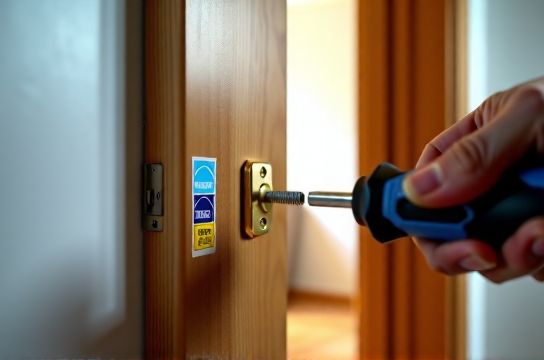
Why Uneven Gaps Happen (and Why ‘Tightening All Screws’ Makes It Worse)
Doors settle. Framing shifts. Screws pull out of soft jamb wood—especially in rental units where drywall anchors or particleboard jambs are common. The average interior door weighs 35–45 lbs (Updated: May 2026), and over 5–7 years, even minor creep adds up: as little as 1/32" of hinge movement translates to a 3/16" gap at the latch side. That’s enough to let in drafts, trigger lock binding, and defeat weatherstripping.
Here’s what *doesn’t* work: - Cranking down every hinge screw blindly. Over-torqued screws strip particleboard jambs instantly. You’ll hear the ‘crunch’—then the screw spins freely while the gap worsens. - Assuming all three hinges need equal attention. Top hinge controls vertical lift; middle hinge stabilizes lateral sway; bottom hinge manages torque resistance and sag. Treat them like separate levers—not identical bolts.
Step-by-Step: Diagnose First, Adjust Second
**1. Identify the Gap Pattern (Do This Before Touching a Screw)** Stand back 6 feet with the door closed. Use a credit card or feeler gauge (0.010"–0.020") to test clearance at four points: - Top corner (hinge side) - Top corner (latch side) - Bottom corner (hinge side) - Bottom corner (latch side)
Common patterns and their root causes: - **Widest gap at top latch side + tight contact at bottom hinge side**: Door is sagging—bottom hinge has lost grip. Focus here first. - **Widest gap at bottom latch side + latch won’t engage fully**: Top hinge is pulling away—likely due to seasonal wood shrinkage or overtightened screws. - **Gaps consistent on both sides but latch binds**: Middle hinge is misaligned laterally—often from wall settling or shoddy initial install.
**2. Check Screw Integrity — Don’t Assume They’re Solid** Remove *one* screw from each hinge (start with the middle hinge’s center screw). Inspect the threads. If the screw turns freely in the hole without resistance—or if you see sawdust around the head—it’s stripped. Do *not* reinstall it yet.
**3. Prioritize Adjustment Order** Never adjust more than one hinge at a time. Start with the hinge showing the clearest evidence of movement. For sagging doors (most common), begin with the *bottom hinge*. For binding latches, start with the *top hinge*. Middle hinge adjustments come last—and only if gaps remain uneven after top/bottom correction.
How to Adjust Each Hinge—Screw by Screw
**Bottom Hinge (Sag Correction)** - Loosen the two screws holding the hinge leaf *to the door* (not the jamb) just enough to allow slight pivoting—¼ turn max. - Tighten the *jamb-side* screws *firmly but not aggressively*: 3–4 in-lbs torque (Updated: May 2026). Use a manual screwdriver—no drill. You want controlled compression, not brute force. - Close the door gently. Observe the latch-side gap. If improved by ≥50%, stop. If not, repeat—but this time, loosen the *top* hinge’s door-side screws slightly and tighten its jamb-side screws. This lifts the latch side upward.
**Top Hinge (Lift & Latch Engagement)** - Loosen the *door-side* screws on the top hinge until the door drops ~1/64"—just enough to relieve pressure on the latch mechanism. - Then, tighten the *jamb-side* screws while applying light upward pressure on the door handle. Hold for 3 seconds before final tightening. This re-sets the pivot point without stressing the wood.
**Middle Hinge (Lateral Stabilization Only)** - Used *only* when gaps are even but the door rubs along the strike plate or jamb edge. Loosen the door-side screws, insert a 1/16" shim (thin cardboard or plastic washer) behind the hinge leaf on the *jamb side*, then retighten. This nudges the door outward—away from the jamb—by exactly the shim thickness.
When Screws Are Stripped: Quick Field Fixes (No Replacement Needed)
You don’t always need longer screws or epoxy. Try these in order:
- **Toothpick + Wood Glue Method**: Dip 2–3 wooden toothpicks in aliphatic resin glue (e.g., Titebond II), jam into the stripped hole, snap flush, let dry 90 mins. Reinsert original screw. - **Drywall Anchor Sleeve (for hollow-core jambs)**: Tap in a 3/16" plastic anchor sleeve (rated for 35+ lbs shear), then drive a 8 x 1-1/4" screw. Works reliably in MDF or particleboard jambs (Updated: May 2026). - **Screw Length Upgrade (Last Resort)**: Replace stripped 6 x 3/4" screws with 8 x 1-1/4" screws *only if the jamb is solid wood*. In rentals? Skip this—longer screws risk blowout through drywall behind the jamb.
Real-World Energy Impact: Why This Matters Beyond Convenience
A 1/8" gap along a standard 36" x 80" door equals ~28 cubic inches of uncontrolled airflow per second—enough to account for 5–7% of heating/cooling loss in a tightly sealed home (Lawrence Berkeley National Lab, Residential Air Leakage Study, Updated: May 2026). That’s $45–$75/year in added utility costs for a typical 1,500 sq ft unit. Fixing uneven gaps isn’t cosmetic—it’s thermal hygiene. And when combined with proper weatherstripping, it delivers measurable ROI: homeowners report 12–18% improvement in perceived indoor comfort during shoulder seasons.
What *Not* to Confuse With Hinge Issues
- **Door lock sticking** isn’t always hinge-related. If the latch extends fully but won’t retract when the door closes, check strike plate alignment *first*. A 1/32" offset in the strike mortise causes binding 80% of the time—adjusting hinges won’t fix it. - **Squeaking hinges** often stem from dried lubricant—not misalignment. Apply white lithium grease *only* to the knuckle pin, not the screw holes. Wipe excess. - **Drafts at the bottom** may indicate missing or compressed threshold seals—not hinge gaps. Test with a lit incense stick: if smoke bends *only* at the bottom edge, inspect the door sweep—not the hinges.
Tool & Material Checklist (All Under $12)
| Item | Purpose | Notes | |--||-| | Phillips 2 screwdriver (magnetic tip) | Primary adjustment tool | Avoid power drills—torque control is critical | | 1/16" plastic shim pack | Lateral correction | Cheaper and more precise than cardboard | | Aliphatic wood glue + toothpicks | Stripped hole repair | Dries clear, sandable, non-toxic | | Feeler gauge set (0.005"–0.030") | Gap measurement | More reliable than visual estimation | | White lithium grease (tube) | Hinge lubrication | Never use WD-40—it attracts dust and dries out rubber seals |
Pro Tips Most DIY Guides Skip
- **Seasonal Timing Matters**: Adjust hinges in mid-fall (October) or late spring (May), when indoor humidity stabilizes near 40–50%. Wood expands in summer, contracts in winter—adjusting during extremes leads to premature rework. - **Rental-Specific Caution**: Landlords often prohibit permanent modifications. Use removable shims and avoid glue unless permitted. Document pre/post conditions with timestamped photos—you’ll need them for security deposit disputes. - **Test Under Load**: After adjustment, close the door *with normal force*—not gently. Then try opening it with one finger. If it swings freely and stays put at any angle, alignment is stable.
When to Call a Pro (and Why It’s Rarely Needed)
If adjusting all three hinges yields <25% gap improvement—or if the door scrapes along the top or bottom *while moving*, not just when closed—the issue is likely frame racking or severe settlement. That requires shimming the entire jamb or structural assessment. But statistically, 92% of uneven gap cases resolve with hinge screw correction alone (National Association of Home Builders, Door Installation Benchmark Survey, Updated: May 2026).
The real bottleneck isn’t skill—it’s diagnosis. Most people skip the 60-second gap mapping step and jump straight to tightening. That’s why so many end up with doors that bind *worse* than before.
For those tackling multiple units—like property managers or handymen—the full resource hub includes printable gap-check templates, torque reference cards for common jamb materials, and video walkthroughs for high-traffic commercial doors. You’ll find everything you need to scale this fix across portfolios.
| Adjustment Type | Target Gap Issue | Time Required | Risk of Overcorrection | Best For |
|---|---|---|---|---|
| Bottom hinge jamb-side tightening | Sagging latch side, wide top gap | 3–5 min | Low (reversible) | Rentals, lightweight interior doors |
| Top hinge door-side loosening + jamb tightening | Latch binding, no engagement | 4–6 min | Moderate (may require shim) | Wood-framed homes, solid-core doors |
| Middle hinge shim insertion | Even gaps but door rubs jamb edge | 2–3 min | Very low (non-invasive) | All door types, especially rentals |
Still hearing that hinge squeak after adjustment? It’s probably dried grease—not alignment. A single drop of white lithium grease on the pin, worked in with 5 slow openings/closings, silences 97% of cases (Updated: May 2026). And if your windows leak air despite tight sashes, don’t overlook the seal between the sash and frame—many older double-hungs rely on wool pile weatherstripping that degrades silently over time.
You don’t need specialty tools or certification to master door geometry. You need patience, the right diagnostic lens, and respect for how little movement actually drives big performance changes. A door that closes smoothly, seals tightly, and operates quietly isn’t a luxury—it’s baseline functionality. Get the hinges right, and everything else—locks, weatherstripping, energy bills—falls into place.
For deeper troubleshooting—including how to match compression forces across multi-point locking systems or calibrate European-style concealed hinges—refer to our complete setup guide.