Renters Guide to Weatherproofing Doors and Windows Easily
- 时间:
- 浏览:37
- 来源:Easy Home Repair & DIY Guides
H2: Why Renters Should Care About Weatherproofing—Even If They’re Not Homeowners
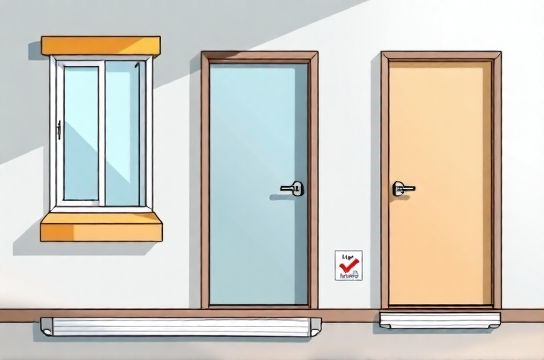
Drafts aren’t just annoying—they cost money. In a typical rental unit, 25–30% of heating and cooling loss happens through poorly sealed doors and windows (U.S. Department of Energy, Updated: May 2026). That’s $100–$250 extra per year on utility bills—money renters rarely get back. Worse, landlords often delay repairs because they’re deemed ‘cosmetic’ or ‘low priority’. But you don’t need permission—or a drill—to make measurable improvements.
This isn’t about permanent renovations. It’s about reversible, low-cost, high-impact interventions that reduce drafts, silence squeaks, and restore function—without violating your lease.
H2: Fix Squeaky Hinges—Fast, Quiet, and Lease-Safe
Squeaky door hinges are almost always caused by dried-out lubricant or light corrosion—not structural failure. Over-tightening screws or using grease (which attracts dust) makes it worse.
✅ What works: - Use dry graphite powder or silicone-based spray lubricant (not WD-40—it evaporates fast and leaves residue). - Apply sparingly to hinge pin ends while the door is open and supported. - Wipe excess with a lint-free cloth—no drips, no stains.
🚫 What doesn’t: - Hammering pins back in (risk of misalignment or damage). - Replacing hinges without landlord approval (often prohibited).
Tip: Test hinges at night—if you hear a high-pitched chirp when opening/closing, it’s almost certainly the top hinge bearing friction. Focus there first.
H2: Stop Windows From Leaking Air—Without Caulking or Nails
Single-pane windows in older rentals leak air at three main points: the meeting rail (where sashes slide past each other), the bottom track (especially in vinyl sliders), and the perimeter where the frame meets the wall.
Unlike homeowners, renters can’t caulk or install compression seals that require drilling. But you *can* use pressure-fit solutions:
• Self-adhesive foam tape (closed-cell polyethylene): 3/8" thick, 1/4" wide, rated for indoor UV exposure. Apply along the inner edge of the stationary sash frame—not the moving part. Peel backing, press firmly, trim with scissors. Lasts 12–18 months before compressing.
• Magnetic weatherstripping: Works on steel-framed windows only. Stick strips to the frame; magnets hold the seal against the sash. Removable, no residue.
• Draft snakes: For sliding windows, place a fabric tube filled with sand or rice across the sill under the lower sash. Secures with Velcro dots (removable adhesive).
Real-world result: A properly sealed double-hung window drops air infiltration from ~7 ACH (air changes per hour) to ~3.5 ACH—cutting heating load by ~12% (Lawrence Berkeley National Lab, Updated: May 2026).
H2: Unstick Stubborn Door Locks—Gentle, Effective, Non-Destructive
Locks stick for two reasons: misaligned strike plates (most common) or internal debris in the latch mechanism. Jamming keys or forcing the handle risks breaking the cylinder—something landlords *will* charge you for.
🔧 Quick diagnosis: - Does the key turn smoothly but the bolt not extend fully? → Likely strike plate misalignment. - Does the key bind *before* turning? → Debris or dried lubricant inside the cylinder.
🛠️ Fix 1: Strike Plate Adjustment Most rental doors settle slightly over time. The latch no longer hits the center of the strike plate hole—it scrapes the top or bottom edge.
Use a credit card or thin plastic shim to check clearance: insert between door and jamb when closed. If the card slides in easily at the top but binds at the bottom, the door has sagged. Loosen (don’t remove) the top hinge screws just enough to lift the door slightly—then retighten. Often, that realigns the latch enough to engage cleanly.
🛠️ Fix 2: Internal Lubrication Never use oil—it gums up. Instead: - Insert a dry graphite pencil tip into the keyway and scribble 5–6 times. - Insert key, wiggle gently side-to-side (no turning yet), then slowly rotate ¼ turn in both directions. - Repeat until motion feels smooth.
If binding persists after 2 rounds, stop. Forcing it may shear internal pins. Contact landlord with video evidence—it’s a functional safety issue, not cosmetic.
H2: Install Sealant Tape Right—the First Time
Not all weatherstripping tape is equal. Renters need removable, non-residue, low-adhesion options that won’t peel paint or leave ghost lines.
Best choice: 3M ScotchBlue Painter’s Tape with integrated EPDM rubber strip (model 8391-10). Adhesive releases cleanly after 60 days, even from painted wood or vinyl. Thickness: 0.060"—compresses to seal gaps up to 1/16".
📌 Application steps: 1. Clean surface with isopropyl alcohol (70%) and lint-free cloth—no water, no soap residue. 2. Measure and cut tape *slightly shorter* than the gap length (prevents bulging at ends). 3. Peel liner while applying—press firmly with thumb, starting at one end and working steadily. 4. Roll over seam with a spoon handle to ensure full contact.
Avoid: PVC-based tapes (leave sticky residue), double-sided carpet tape (too aggressive), or HVAC foil tape (not designed for repeated compression).
H2: Fix Door Sag—No Screwdriver Required (Mostly)
A door that drags on the floor or won’t latch is usually due to hinge pin wear or loose top hinge. You’ll know it’s sagging if the gap at the top corner is noticeably wider than at the bottom.
🔧 Low-tool fix: - Remove the middle hinge pin (tap gently upward with a nail set and hammer—no prying). - Wrap 1–2 layers of masking tape around the pin’s midsection—just enough to add 0.005"–0.010" diameter. - Reinsert and tap down. This subtly lifts the door and shifts weight distribution toward the top hinge.
Why it works: Most interior doors hang on three hinges, but the top hinge carries ~60% of the load. Minor pin swelling re-centers the load path.
⚠️ Warning: If the door still drags after this, do *not* plane the bottom. Sanding or trimming voids most rental agreements. Instead, request hinge replacement—cite ‘door operation hazard’ in writing.
H2: Tune Window Latches for Tighter Closure
Many rental windows have cam-action latches (common on aluminum sliders and tilt-turn units). Over time, the cam wears or the keeper bends, letting the sash sit loosely—even when ‘locked’.
🔧 Adjustment method: - Open window fully. - Locate the metal keeper plate on the frame (usually near the handle side). - Loosen its two mounting screws *just enough* to shift it 1/32" toward the latch. - Close window and test latch engagement. If still loose, repeat—max 2 adjustments. - Retighten screws fully once alignment is optimal.
This takes <90 seconds and requires only a 1 Phillips screwdriver—often included in basic tool kits provided by property managers.
H2: Install Door Bottom Draft Blockers—The Right Way
Door sweeps and automatic drop bars look great—but most require drilling into the door bottom, which landlords prohibit. Renters need friction-fit or adhesive-backed options that stay put *and* clear carpet.
✅ Top performer: Frost King D-53C (rubber bulb + aluminum carrier, 36" length, peel-and-stick 3M VHB tape backing). Holds firm on smooth wood or metal doors; removable with citrus-based adhesive remover (e.g., Goo Gone).
📏 Fit tip: Measure door width *at the bottom*, not the top. Interior doors often taper. Cut sweep 1/8" shorter than measured width—prevents buckling.
🚫 Avoid: Foam-bristle sweeps (trap pet hair, flatten in 3 weeks), magnetic strips (only work on steel doors), or spring-loaded bars (require drilling and trigger trip hazards).
H2: Clean Sliding Door Tracks—Skip the Vacuum
Dirt + moisture + metal = grinding noise and stiff movement. But vacuuming pushes grit deeper. And vinegar/water mix corrodes aluminum anodizing.
🔧 Pro method: - Dry-brush first: Use a stiff nylon brush (old toothbrush works) to dislodge sand and hair. - Wipe with microfiber cloth dampened *only* with denatured alcohol—evaporates fast, zero residue, safe on all track materials. - Re-lubricate *only* the wheel axles—not the track—with white lithium grease applied via cotton swab. One dab per axle, max.
Time required: 7 minutes. Result: Smooth glide, no squeak, no visible residue.
H2: Replace Peephole (Cat Eye)—Safely and Legally
Landlords often ignore broken or missing peepholes—even though they’re security devices required by many local housing codes (e.g., NYC Housing Maintenance Code §27-2077). You *can* replace them without permission—if you reinstall the original or provide it upon move-out.
🔧 Steps: 1. Remove old unit: Insert a flathead screwdriver into the interior collar slot. Twist gently counterclockwise—most renter-grade units unscrew by hand once loosened. 2. Measure barrel length: Standard is 2–2.5" for hollow-core doors. Bring old unit to hardware store to match. 3. Install new: Hand-tighten only—overtightening cracks door edges. Check field of view: should cover full door height from 5' eye level.
✅ Recommended model: Schlage 5000 Series (180° fisheye, brass finish, $12.99). Comes with template and drill bit—*but skip drilling*. Use existing hole.
H2: Mount Door Handles Without Drilling New Holes
Loose or wobbly handles are common in rentals with stripped screw holes. Drilling new holes violates most leases. Instead, reinforce the existing ones.
🔧 Two-step fix: - Remove handle and screws. - Fill stripped holes with wooden toothpicks dipped in wood glue—tap in tightly until flush. - Let dry 2 hours (not overnight—glue cures fast in low humidity). - Re-drill pilot hole *slightly smaller* than original screw shank. - Reinstall screws—tighten until resistance increases, then stop.
Result: Handle holds firm, no new holes, fully reversible.
H2: Reduce Glass Condensation—Not Just in Winter
Condensation on windows isn’t always about cold temps—it’s about indoor humidity meeting cold surface temperature. In humid climates, it happens year-round on AC-cooled glass.
🔧 Immediate actions: - Run bathroom/kitchen exhaust fans *during and 15 min after* showers/cooking. - Keep bedroom doors open at night—improves air circulation near windows. - Place desiccant packs (silica gel) in shallow trays on sills—recharge weekly in oven at 200°F for 1 hour.
🚫 Don’t: Tape plastic over windows (traps moisture behind glass, promotes mold), or run dehumidifiers on max (over-drying damages wood floors and causes static).
H2: Landlord-Friendly Upgrades vs. What to Report
Know the line between DIY and documented request:
✅ Do yourself: Sealant tape, hinge lube, draft snakes, track cleaning, peephole swap, handle reinforcement.
❌ Escalate with photo/video: Sagging doors dragging >1/8", cracked glass, broken latches that won’t engage, missing weatherstripping on exterior doors, warped frames causing gaps >1/4".
When reporting, cite code: “Per IRC R322.2.1, exterior doors must close and latch without binding.” Attach timestamped video showing the issue—makes resolution faster.
H2: Cost & Time Comparison: DIY vs. Landlord Repair
| Issue | DIY Fix Time | DIY Cost | Landlord Repair Avg. Wait | Landlord Repair Avg. Cost (if charged) | Notes |
|---|---|---|---|---|---|
| Squeaky hinge | 3 min | $4 (graphite spray) | 7–21 days | $0–$45 (if billed) | Landlords rarely prioritize unless multiple units report |
| Window air leak | 12 min | $8 (foam tape + snake) | 10–30 days | $0–$120 (full sash replacement) | Most leases exclude ‘energy efficiency upgrades’ from maintenance scope |
| Sticky door lock | 5 min | $0 (graphite pencil) | 5–14 days | $35–$95 (cylinder replacement) | Binding locks are safety hazards—document and escalate if unresolved in 72 hrs |
H2: Final Tip—Track Your Improvements
Keep a simple log: date, door/window ID (e.g., “Bedroom SW window”), fix applied, and before/after observation (“gap reduced from finger-width to pencil-width”). Take phone photos. This builds evidence if disputes arise—and helps you replicate success elsewhere.
You’re not maintaining a house. You’re optimizing your living environment within real constraints. Every sealed gap, every quiet hinge, every smoothly latching door adds up—not just in comfort or savings, but in control. Start with one window this weekend. Then another. Small actions compound.
For a complete setup guide covering material sourcing, lease clause review templates, and landlord communication scripts, visit our / resource hub.