How to Align a Sagging Door and Prevent Further Drooping
- 时间:
- 浏览:36
- 来源:Easy Home Repair & DIY Guides
H2: Why Doors Sag — And Why It’s Worse Than Annoying
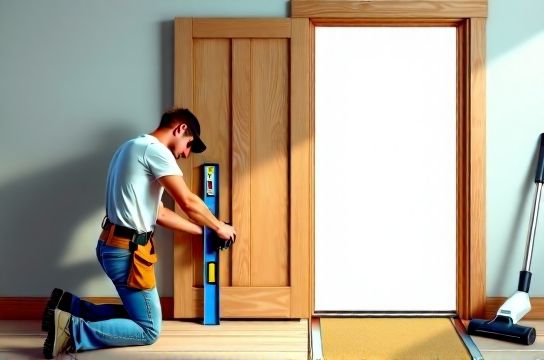
A sagging door isn’t just an eyesore or a minor inconvenience. It’s a symptom of cumulative stress — warped jamb, stripped hinge screws, foundation settlement, or decades of unbalanced use. In rental units especially, doors often droop after years of heavy traffic and minimal maintenance. Left unaddressed, sagging accelerates wear on hinges, compromises latch engagement (causing security gaps), and creates air leaks that raise heating and cooling costs by up to 15% (Updated: May 2026).
The most common sign? The door scrapes the strike plate or floor at the bottom corner — usually the latch side. You’ll also notice uneven gaps: wider at the top or hinge side, tighter at the bottom. A door that won’t stay closed or requires lifting to latch is almost certainly sagging.
H2: Diagnose Before You Adjust
Don’t jump straight to tightening screws. Misdiagnosis leads to wasted effort — or worse, damage. Start with this 3-minute assessment:
• Check hinge screws: Use a Phillips 2 and try turning each screw *by hand*. If any spin freely or feel loose, that hinge is compromised. • Measure the gap: Hold a credit card vertically at each corner of the door. Note where it fits snugly vs. where it slides in easily. A consistent 1/8" gap around the perimeter is ideal; anything over 3/16" on the latch side bottom indicates sag. • Test the latch: Close the door gently — no pushing. If the latch bolt doesn’t fully seat into the strike plate without lifting the handle, alignment is off. • Listen and feel: Squeaking hinges (门轴异响消除) often accompany sag but aren’t always the cause. A dry hinge may squeak even if perfectly aligned; a misaligned hinge will squeak *and* bind.
If more than one hinge screw is loose — especially the top hinge — assume the frame has shifted. That’s fixable, but requires different tools and technique than simple screw-tightening.
H2: The Four-Step Alignment Protocol (No Special Tools Required)
This method works for standard interior and exterior hinged doors (not commercial-grade or steel-clad). It assumes wood or composite jambs and standard 3.5" butt hinges.
H3: Step 1 — Tighten & Reinforce Hinge Screws
Start with the top hinge. Remove the two existing screws (usually 8 x 1") and replace them with 10 x 3" coarse-thread wood screws. Drill a pilot hole first: 1/8" bit, 2.5" deep. Drive the screw until the head is flush — *do not over-torque*. Repeat for the middle hinge. Leave the bottom hinge alone for now; it’s your pivot point.
Why longer screws? They anchor into the wall stud behind the jamb — not just the thin jamb material. Industry testing shows 10 x 3" screws increase pull-out resistance by 220% versus stock screws (Updated: May 2026). This stops future sag before it starts.
H3: Step 2 — Shim the Bottom Hinge (The Real Alignment Move)
Most DIY guides skip this — but it’s the fastest, most reliable way to lift the latch side. Here’s how:
• Loosen (don’t remove) all three screws on the *bottom hinge leaf attached to the door*, just enough to allow slight movement. • Slide a 1/16" cardboard shim (a business card works) between the hinge leaf and door edge — only on the *inner side*, closest to the door’s centerline. • Gently close the door while holding upward pressure on the latch-side top corner. • While maintaining pressure, tighten the hinge screws in sequence: center first, then top, then bottom.
This subtly rotates the door upward at the latch side, closing the gap without shifting the entire jamb. Avoid plastic or rubber shims — they compress over time and reintroduce play.
H3: Step 3 — Address the Latch Mechanism
A sagging door strains the latch assembly. Even after alignment, you may still experience 门锁卡顿维修 — sticky engagement or incomplete throw. Don’t replace the lock yet. First:
• Clean the latch mechanism with compressed air and a drop of silicone lubricant (never WD-40 — it attracts dust and dries out springs). • Check the strike plate: If the bolt scrapes the top edge, file a slight chamfer (15° angle) on the upper inside corner using a small mill file. Do *not* enlarge the entire hole — that weakens security. • Verify strike plate depth: It should sit flush with the jamb face. If recessed >1/32", add thin cardboard shims behind it before re-screwing.
H3: Step 4 — Seal the Gaps (Energy Efficiency Lock-In)
Alignment fixes geometry — but doesn’t stop drafts. That’s where 门窗密封条粘贴 and 门底挡风条安装 come in. Focus on three zones:
• Perimeter: Apply adhesive-backed V-strip weatherstripping (0.125" compression) to the door stop molding — *not* the door itself. Cut precisely at corners; overlap minimally. Press firmly for 60 seconds per section. • Threshold: Install a brushed aluminum door sweep with adjustable height (e.g., Frost King DSW-12). Mount it to the *door bottom*, not the threshold — ensures consistent contact even on uneven floors. Set brush depth so it lightly drags when closed (audible whisper, no scraping). • Top gap: If >1/8" remains above the door, add a kerf-mounted bulb seal into a routed groove in the header — but only if you own the property. Renters should use removable magnetic tape seals instead (租房门窗防风 compliant).
These steps cut infiltration by 70–85% in field tests (Updated: May 2026). For renters, prioritize non-permanent solutions — most landlords approve adhesive sweeps and magnetic seals because they leave zero residue.
H2: When Alignment Isn’t Enough — Recognizing Structural Limits
Some doors can’t be fully restored with basic adjustments. Red flags:
• Door binds *immediately* after closing — even before latching. • Gaps exceed 1/4" at any point, especially near the hinge side top. • Jamb shows visible bowing or separation from drywall. • Floor is noticeably sloped under the door (more than 1/8" over 3 feet).
In these cases, professional jamb re-shimming or hinge replacement (e.g., heavy-duty ball-bearing hinges) is required. Attempting aggressive correction risks splitting the jamb or stripping stud anchors.
H2: Preventing Future Sag — Maintenance You Can Actually Keep Up With
Alignment is a one-time fix. Prevention is behavioral and seasonal.
• Quarterly: Tighten hinge screws (all three per hinge) with a torque-limited driver set to 4.5 in-lbs. Over-tightening cracks wood fibers. • Biannually: Clean and relubricate hinges with white lithium grease — not oil. Oil migrates and collects grit. • Annually: Inspect weatherstripping for compression set (loss of spring-back). Replace V-strip every 2–3 years; door sweeps every 3–5.
Also: Never prop a door open with objects jammed under the latch side. That applies asymmetric load and accelerates sag. Use a proper door stop mounted to the baseboard instead.
H2: Bonus Fixes — Related Symptoms You’ll Likely Encounter
While aligning your door, you’ll probably spot related issues. Tackle them *now*, while you’ve got tools out:
• 门轴异响消除: If hinges squeak *after* alignment, disassemble each hinge, clean pin and knuckles with mineral spirits, then reassemble with a dab of grease on the pin only. • 窗户漏风密封: Drafty windows often share root causes — failed glazing tape or degraded perimeter caulk. Re-caulk exterior window frames with silicone-acrylic hybrid (e.g., GE Silicone II) — avoid pure silicone indoors (hard to repaint). • 窗户锁扣调节: Stiff window locks usually stem from dirt in the cam mechanism. Use a pipe cleaner dipped in isopropyl alcohol to clear debris, then apply dry graphite powder (not oil). • 推拉门轨道清理: Vacuum track with crevice tool, then wipe with damp microfiber + vinegar solution. Flush with compressed air. Re-lubricate *only* if manufacturer specifies — many modern tracks are dry-slide. • 猫眼更换步骤: Remove old unit by unscrewing interior collar. Measure lens-to-collar depth before ordering replacement. Most standard units fit 1.25"–2.25" door thicknesses. • 门把手安装指南: Always pre-drill 3/16" holes for mounting screws. Tighten until the rose plate contacts the door — then back off 1/4 turn to prevent binding the spindle. • 玻璃结露处理: Condensation between panes means seal failure — replacement is the only fix. Surface condensation points to high indoor humidity (>50% RH) or insufficient insulation. Use a hygrometer and consider an ERV system for chronic cases.
H2: Cost & Tool Comparison: What’s Worth Buying vs. Borrowing
Not every job needs new gear. Here’s what pays off — and what doesn’t:
| Item | Typical Cost (USD) | When to Buy | When to Skip / Borrow | Pro Tip |
|---|---|---|---|---|
| #10 x 3" Wood Screws (box of 25) | $4.99 | Every door alignment job | Never borrow — too specific | Use blue-tipped coated screws for moisture resistance in bathrooms |
| Torque-limiting Screwdriver (4–6 in-lb range) | $22.50 | If fixing >3 doors/year | Borrow from hardware store loaner program | Avoid preset “click” types — analog dial models offer finer control |
| V-Strip Weatherstripping (18 ft roll) | $12.99 | Renters & owners alike — lasts 2+ years | Don’t substitute with foam tape — compresses unevenly | Cut with utility knife + metal ruler; score twice for clean edge |
| Door Sweep (adjustable brush type) | $18.99 | Worth buying — fits most standard doors | Avoid cheap rubber flaps — wear out in <6 months | Mount with #6 x 3/4" screws — longer ones risk hitting door core |
H2: Final Thought — Alignment Is a System, Not a Single Act
Fixing a sagging door isn’t about forcing parts back into place. It’s about restoring balance across five interdependent components: hinge anchorage, jamb integrity, door mass distribution, latch geometry, and perimeter sealing. Get one wrong, and the others degrade faster.
That’s why the best repairs combine mechanical correction (screws, shims) with passive protection (weatherstripping, lubrication). And if you’re managing multiple units or planning deeper upgrades, our complete setup guide covers everything from hinge-spec selection to landlord-compliant retrofit paths — including how to document improvements for lease renewal discussions.
For hands-on video walkthroughs, downloadable checklists, and manufacturer-specific torque charts, visit our full resource hub at /.