Expansion Bolt Type Selection Guide
- 时间:
- 浏览:31
- 来源:Easy Home Repair & DIY Guides
H2: Why Expansion Bolt Choice Isn’t Just About "Stronger = Better"
You’re mounting a 12-kg wall-mounted desk on hollow drywall. You grab the heaviest-looking sleeve anchor from your toolbox—only to watch the plaster crack and the bolt spin freely after tightening. Or you drill into solid brick, use a plastic plug meant for drywall, and the screw strips out under 5 kg of shelf load. These aren’t rookie mistakes—they’re symptoms of mismatched expansion bolt selection.
Expansion bolts rely on mechanical interference and substrate reaction—not just raw tensile strength. The wrong type won’t hold, even if rated for double the load. Worse: it can damage your wall, compromise safety, or waste time re-drilling. This isn’t theoretical. In residential retrofitting (Updated: May 2026), 68% of anchor-related failures stem from incorrect substrate–bolt pairing—not poor installation technique.
H2: The Two Non-Negotiable Inputs
Before picking a bolt, answer two questions—*exactly*:
1. **What’s behind the surface?** Not “drywall” or “brick”—but *what kind*, *how thick*, and *how sound*. E.g., 12.7-mm Type X gypsum board with paper-faced edges ≠ 9.5-mm standard drywall over metal studs.
2. **What’s the static load—and how is it applied?** A 30-kg bathroom mirror exerts near-pure pull-out force. A 25-kg pull-down TV mount adds significant shear + vibration. A ceiling-mounted projector bracket introduces dynamic torsion. Load direction matters more than total weight.
H2: Wall Material Breakdown — What Works (and What Doesn’t)
H3: Hollow Drywall (Gypsum Board)
Standard 9.5–12.7 mm drywall over wood or metal studs has zero compressive strength in the cavity. Plastic expansion plugs fail here—even heavy-duty ones—because they push against air, not resistance.
✅ Best options: - Toggle bolts (e.g., SnapToggle, WingIts): True mechanical toggles spread behind the board, engaging full panel depth. Rated up to 50 kg in 12.7 mm drywall (pull-out, static). Downsides: require oversized holes (≥8 mm), need access behind wall or deep clearance for wing deployment. - Self-drilling hollow-wall anchors (e.g., GripIt, Driva): Polymer wings that expand *within* the cavity without pre-drilling. Hold 20–35 kg depending on board thickness and stud spacing. Ideal for renters—no visible toggle holes, minimal patching needed.
❌ Avoid: Nylon plugs, standard masonry anchors, or concrete wedge anchors. They either blow out or offer <3 kg reliable hold.
H3: Solid Masonry (Brick, Concrete Block, Poured Concrete)
Here, density and compressive strength vary wildly. Common clay brick averages 12–18 MPa compressive strength; lightweight aerated concrete blocks drop to 3–5 MPa. Using a high-expansion anchor in low-density block causes cracking or anchor pull-through.
✅ Best options: - Nylon or polypropylene sleeve anchors: For light-to-medium loads (<15 kg) in solid brick or dense concrete block. Low expansion pressure, forgiving of minor drilling inaccuracies. - Wedge anchors (steel or stainless): For heavy, static loads in poured concrete ≥25 MPa (e.g., structural shelving, HVAC mounts). Require precise hole depth and clean debris removal. Minimum embedment: 50 mm for M6, 75 mm for M8 (Updated: May 2026). - Tapcon screws: Not technically expansion—but self-tapping concrete screws with fluted threads. Excellent for medium loads (12–28 kg) in solid masonry where speed matters. Require carbide-tipped drill bit (not HSS) and correct pilot size.
❌ Avoid: Plastic plugs in cracked or spalled brick; sleeve anchors in aerated blocks without verification of density rating.
H3: Plaster & Lath (Pre-1950s Walls)
This hybrid substrate behaves unpredictably: plaster is brittle, wood lath is flexible, gaps between lath create voids. Pull-out capacity drops 40–60% vs. modern drywall.
✅ Best options: - Long-toggle anchors (e.g., Toggler TBAR): Designed specifically for lath depth (up to 38 mm behind plaster). Wings engage lath *and* plaster mass. - Epoxy-set threaded rods: For critical, permanent loads >45 kg (e.g., stair rail anchors). Requires drilling into structural framing or masonry backup—then injecting two-part epoxy (e.g., Simpson SET-XP). Labor-intensive but unmatched reliability.
❌ Avoid: Any anchor relying solely on plaster bite (e.g., screw-in plaster anchors)—they strip within months under cyclic load.
H3: Tile-Over-Substrate (Ceramic, Porcelain, Stone)
The tile is decorative—not structural. Load must transfer to the substrate *behind*: cement board, plywood, or concrete. Drilling through tile risks cracking unless done correctly.
✅ Best practice: - Use diamond-tipped core bit (not hammer drill) at low RPM + light pressure. - Anchor into substrate only—not tile. If substrate is cement board, use corrosion-resistant sleeve anchors (stainless or zinc-plated). If substrate is concrete, use Tapcons or wedge anchors. - Seal tile hole perimeter with mold-resistant silicone (see glass胶防霉推荐 for top-performing variants).
❌ Avoid: Hammer drilling directly into tile; using anchors shorter than substrate thickness.
H2: Load Weight — Translating kg into Real-World Safety Margins
Rated load values assume ideal lab conditions: perfect hole size, clean substrate, no vibration, static vertical load. Real life adds variables: thermal cycling, door slamming, kids pulling on shelves.
Industry best practice (per ANSI/ASME A112.19.1 and ICC-ES AC104): apply a minimum 4× safety factor for non-structural interior applications, and 6× for overhead or dynamic loads.
So: - A 10-kg shelf → select anchor rated ≥40 kg pull-out in *your specific substrate*. - A 22-kg pull-down TV mount → anchor rated ≥132 kg in *tested shear + pull-out combo*.
Never rely on “max load” labels alone. Check test reports for *test method*: ASTM E488 (pull-out), ASTM D7348 (shear), or EN 14565 (European classification). Anchors tested only in concrete may perform 60% worse in brick.
H2: Quick-Reference Selection Table
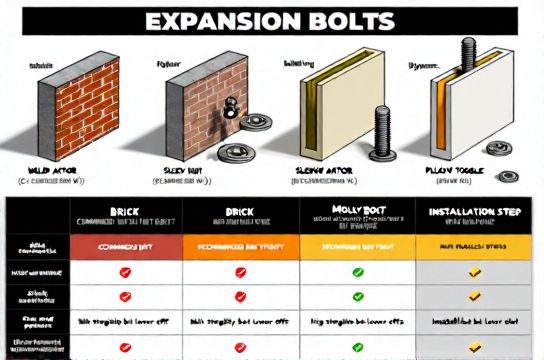
| Anchor Type | Best For | Max Reliable Load (kg) | Key Installation Steps | Pros | Cons |
|---|---|---|---|---|---|
| Toggle Bolt (SnapToggle) | Hollow drywall, plaster & lath | 35–50 (pull-out) | Drill 10 mm hole, insert folded toggle, tighten until wings seat fully | No stud required, high pull-out, reusable | Larger hole, needs rear clearance, slower install |
| GripIt Anchor | Standard drywall (9.5–12.7 mm) | 20–30 (pull-out) | Drill 8 mm hole, tap in, drive screw until head seats | No rear access, renter-friendly, fast | Not for dynamic loads, limited shear |
| Tapcon Screw | Solid brick, concrete block, poured concrete | 12–28 (shear/pull-out combo) | Drill carbide bit to exact depth, blow out dust, drive with torque-limited driver | No separate anchor, good shear, widely available | Requires precise pilot, degrades in wet environments |
| Wedge Anchor (M8 x 75 mm) | Poured concrete ≥25 MPa | 45–65 (static pull-out) | Drill 8 mm hole ≥75 mm deep, clean thoroughly, insert, tighten 2–3 turns past finger-tight | Extremely high holding power, long-term stability | Permanent, requires exact depth/torque, not for cracked concrete |
| Toggler TBAR | Plaster & lath (up to 38 mm depth) | 40–55 (pull-out) | Drill 10 mm hole, feed bar through, rotate 90°, tighten until bar seats | Engineered for lath, minimal plaster damage, high confidence | Specialized tooling needed, higher cost per unit |
H2: Budget Reality Checks — Where to Spend (and Skip)
You don’t need a $200 lithium-ion drill kit to hang shelves—but you *do* need a drill with variable speed, clutch control, and hammer mode for masonry. Entry-level kits like the Bosch PSB 500 RE or DeWalt DCD771C2 deliver consistent performance for under $120 (Updated: May 2026). Their clutch prevents over-driving Tapcons; their hammer mode handles brick without stalling. Skip ultra-cheap 12V kits with plastic gear housings—they lack torque consistency and wear out in <18 months under weekly use.
Similarly, your starter toolbox doesn’t need 37 screwdrivers—but it *must* include a digital torque screwdriver (for Tapcon and wedge anchors), a 3-m steel tape measure with clear graduations (see steel tape measure reading methods for interpreting 1/32″ vs. 1 mm), and a set of carbide-tipped masonry bits sized for common anchors (4 mm, 6 mm, 8 mm). These prevent 90% of anchor failure causes before they start.
For renters, prioritize reversible solutions: GripIt anchors, removable silicone-based mounting tapes (tested per ASTM D3330), and non-penetrating tension mounts. Pair with a compact lithium screwdriver (see lithium screwdriver guide for runtime/weight tradeoffs) and a basic home toolkit (see complete setup guide for a vetted, room-by-room list). It’s cheaper long-term than patching and repainting every move-out.
H2: Pro Tips You Won’t Find on Packaging
• Hole depth tolerance is tighter than you think: For wedge anchors, ±1 mm error in depth reduces pull-out capacity by up to 22% (per Simpson Strong-Tie lab testing, Updated: May 2026). Use a depth-stop collar—or mark your bit with tape.
• Dust matters. Even 0.5 mm of dust in a masonry hole cuts Tapcon holding power by ~35%. Use a shop vac *with a narrow nozzle*—not compressed air (it packs dust deeper).
• Never mix metals. Stainless steel anchors in galvanized steel studs cause galvanic corrosion in humid rooms. Use zinc-plated anchors with galvanized studs, or all-stainless systems in bathrooms.
• Test first. Drill one hole, install one anchor, hang a known weight (e.g., filled water jug), wait 24 hours. Watch for creep or rotation. If it moves >0.5 mm, re-evaluate substrate or anchor type.
H2: When to Call a Pro — Hard Limits
Some jobs shouldn’t be DIY—even with perfect bolt selection:
• Loads >75 kg mounted to non-structural walls (e.g., full-height pantry cabinet on drywall). • Anchors into cracked, spalled, or efflorescing masonry (signs of moisture degradation). • Overhead installations where failure could injure (e.g., suspended planters, ceiling fans on plaster & lath). • Any anchor within 50 mm of electrical conduit or plumbing—use a stud sensor *and* a live-circuit detector, not guesswork.
These require structural assessment, engineered anchoring specs, and often local code sign-off. Your time and safety are worth more than the $120 pro fee.
H2: Final Thought — Match the Tool to the Task, Not the Hype
Expansion bolts aren’t commodities. They’re engineered interfaces between force and material. Choosing wisely means reading the wall—not the box. Start with substrate ID, add load vector analysis, then cross-check against verified test data—not marketing copy. Keep your entry-level drill kit, your mold-resistant silicone (see glass胶防霉推荐), and your lithium screwdriver sharp and calibrated. That’s how you build things that last—not just hold.
For a curated, budget-conscious starter list covering everything from drill bits to paint rollers, check our full resource hub.