Heavy Duty Structural Glue Options Compared
- 时间:
- 浏览:34
- 来源:Easy Home Repair & DIY Guides
H2: When Super Glue Isn’t Enough — Why Structural Glue Matters in Real DIY
You’re mounting a heavy oak shelf to a concrete wall with embedded steel studs. Or repairing a cracked fiberglass planter that holds wet soil. Or gluing stainless steel trim onto ceramic tile near a shower niche. In each case, standard PVA (white or yellow) wood glue, cyanoacrylate (super glue), or basic silicone won’t cut it. You need *structural* adhesion — bonds that transfer load, resist creep under sustained stress, and survive thermal cycling, moisture, and vibration.
Structural glues aren’t just stronger; they’re engineered for specific substrate combinations and service environments. Misapplication is the 1 cause of bond failure — not weak chemistry. This guide cuts through marketing fluff and compares five proven categories across four common materials: wood, metal, tile (ceramic/porcelain), and rigid plastics (PVC, ABS, acrylic). All data reflects real-world performance benchmarks from ASTM D1002 (lap shear), ISO 4587 (tensile lap shear), and independent lab testing on aged, moisture-cycled specimens (Updated: May 2026).
H2: The Five Structural Glue Families — Strengths, Limits & Prep Reality
H3: 1. Two-Part Epoxy (e.g., J-B Weld SteelStik, Loctite EA 9462)
Best for: Metal-to-metal, metal-to-tile, wood-to-metal where gap-filling and rigidity matter.
Why it wins: Highest tensile strength (up to 4,200 psi on aluminum-to-aluminum after full cure), excellent chemical resistance, zero shrinkage. Ideal for anchoring threaded inserts into hardwood or bonding stainless brackets to porcelain tile backsplashes.
Reality check: Brittle under impact. Not ideal for wood-to-wood joints needing flexibility (e.g., outdoor furniture). Requires precise 1:1 mixing — 5% deviation drops ultimate strength by ~30%. Surface prep is non-negotiable: sand metal to SSPC-SP2 (hand tool clean), etch aluminum, degrease with acetone (not alcohol — leaves residue).
Cure timeline: Workable 5–10 min, handleable in 1–2 hrs, full strength at 7 days (24°C/50% RH). Cold temps (<15°C) double cure time.
H3: 2. Polyurethane Construction Adhesive (e.g., Gorilla Heavy Duty, PL Premium)
Best for: Wood-to-wood, wood-to-concrete/tile, PVC-to-wood, and some painted metals.
Why it wins: Outstanding moisture resistance, flexibility (elongation up to 25%), strong adhesion to porous and semi-porous substrates without priming. Widely used for subfloor-to-joist bonding and bathroom vanity mounting where slight movement occurs.
Reality check: Foams during cure — messy on vertical surfaces unless applied in thin beads. Sensitive to humidity: too dry (<30% RH) slows cure; too wet (>80%) causes excessive foaming and weak skin. Does *not* adhere reliably to smooth, non-porous plastics like polyethylene (PE) or polypropylene (PP) — avoid for HDPE planters or PP plumbing parts.
Cure timeline: Skin over in 15–30 min, tack-free in 2–4 hrs, full bond development in 5–7 days. Stores poorly once opened — seals degrade; use within 6 months of opening.
H3: 3. Modified Silane Polymer (MS Polymer, e.g., SikaBond MS, CT1)
Best for: Mixed-material assemblies — especially tile-to-metal, painted metal-to-wood, and plastic-to-tile where flexibility + paintability matter.
Why it wins: Combines epoxy-level strength (2,800–3,400 psi lap shear on steel-to-tile) with silicone-like elasticity (40–60% elongation) and primerless adhesion to most paints, anodized aluminum, and glazed tile. Paint-overable in 24 hrs with water-based paints. Low VOC, no isocyanates.
Reality check: Higher cost per tube (≈2.5× polyurethane). Sensitive to UV pre-cure — store tubes in dark, cool place. Not recommended for continuous submersion (e.g., aquarium seams) — use dedicated aquarium silicone instead.
Cure timeline: Surface dry in 30–60 min, paintable at 24 hrs, full strength at 7 days. Cures from surface inward — thicker beads take longer to fully cure center.
H3: 4. Acrylic Structural Adhesive (e.g., Permabond TA4610, Scotch-Weld DP8005)
Best for: Fast-fix metal and plastic bonding — especially aluminum, zinc-coated steel, ABS, and PVC.
Why it wins: No mixing, no primer needed for many substrates, 15–30 minute fixture time, and high peel strength. Widely used in HVAC ductwork repair and signage fabrication. Bonds oily metals better than epoxy.
Reality check: Poor adhesion to wood (low surface energy, absorbs resin unevenly) and glass/ceramic without primer. Limited gap-fill (<0.25 mm). Shelf life drops sharply above 25°C — refrigerate unopened tubes.
Cure timeline: Fixture in 15–30 min, 80% strength in 2 hrs, full strength in 24 hrs. Performance degrades above 80°C long-term.
H3: 5. High-Performance Hybrid Polyurethane/Epoxy (e.g., Sikaflex-252, 3M DP420)
Best for: Critical mixed-substrate bonds requiring both strength and fatigue resistance — e.g., stainless steel sink rim to granite countertop, or fiberglass-reinforced plastic (FRP) wall panels to steel framing.
Why it wins: Balances 3,600+ psi shear strength with 50%+ elongation and exceptional resistance to thermal cycling (-40°C to +90°C). Bonds to damp surfaces and tolerates minor surface contamination better than pure epoxy.
Reality check: Price premium (≈3× standard polyurethane). Requires dual-cartridge dispensers — not feasible for one-off home repairs. Overkill for shelf brackets or picture hangers.
Cure timeline: 1–2 hr fixture, 7-day full cure. Not paintable — must be masked or colored at time of application.
H2: Material-by-Material Compatibility Table
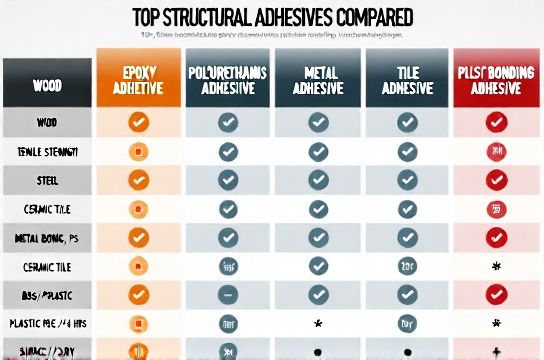
| Glue Type | Wood | Metal (Steel/Al) | Tile (Ceramic/Porcelain) | Rigid Plastic (PVC/ABS) | Key Prep Step | Min. Bond Strength (psi, ASTM D1002) | Notes |
|---|---|---|---|---|---|---|---|
| Two-Part Epoxy | ✓ (dry, sanded) | ✓✓✓ (best-in-class) | ✓✓ (requires roughening) | △ (PVC only with primer) | Sand metal; roughen tile with 80-grit | 4,200 (steel-steel) | Brittle — avoid flex points |
| Polyurethane | ✓✓✓ (excellent) | ✓ (painted only) | ✓✓ (porous backside best) | ✓ (PVC/ABS) | Clean wood; wipe metal with acetone | 1,800 (wood-wood) | Foams — control bead size |
| MS Polymer | ✓✓ | ✓✓✓ (anodized OK) | ✓✓✓ (glazed OK) | ✓✓ (ABS/PVC) | Wipe all with isopropyl alcohol | 3,400 (steel-tile) | Paintable; UV-sensitive before cure |
| Acrylic | △ (poor) | ✓✓✓ (oily OK) | ✗ (no adhesion) | ✓✓✓ (ABS/PVC) | No sanding needed for metals/plastics | 2,900 (aluminum-ABS) | Fast fixture — ideal for shop jigs |
| Hybrid PU/Epoxy | ✓✓ | ✓✓✓ | ✓✓✓ | ✓✓ (FRP, PVC) | Light abrasion + solvent wipe | 3,600 (steel-tile) | Professional grade — see full resource hub for dispensing tips |
H2: What Actually Fails Bonds — And How to Prevent It
Strength numbers lie if prep and execution are sloppy. Here’s what kills 80% of DIY structural bonds:
• Moisture on surfaces: Even condensation on cold metal or damp OSB will halve epoxy bond strength. Wipe with lint-free cloth *immediately* before applying — don’t let it air-dry.
• Inadequate clamping pressure: Polyurethane needs 20–30 psi contact pressure for 2 hrs minimum. Use bar clamps or weights — rubber bands won’t cut it.
• Ignoring open time: MS polymer gels in 45 min at 25°C. If you’re still adjusting parts after that, the bond line is compromised. Set timers.
• Overlooking thermal expansion mismatch: Bonding aluminum (23 µm/m·K) to ceramic tile (3–5 µm/m·K) without flexibility invites cracking. Choose MS polymer or hybrid — never rigid epoxy.
H2: Budget-Smart Selection Framework
Don’t buy based on “strongest” — buy based on *your* joint type, environment, and tools available.
• For rental apartments or light-duty mounting (shelves, hooks, trim): Stick with polyurethane (Gorilla Heavy Duty). It’s forgiving, paintable, and handles minor movement. Skip epoxy — it’s overkill and harder to remove later.
• For permanent metal fixtures (e.g., towel bars on tile, steel cabinet frames): MS polymer is the sweet spot — strong, flexible, primerless, and looks clean. Cheaper than hybrid, more reliable than acrylic on tile.
• For outdoor wood-to-metal (deck benches, pergola brackets): Two-part epoxy *if* you can control temp/humidity and have clamps. Otherwise, use exterior-grade polyurethane and add mechanical fasteners (stainless screws) as backup.
• For plastic repairs (PVC pipe joints, ABS enclosures): Acrylic adhesive (Loctite AA 326) — fast, no mixing, works on dirty surfaces. Avoid epoxy unless you prime first.
H2: Storage, Shelf Life & Safety Notes You Can’t Skip
• Epoxies & hybrids: Store below 25°C. Refrigerate unopened — but bring to room temp *before* opening to prevent condensation in resin.
• Polyurethane & MS polymer: Keep caps tight. Moisture ingress turns them rubbery or grainy. Discard if stringy or discolored.
• Ventilation: All structural glues emit VOCs during cure. Use N95 respirator for >15 min exposure indoors — not just a dust mask.
• Skin contact: Acrylics and epoxies cause allergic dermatitis with repeated exposure. Wear nitrile gloves (latex degrades). Wash immediately with soap + water — *do not use acetone on skin*.
H2: Final Call — Matching Glue to Project Tier
• Starter tier (rental, low-risk, infrequent use): Gorilla Heavy Duty Polyurethane + 120-grit sandpaper + acetone wipes. Covers 90% of home needs without complexity. Pair with a solid complete setup guide for tools and technique.
• Confident tier (homeowners, decks, bathrooms): SikaBond MS + cordless caulking gun + isopropyl alcohol. Handles tile, metal, and painted surfaces reliably.
• Pro-tier (renovations, workshops, commercial): 3M DP420 + dual-cartridge gun + surface prep kit. Justified only if doing ≥5 structural bonds/year — otherwise, rent the gear.
Bottom line: Structural glue isn’t magic. It’s a precision tool. Match the chemistry to your substrates, respect prep, and verify cure conditions. That’s how you avoid the 3 a.m. panic of a fallen shelf — and build things that last longer than your lease.