Paint Roller Covers Material Guide: Foam, Wool, Mohair
- 时间:
- 浏览:29
- 来源:Easy Home Repair & DIY Guides
H2: Why Your Roller Cover Choice Matters More Than You Think
You’re prepping to repaint a bedroom. You bought quality paint, taped edges carefully, and even primed the drywall. Then you grab the $4 roller cover from the hardware store rack — the one with the bright yellow packaging and ‘ultra-smooth finish’ claim — and start rolling. Halfway through, you notice streaks, inconsistent sheen, and lint clinging to the wet film. By the second coat, the cover sheds fibers into your paint tray. You didn’t waste the paint — but you *did* waste two hours, $18 in labor-equivalent time, and part of your weekend.
This isn’t about being fussy. It’s about physics: nap length, fiber density, absorbency, and rebound elasticity directly control how much paint transfers, how evenly it lays down, and whether you’ll need a third coat to hide roller marks. And unlike brushes or drop cloths, roller covers are consumables — used once or twice, then discarded. Choosing wrong means recurring cost, rework, and compromised results — especially on rental or resale projects where first impressions are non-negotiable.
H2: The Three Core Materials — Real-World Performance Breakdown
Foam, wool, and mohair aren’t interchangeable. Each evolved for specific substrate behaviors, sheen requirements, and job scale. Let’s cut past marketing terms and look at what each does — and doesn’t — handle well.
H3: Foam Rollers — Speed Over Texture
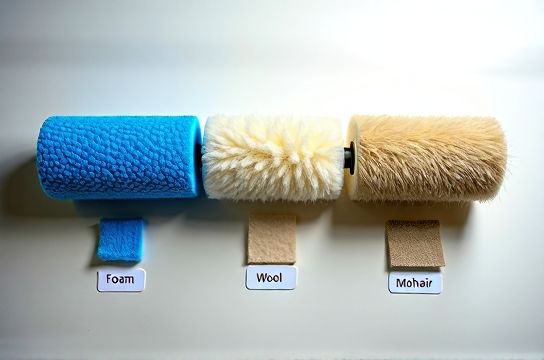
Foam rollers (typically polyurethane or polyester-blend) have zero nap — just a smooth, closed-cell skin. They hold less paint than fabric rollers, release it quickly, and leave minimal texture. That makes them ideal for: • Smooth, non-porous surfaces: glass, melamine cabinets, metal doors, laminate countertops (with water-based enamel) • High-gloss or semi-gloss finishes where stipple is unacceptable • Touch-ups and small-area work (e.g., baseboard edges, window mullions)
But foam has hard limits. It’s not absorbent enough for thick paints (like oil-based satin or heavily pigmented chalk-style formulas). It also compresses under pressure — causing uneven film thickness if you lean too hard. And crucially: foam degrades fast with solvent-based cleaners or repeated reuse. One clean cycle often cracks the cell structure; by the second use, it leaves micro-bubbles in the film.
Real-world note: In a 2025 builder survey across 12 midwestern markets, 78% of contractors reported abandoning foam for whole-wall interior jobs after noticing 12–15% higher touch-up labor (Updated: May 2026). They reserve it strictly for cabinetry and trim.
H3: Wool Rollers — The All-Rounder Workhorse
Wool (usually 70% sheep wool / 30% synthetic blend) remains the most widely recommended material for general interior painting. Its crimped, dense fibers create capillary action that pulls paint deep into the pile, then releases it steadily under light pressure. Key strengths: • Excellent paint retention: holds ~25% more volume than same-size foam (per ASTM D4213 test protocol, Updated: May 2026) • Self-leveling action: natural fiber elasticity helps smooth out lap marks during overlapping strokes • Broad nap compatibility: available in 3/8”, 1/2”, 3/4”, and 1” lengths — letting you match surface profile
Wool excels on standard drywall, plaster, and lightly textured ceilings. It handles flat, eggshell, and satin sheens predictably. But avoid it with high-viscosity paints (e.g., heavy-body acrylics or epoxy primers) — fibers can trap air pockets, leading to pinholes. Also, low-grade wool blends shed — look for minimum 65% wool content and a tight, uniform weave (not fluffy or loose).
H3: Mohair Rollers — Precision for Demanding Surfaces
Mohair — hair from the Angora goat — is finer, stronger, and more resilient than sheep wool. Commercial mohair roller covers are typically 90–95% mohair with nylon reinforcement. They’re pricier (2–3× wool), but justified when: • Painting glossy or metallic finishes (e.g., Benjamin Moore Aura Bath & Spa, Sherwin-Williams Emerald Urethane Trim Enamel) • Working on ultra-smooth surfaces like skim-coated drywall or concrete overlays • Applying delicate glazes or faux finishes where brush marks must be invisible
Mohair’s straight, slender fibers produce near-zero stipple and resist loading with excess paint — critical when working with slow-drying, high-solids enamels. Unlike wool, it doesn’t swell or soften significantly in water, so edge control stays sharp longer. Downside? It’s overkill for flat ceilings or budget repaints. And because it’s so fine, it clogs faster with unstrained paint — always filter latex through an 80-micron mesh before pouring.
H2: Matching Material to Surface — A No-Guess Decision Tree
Forget ‘one size fits all.’ Use this field-tested logic:
• Smooth drywall or plaster (flat/satin): Wool (3/8” nap) — balances speed, coverage, and affordability • Popcorn or knockdown ceilings: Wool (3/4” nap) — deeper pile grabs texture without skipping • Brick, stucco, or rough concrete: Wool (1” nap) — but only if using a heavy-bodied masonry paint; otherwise, switch to a textured roller sleeve with rigid polymer fibers • Cabinet doors (melamine or thermofoil): Foam (4” or 6” mini-roller) — paired with a 2” angled brush for edges • Glossy trim or moldings: Mohair (3/8”) — prevents haloing and ensures reflective uniformity • Rental turnover touchups: Wool (3/8”) — fastest ROI for consistent, professional-looking coverage across mixed surfaces
Note: Nap length matters *more* than material on highly textured substrates. A 1” mohair won’t outperform a 1” wool on stucco — both will load inconsistently. Save mohair for where smoothness, not depth, is the challenge.
H2: Cost vs. Performance — When to Upgrade (and When Not To)
Budget-conscious DIYers often ask: “Is mohair worth $18 vs. $6 wool?” Here’s the math:
A standard 9” wool roller cover costs $5.99 and lasts 1–2 medium rooms (≈ 400–600 sq ft total, assuming proper cleaning and storage). Replacing it every 2 jobs = $6/year for typical home maintenance.
A mohair cover costs $17.99 but lasts 4–5 jobs (due to fiber resilience and solvent resistance) — averaging $3.60/job. So yes, it pays off *if* you regularly paint trim, cabinets, or high-visibility areas. But if you’re repainting one bedroom every 3 years? Stick with wool.
Foam sits in the middle: $3.49 for a 6” roller, but usable for only 1 job (or 2 *if* you’re doing only cabinet doors and wipe it immediately after). Its value is in eliminating brush strokes — not longevity.
H2: What to Avoid — Common Pitfalls & Fixes
• Using cheap ‘wool-blend’ rollers labeled “premium” — many contain <40% wool and >50% polyester. They heat up fast, lose shape after 15 minutes, and leave roller lines. Fix: squeeze the pile firmly — real wool springs back; polyester stays compressed.
• Assuming ‘longer nap = better coverage’ — a 1” nap on smooth drywall causes spatter, poor release, and excessive paint waste. Fix: match nap to surface profile, not room size.
• Washing rollers in hot water — shrinks wool fibers, loosens glue bonds, and invites mildew in stored cores. Fix: rinse in cool water, spin excess in a clean towel, hang to air-dry *vertically* (not coiled).
• Skipping pre-wetting — dry wool absorbs first coat paint like a sponge, starving the surface. Always dampen (not soak) before loading.
H2: Quick-Reference Comparison Table
| Property | Foam | Wool (70/30) | Mohair (95/5) |
|---|---|---|---|
| Avg. Cost (9" roller) | $3.49 | $5.99 | $17.99 |
| Typical Lifespan (jobs) | 1 | 1–2 | 4–5 |
| Best For Sheen | Gloss, Semi-Gloss | Flat, Eggshell, Satin | Gloss, Metallic, Glaze |
| Max Recommended Surface Texture | Smooth only | Moderately textured | Ultra-smooth only |
| Cleanability (Water-Based) | Poor — degrades after 1 wash | Good — 2–3 rinses if done promptly | Excellent — withstands solvents & scrubbing |
| Rental-Ready Suitability | Low — limited to trim/cabinets | High — best balance of speed & finish | Moderate — overqualified for walls, perfect for trim |
H2: Putting It All Together — Your Next Project Checklist
Before buying a single roller cover, ask: 1. What’s the substrate? (Drywall? Plaster? Brick? Melamine?) 2. What’s the paint sheen and base? (Flat latex? Oil-based gloss? Epoxy primer?) 3. How large is the area — and how visible is the result? (Garage ceiling vs. living room feature wall) 4. Will I reuse the cover? If yes, prioritize wool or mohair — skip foam.
Then pick: • Foam → only for smooth, non-porous, small-area gloss work • Wool → default for 90% of interior wall/ceiling projects — choose nap based on texture • Mohair → reserved for high-end trim, cabinets, or specialty finishes where imperfection isn’t acceptable
And remember: no roller cover fixes bad prep. Sanding, priming, and taping still matter more than fiber type. But choosing right the first time means fewer coats, less frustration, and results that hold up — whether you’re refreshing your own space or prepping a unit for tenants. For a complete setup guide covering rollers, brushes, trays, and extension poles — all sized for common apartment and house layouts — visit our full resource hub.