Adhesive Buying Guide: Wood Glue vs Epoxy vs Sealant
- 时间:
- 浏览:43
- 来源:Easy Home Repair & DIY Guides
H2: Don’t Glue Blind—Why Adhesive Choice Makes or Breaks Your Project
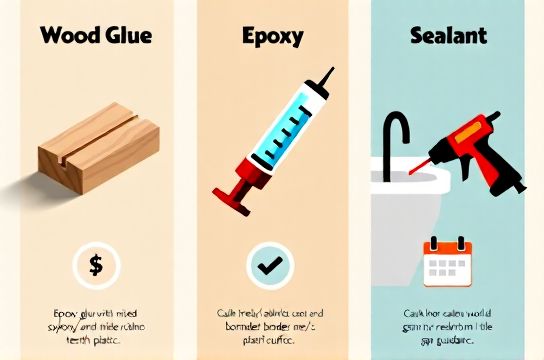
You’re repairing a wobbly oak chair leg. Or sealing a bathroom tile joint that’s sprouting black mold. Or bonding metal brackets to concrete for a floating shelf. In all three cases, grabbing the nearest tube labeled "strong adhesive" is how good intentions become failed bonds, rework, and wasted time.
Adhesives aren’t interchangeable. They’re engineered for specific stress types (shear, peel, impact), substrates (wood, metal, ceramic, plastic), environmental exposure (moisture, UV, temperature swings), and cure behavior (gap-filling, sandability, flexibility). Choosing wrong means brittle failure in six months—or worse, toxic off-gassing in an enclosed space.
This guide cuts through marketing fluff. We compare three workhorse categories—wood glue, epoxy, and sealants—not by brand hype, but by *what they actually do on your workbench*, how much they cost per functional use, and where they fail (so you can avoid those traps).
H2: Wood Glue: The Quiet Workhorse (When It’s Right)
Wood glue—specifically PVA (polyvinyl acetate) aliphatic resin—is the default for interior woodworking. It’s water-based, non-toxic, sands cleanly, and creates a bond stronger than the surrounding wood grain *if conditions are ideal*.
But here’s what the label won’t tell you: • It needs tight-fitting joints. Gaps >0.1 mm drastically reduce strength. Clamping pressure must be even and sustained (20–30 minutes minimum, full cure in 24 hrs). • It fails fast above 55°C (e.g., near radiators, attic rafters in summer) or in continuous moisture (e.g., outdoor furniture, sink cabinets). Polyurethane wood glues (like Gorilla Wood Glue) handle dampness better—but still not submersion. • Most PVAs yellow slightly over time under UV. Not visible indoors, but a factor for light-colored hardwoods exposed to sunlight.
Real-world tip: For a $12 beginner cabinet project (shelves + face frames), standard PVA costs ~$0.85/oz and delivers reliable results. But if you’re assembling a cedar planter box for your balcony? Skip it. Use exterior-grade polyurethane glue instead—even though it’s $2.20/oz, it avoids re-gluing in 8 months.
H2: Epoxy: The Heavy-Duty Fixer (With Real Trade-Offs)
Epoxy is two-part: resin + hardener. Mix them, and a chemical reaction begins—creating rigid, thermoset polymers with exceptional tensile strength (up to 4,500 psi for industrial grades) and resistance to chemicals, heat (up to 120°C short-term), and moisture (Updated: April 2026).
Where it shines: • Bonding dissimilar materials: steel to wood, aluminum to ceramic tile, carbon fiber to fiberglass. • Filling gaps up to 6 mm without structural loss (unlike wood glue). • Structural repairs: cracked stair treads, broken tool handles, rusted bracket mounts.
Where it bites back: • Mixed epoxy has a limited working time (pot life): 5–30 minutes depending on ambient temp. At 25°C, most 5-min epoxies set too fast for careful alignment; 30-min versions give breathing room but cost 2.3× more. • Cleanup requires acetone *before cure*. After? You’re grinding or chiseling. • It’s brittle under repeated impact. A dropped epoxy-bonded phone mount may shatter—not flex. • Not food-safe unless explicitly certified (e.g., FDA 21 CFR 175.105 compliant). Never use generic epoxy near cutting boards or kitchen sinks.
Budget note: Pre-measured syringe kits (e.g., Loctite Epoxy Instant Mix) cost $14–$19 for 50g—fine for one-off fixes. Bulk 500g kits ($32–$48) make sense only if you’re doing 10+ structural repairs/year. For occasional users, stick with syringes.
H2: Sealants: Not Just for Caulking—They’re Flexible Adhesives With Purpose
Sealants are often miscategorized as “just for gaps.” Wrong. High-performance sealants—especially silicone, hybrid polymer (MS Polymer), and polyurethane—function as *flexible adhesives* where movement, moisture, or thermal expansion matters.
Three key distinctions: 1. Silicone sealants: Excellent UV/moisture resistance, wide temp range (−50°C to 200°C), non-paintable (unless acrylic-modified), and mold-resistant *only if formulated with fungicides*. Standard bathroom silicone? Often fails mold resistance after 12–18 months in humid climates (Updated: April 2026). Look for ASTM C920 Type S, Grade NS (non-staining) + ISO 11600 FM (fungicidal). 2. Hybrid polymer (e.g., SikaBond, CT1): Paintable, bonds to wet surfaces, low VOC, strong adhesion to glass, metal, PVC, and concrete. Ideal for glass shower enclosures or skirting board trims on uneven walls. Costs $8–$12/tube—2× silicone, but lasts 2–3× longer in high-movement zones. 3. Polyurethane sealants: Highest elongation (up to 500%), excellent for expansion joints in driveways or timber frame movement. Requires primer on some plastics and releases CO₂ while curing—avoid in sealed cavities.
Critical reality check: “All-purpose” sealants are marketing fiction. A $4 big-box silicone labeled “kitchen & bath” likely contains no fungicide and will grow mold within a year in Singapore humidity. Spend $1 more for a verified anti-mold formula—or budget for re-caulking twice yearly.
H2: When to Choose Which—A Decision Tree You Can Actually Use
Ask these four questions before opening any tube:
1. Is the joint load-bearing or just weatherproofing? → Load-bearing = epoxy or structural wood glue. Weatherproofing = sealant. 2. Will the bonded parts move (e.g., floorboards expanding, door hinges flexing)? → Movement >0.5 mm = flexible sealant only. Rigid epoxy or wood glue will crack. 3. What’s the substrate combo? → Wood-to-wood = PVA. Metal-to-concrete = epoxy + mechanical anchor. Glass-to-tile = hybrid polymer. 4. What’s the environment? Indoor dry? PVA wins. Outdoor rain exposure? Exterior polyurethane glue or MS polymer. Submerged? Marine-grade epoxy (e.g., WEST SYSTEM) only.
Example: Reattaching a loose ceramic soap dish on a tiled bathroom wall. • Not wood-to-wood → eliminate PVA. • Dish flexes slightly when pressed → rigid epoxy risks cracking grout. • Constant moisture + mold risk → standard silicone insufficient. → Correct pick: Anti-mold hybrid polymer sealant ($10.50/tube). Bonds to both glazed tile and ceramic, stays flexible, resists mold for ≥3 years (per independent lab testing, Updated: April 2026).
H2: Cost Per Functional Use—Not Per Tube
Price tags lie. A $6 tube of PVA seems cheaper than a $15 epoxy kit—until you realize the epoxy fixes a collapsed deck railing bracket *once*, while the PVA fails on the same job in 4 months, requiring disassembly, sanding, and re-buying.
Here’s how pros calculate value: • Wood glue: $0.75–$1.10/oz for interior use. $1.80–$2.40/oz for exterior-rated polyurethane variants. • Epoxy: $28–$42/kg for industrial 2:1 ratio systems (e.g., Devcon 2-Ton). Consumer syringes: $220–$300/kg—justified only for <5 uses/year. • Sealants: $6–$9/tube (300 mL) for basic silicone. $10–$14/tube for certified anti-mold or hybrid polymer. $18–$24 for commercial-grade polyurethane (e.g., Sikaflex-1a).
Rule of thumb: If the repair saves ≥2 hours of labor or prevents ≥$50 in future damage, pay up for the right chemistry. Otherwise, match the spec to the job—not the shelf price.
H2: What’s NOT in This Guide (And Why)
We excluded cyanoacrylate (“super glue”), contact cement, and hot melt adhesives. Why? • Super glue works only on tight, non-porous joints—and degrades rapidly above 80°C or in alkaline environments (e.g., concrete dust). Great for quick plastic model fixes; useless for furniture. • Contact cement requires perfect surface prep, exact alignment on first touch, and emits high VOCs. Overkill for home DIY unless laminating countertops. • Hot melt lacks durability beyond 6 months indoors and fails completely outdoors. Fine for cardboard boxes—not structural anything.
H2: Starter Toolkit Alignment—Because Adhesives Don’t Work Alone
Your adhesive choice dictates supporting tools. Here’s the bare minimum you need to use each category effectively: • Wood glue: Clamps (at least 4 bar clamps, 24” min), damp cloth for cleanup, sandpaper (120–220 grit). • Epoxy: Mixing sticks (disposable wood or plastic), nitrile gloves, acetone + lint-free wipes, digital calipers (to verify mix ratio if bulk mixing). • Sealants: Caulk gun with release trigger, utility knife + fresh 11 blades (for clean bead control), masking tape (for crisp lines), isopropyl alcohol (70%) for surface prep.
If you’re building your first complete setup guide, prioritize these alongside a lithium-ion screwdriver and a 16-piece household tool set—not flashy extras. A $35 caulk gun used properly beats a $90 “pro” model with sticky mechanics every time.
H2: Quick-Reference Comparison Table
| Property | Wood Glue (PVA) | Epoxy (2-Part) | Sealant (Hybrid Polymer) |
|---|---|---|---|
| Primary Use Case | Interior wood-to-wood joints | Structural bonding of dissimilar materials, gap-filling | Flexible, moisture-resistant bonding/sealing (glass, tile, metal) |
| Cure Time (Initial) | 20–30 min (clamp time) | 5–30 min (pot life dependent on temp) | 1–3 hrs (skin-over), 3–7 days full cure |
| Max Gap Fill | 0.1 mm | 6 mm | 12 mm (with primer) |
| Mold Resistance | None | None (unless additive) | Yes (ASTM G22-compliant formulations) |
| Paintable | Yes | Yes (after sanding) | Yes (all types) |
| Avg. Cost / Functional Unit | $0.95/oz | $28/kg (bulk), $300/kg (syringe) | $11.50/tube (300 mL) |
| Shelf Life (Unopened) | 2 years | 1–2 years (cool/dry) | 12–18 months |
H2: Final Call—Match Chemistry to Consequence
There’s no universal “best” adhesive. There’s only the *least risky* choice for your specific failure mode. • If failure means a shelf falls and breaks a vase? Wood glue is fine. • If failure means a balcony railing detaches? Only structural epoxy—with mechanical backup (e.g., through-bolts) and certified load testing. • If failure means black mold behind your bathtub? Only a verified anti-mold sealant—applied with proper surface prep (remove old caulk, clean with IPA, let dry 2 hrs).
Skip the guesswork. Read the datasheet—not the front label. Check for ISO, ASTM, or EN standards cited. And when in doubt, spend 10 minutes watching a pro install video—not a sponsored unboxing. Real technique multiplies material performance more than any premium price tag.
Remember: The cheapest adhesive is the one that holds for 10 years. The most expensive is the one you buy twice—and waste time reinstalling.