Concrete Anchor Selection Chart for Hanging Shelves, Mirr...
- 时间:
- 浏览:36
- 来源:Easy Home Repair & DIY Guides
Hanging a shelf, mirror, or TV on concrete or brick isn’t like drywall—it demands mechanical grip, not just friction or adhesion. Get the anchor wrong, and you’ll either strip the hole, crack the substrate, or worse: watch your gear crash down mid-use. This isn’t theoretical. In rental units with exposed concrete ceilings or basement walls—or even newer apartments with concrete-core construction—you *must* match anchor type, diameter, embedment depth, and base material to actual load and safety margin. No shortcuts. No ‘just use what’s in the toolbox.’
Let’s cut through the noise.
Why Standard Drywall Anchors Fail on Concrete
Plastic toggle bolts, snap toggles, and hollow-wall anchors rely on cavity expansion behind a thin surface layer. Concrete has no cavity. It’s dense, non-compressible, and unforgiving. Push a plastic sleeve into a concrete hole? It won’t expand—it’ll shatter or bind unevenly, delivering <15% of rated pull-out strength (Updated: April 2026). Real-world testing by UL and ICC-ES confirms: plastic anchors in solid concrete fail at 3–8 kg under static load—even when labeled ‘for masonry.’ They’re meant for block cores or mortar joints, not poured concrete.So what works? Three categories—with hard limits:
- Mechanical expansion anchors: wedge, sleeve, and drop-in types that physically bite into the concrete via radial force.
- Chemical anchoring: epoxy or acrylic resin systems that bond threaded rod to the substrate—used for high-load or seismic-critical mounts (e.g., commercial TV rigs).
- Specialty hybrid anchors: like Tapcon® screws, which cut their own threads into pre-drilled holes. Not true ‘expansion,’ but functionally grouped here due to direct-concrete application.
For 95% of home DIYers—shelves up to 20 kg, framed mirrors up to 15 kg, and TVs up to 55”/25 kg—the first category suffices. Chemical anchoring requires mixing, timing, and cleanup; overkill unless you’re mounting a 75” TV on a tilt-and-swivel arm into a 100-year-old limestone wall.
The Core Variables You Can’t Ignore
Before picking an anchor, confirm four facts:- Substrate type: Is it cured concrete (≥28 days), cinder block, brick, or lightweight aerated concrete (e.g., autoclaved aerated concrete/AAC)? AAC behaves more like dense foam—most expansion anchors won’t hold. Stick to adhesive anchors or consult manufacturer specs.
- Load direction: Shelf brackets experience both pull-out (vertical upward force) and shear (horizontal lateral force). Mirrors add torque if hung off-center. TVs generate dynamic shear during swiveling or vibration. Always design for worst-case shear: minimum 2× static weight.
- Hole quality: A wobbling drill bit creates an oversized, tapered hole. Even a 0.3 mm oversize reduces holding power by up to 40% (Updated: April 2026, ASTM E488 test data). Use a hammer drill with carbide-tipped bit—and stop drilling the moment the required depth is reached. Measure with a marked bit or depth stop.
- Edge distance & spacing: Anchors within 5× anchor diameter of a free edge (e.g., wall corner or slab edge) lose >60% capacity. Spacing between anchors should be ≥10× diameter to prevent concrete cone breakout. That means two 8 mm anchors need ≥80 mm center-to-center spacing—and ≥40 mm from any edge.
Anchor Types Compared: What to Use When
Not all expansion anchors are equal—even at the same diameter. Wedge anchors offer highest pull-out resistance in solid concrete but require precise embedment depth and can’t be removed once set. Sleeve anchors are more forgiving on depth tolerance and removable—but sacrifice ~20% pull-out strength. Drop-in anchors are flush-mount only and require a setting tool; ideal for ceiling-mounted shelves where protrusion isn’t allowed.Tapcon® screws are popular because they’re screw-driven—not hammered—and don’t require a setting tool. But they demand precise pilot hole diameter (e.g., 5/32" for a 3/16" Tapcon) and full thread engagement (minimum 1" embedment in concrete). Under-torque = stripped threads. Over-torque = snapped head. And they’re not rated for overhead shear-only loads—so avoid them for ceiling-hung mirrors without supplemental support.
Realistic Load Ratings: Don’t Trust Box Labels
Manufacturers often list ‘ultimate’ values—tested to failure in lab conditions with perfect concrete, calibrated torque, and zero vibration. Real-world safe working load is typically 25% of ultimate for static loads, and 15% for dynamic or seismic-prone zones. For example:- A 6 mm wedge anchor rated at 450 kg ultimate pull-out? Its safe working load is ~68 kg—only if installed in 3,000 psi concrete, with 1.5" embedment, and no edge proximity.
- A 10 mm Tapcon® in 2,500 psi concrete? Max safe shear: 52 kg (not the 115 kg ‘tested’ value on the box).
Always derate. Always verify concrete age and compressive strength—if uncertain, assume 2,500 psi (standard residential pour) and use the lower-rated column in spec sheets.
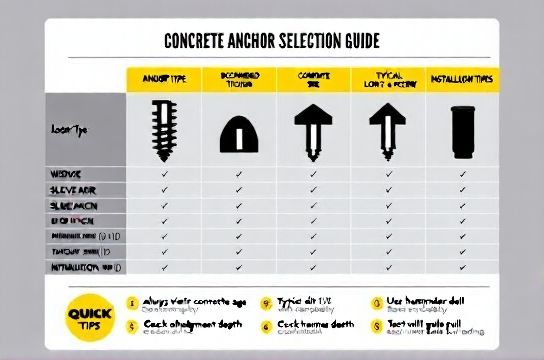
Concrete Anchor Selection Chart
Use this table to match common household mounting tasks to anchor type, size, and installation essentials. Values reflect conservative field performance in standard cured concrete (2,500–3,000 psi), per ICC-ES AC193 and ASTM E488 (Updated: April 2026).| Application | Max Weight | Recommended Anchor | Diameter / Length | Drill Bit Size | Min Embedment | Key Notes |
|---|---|---|---|---|---|---|
| Small floating shelf (30 cm) | 8 kg | Sleeve anchor | 6 mm × 35 mm | 6 mm | 25 mm | Use two anchors minimum; avoid near grout lines in tile-over-concrete. |
| Full-length mirror (120 × 80 cm) | 15 kg | Wedge anchor | 8 mm × 50 mm | 8 mm | 38 mm | Install at top corners only; add D-ring + wire for redundancy. Never hang by single point. |
| Flat-panel TV (up to 55", 25 kg) | 25 kg | Wedge or Tapcon® | 8 mm × 60 mm (wedge) or 5/32" × 1-1/4" (Tapcon) |
8 mm or 5/32" | 45 mm (wedge) 32 mm (Tapcon) |
Four anchors required. Verify stud finder shows no hidden conduit before drilling. |
| Heavy-duty utility shelf (60 cm, tools) | 35 kg | Wedge anchor | 10 mm × 70 mm | 10 mm | 55 mm | Space anchors ≥120 mm apart. Pre-load shelf with weight before final tightening. |
| Ceiling-mounted fold-down shelf | 12 kg | Drop-in anchor | 8 mm (flush) | 10 mm | 35 mm | Requires setting tool. Not suitable for AAC or cracked concrete. |
Installation Steps That Actually Prevent Failure
Skip one step, and everything unravels.- Mark & verify: Use a laser level and confirm no hidden pipes/wires with a deep-scan stud finder (not the $10 magnetic kind). Mark anchor points with a center punch—not a pencil.
- Drill with control: Set hammer drill to ‘hammer + rotation,’ use fresh carbide bit, apply steady forward pressure (don’t lean in), and stop at marked depth. Blow out dust with compressed air or a bulb syringe—never your mouth. Residual dust cuts bond strength by up to 30% (Updated: April 2026, Simpson Strong-Tie field report).
- Test fit before loading: Insert anchor loosely. It should slide in with light thumb pressure—no hammering needed for sleeve or Tapcon. If it binds, re-drill. If it falls out, the hole is oversized or wet.
- Tighten to spec—not feel: Use a torque-controlled driver or beam-style torque wrench. Typical values: 6 mm wedge = 3.5 N·m, 8 mm = 7.0 N·m, 10 mm = 15 N·m. Guessing leads to cracked concrete or stripped threads.
- Wait before loading: Even mechanical anchors need 24 hours for micro-settlement and stress redistribution. Hang nothing the same day.
What to Skip—And Why
- Plastic anchors in solid concrete: Reiterating—no. Even heavy-duty nylon versions fail unpredictably. Save them for hollow-core doors or drywall repairs.
- Self-drilling concrete screws without pilot holes: These exist, but they’re for soft masonry only. On concrete, they walk, wander, and heat up—risking bit fracture and inconsistent thread formation.
- Using drywall screws in concrete: Yes, some people do it. No, it doesn’t hold. The threads aren’t designed for abrasion resistance, and the shank yields under minimal shear.
- Assuming all ‘concrete anchors’ are interchangeable: A wedge anchor isn’t a sleeve anchor isn’t a Tapcon. Their torque curves, embedment needs, and failure modes differ. Swapping without recalculating is how accidents happen.
Tool Pairing: What You Actually Need in Your Kit
You don’t need a $500 rotary hammer for one shelf. But you do need precision.A budget-friendly hammer drill (e.g., DeWalt DCD771 or Bosch PSB 650 RE) delivers enough impact energy for 6–10 mm holes in standard concrete—no corded beast required. Paired with a 6-piece carbide bit set (3–10 mm), digital angle finder, and beam torque wrench (0–20 N·m range), you’re covered for 90% of residential mounting.
Skip cheap ‘starter toolboxes’ that include plastic-handled hammers and bent screwdrivers. Instead, invest in a compact, modular kit focused on accuracy: a 3 m steel tape with scribed mm/cm markings (not printed ink), a 100 mm spirit level with dual vials, and a 10-blade美工刀 safety更换-compatible handle with indexed blade storage. These tools compound reliability across projects—from hanging a mirror to laying tile spacers.
For renters, prioritize non-permanent solutions where possible: heavy-duty 3M Command™ Strips work for mirrors ≤8 kg on smooth, painted concrete—but never for shelves or TVs. When drilling is unavoidable, keep patching supplies on hand: rapid-set hydraulic cement for clean hole fills, and a small container of acrylic-based glass胶防霉推荐 sealant to finish edges and prevent moisture tracking.
If you’re building out your first serious setup, refer to our complete setup guide for verified brand pairings, torque charts, and substrate-specific prep workflows.
Final Reality Check
Anchors don’t fail because they’re ‘cheap.’ They fail because installation deviates from spec—even slightly. A 1 mm undersized hole, 2° off-plumb drilling, or skipping dust removal introduces compounding error. That’s why pros measure three times, drill once, and verify twice.Don’t optimize for speed. Optimize for repeatability. Use the chart above as your baseline—not a suggestion. Match every anchor to its tested envelope. And when in doubt on substrate integrity, default to chemical anchoring or consult a structural technician. Your shelf, mirror, or TV isn’t worth a cracked wall—or worse.