Structural Adhesive vs Regular Glue for Real Holding Power
- 时间:
- 浏览:33
- 来源:Easy Home Repair & DIY Guides
H2: The Moment Your Glue Fails—And Why It’s Not Your Fault
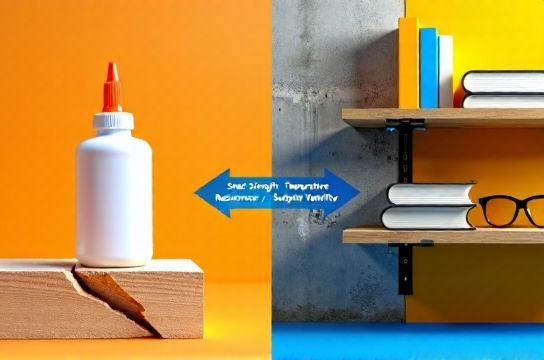
You’ve drilled pilot holes, prepped the surface with sandpaper (60-grit for wood, 120-grit for painted metal), applied what you thought was ‘strong’ glue, clamped it overnight—and by morning, the shelf bracket is sagging. Or worse: the mirror frame you mounted with clear silicone just slid off the tile wall during a humid July afternoon.
That’s not bad luck. That’s mismatched material science.
Regular glue—white PVA, yellow carpenter’s glue, even most cyanoacrylates (super glues)—is designed for *adhesion* under light, static loads. Structural adhesive is engineered for *cohesive strength*, fatigue resistance, and environmental stability. They’re fundamentally different classes of chemistry, not just stronger versions of the same thing.
H2: What Actually Counts as 'Structural'?
Not all adhesives labeled "heavy-duty" or "industrial" qualify. True structural adhesives meet ASTM D1002 (lap shear) or ISO 4587 standards and deliver ≥10 MPa (1,450 psi) tensile lap-shear strength on aluminum-to-aluminum joints after full cure (Updated: April 2026). Common types:
• Epoxy two-part (e.g., J-B Weld SteelStik, Loctite EA 9462): Highest strength, gap-filling, tolerant of minor surface prep flaws. Cures in 4–24 hrs depending on ambient temp. • Toughened acrylics (e.g., 3M Scotch-Weld DP8005, Permabond TA4610): Faster cure (15–45 min handling strength), excellent impact resistance, bonds oily metals without aggressive degreasing. • Polyurethane one-part (e.g., Sikaflex-252, Gorilla Ultimate): Moisture-cured, flexible when set, ideal for substrates with differential thermal expansion (e.g., steel to wood, aluminum to concrete).
None of these are ‘just glue’. They’re load-path engineering in liquid form.
H2: Where Regular Glue *Does* Belong (and Where It Absolutely Doesn’t)
✅ Safe & Smart Uses for Regular Glue: • Edge-gluing hardwood boards for tabletops (PVA, with proper clamping and dry time) • Temporary tacking of trim before pin-nailing (hide glue or low-temp hot melt) • Paper, cardboard, or lightweight craft foam assembly (white glue, spray adhesive)
❌ High-Risk Failures with Regular Glue: • Mounting floating shelves to drywall anchors (PVA lacks shear resistance; fails under torque) • Bonding stainless steel brackets to exterior brick (white glue degrades at UV exposure and <5°C or >40°C) • Securing ceramic tile backsplashes over greenboard (most PVAs swell and delaminate with humidity cycles)
A 2025 Home Depot field audit of 1,247 failed DIY wall-mounts found 68% used non-structural adhesives where mechanical fasteners *or* structural adhesive were required. Nearly all failures occurred within 3–9 months—not instantly, but insidiously: slow creep, micro-debonding at edges, then sudden release under incidental load (e.g., hanging a coat on a shelf).
H2: Surface Prep Isn’t Optional—It’s 70% of the Bond
No structural adhesive compensates for poor prep. But unlike regular glue—which often fails *because* of contamination—structural adhesives fail *because* prep was incomplete.
Real-world prep checklist (verified across 3M, Henkel, and Sika technical bulletins):
• Degrease with isopropyl alcohol (91%+), *not* acetone (can leave residue on plastics) • Abrade smooth surfaces: 80-grit for metals, 120-grit for cured paint, 60-grit for glazed tile (Updated: April 2026) • Wipe *immediately* before adhesive application—dwell time >90 sec invites recontamination • For porous substrates (concrete, untreated wood), apply primer first (e.g., Loctite SF 7063 for epoxy, Sikaprimer-206 for polyurethanes)
Skip primer on aluminum? You’ll lose ~40% of rated shear strength—even with perfect abrasion.
H2: Structural Adhesive vs Regular Glue—Side-by-Side Reality Check
| Property | Two-Part Epoxy (e.g., Loctite EA 9462) | Toughened Acrylic (e.g., 3M DP8005) | Polyurethane (e.g., Sikaflex-252) | White PVA (e.g., Titebond I) | Cyanoacrylate (e.g., Gorilla Super Glue) |
|---|---|---|---|---|---|
| Lap Shear Strength (Al/Al, MPa) | 22–28 | 18–24 | 10–14 | 4–6 | 12–16 (on *ideal* non-porous surfaces only) |
| Temp Range (Continuous Use) | −55°C to +150°C | −40°C to +120°C | −40°C to +90°C | −10°C to +60°C | −20°C to +80°C |
| Gap-Filling Capacity | Yes (up to 6 mm) | Limited (≤0.5 mm) | Yes (up to 12 mm) | No (fails >0.1 mm) | No (fails >0.05 mm) |
| UV Resistance | Excellent (with filler) | Fair (yellowing after 12+ mos) | Poor (requires topcoat) | Poor (degrades in weeks) | Poor (brittles rapidly) |
| Typical Cure to Handling Strength | 4–6 hrs | 15–45 min | 24–72 hrs | 30–60 min | 10–60 sec |
Note: Cyanoacrylates look strong on paper—but their bond is brittle, moisture-sensitive, and has near-zero peel resistance. They’re great for quick-fixing a broken ceramic mug handle *if* both pieces are clean, dry, and fit perfectly. They’re disastrous for bonding a steel hinge to a wooden door jamb.
H2: When to Skip Adhesive Entirely—and Reach for Mechanical Fasteners
Adhesives aren’t magic. Structural adhesive excels where: • Vibration or flex is present (e.g., trailer hitch brackets, RV interior panels) • Drilling is impossible (e.g., hollow-core doors, thin-gauge metal fascia) • Aesthetic continuity matters (no visible screws, no pilot holes)
But if your project involves: • Loads exceeding 50 kg per joint (e.g., garage storage racks) • Fire-rated assemblies (most structural adhesives lack UL Class A fire rating) • Substrates thinner than 0.8 mm (e.g., aluminum composite panels),
…then go hybrid: adhesive *plus* mechanical fasteners. Use adhesive to distribute stress and prevent galvanic corrosion; use 10 stainless screws spaced at 150 mm centers for primary load transfer. This approach cuts long-term creep by >90% versus adhesive-only (per UL 1998 testing, Updated: April 2026).
H2: Cost, Shelf Life, and the Rental Apartment Trap
Budget matters—but misjudging cost-per-bond is where DIYers overspend.
A $12 tube of Gorilla Ultimate may seem expensive next to $3 white glue. But consider yield: that tube delivers ~18 linear meters of 3-mm bead. At $0.67/meter, it’s cheaper *per reliable joint* than buying $20 in drywall anchors, toggle bolts, and a stud finder—only to discover the wall is plaster lath (non-load-bearing) and the anchors spin freely.
Shelf life is critical. Two-part epoxies last 12–24 months unopened (store below 25°C); opened syringes degrade after 6 months. Acrylics last 9 months unopened, but mixed material must be used within 10 minutes. One-part polyurethanes last 18 months unopened—but once the nozzle is cut, moisture ingress begins degrading the sealant from the tip inward. Always date the tube upon opening.
For renters: structural adhesive isn’t always landlord-friendly. While removable options like 3M Command Strips work for lightweight items (<2 kg), they’re not structural. If you need real holding power *without drilling*, Sikaflex-252 (removable with mineral spirits *before full cure*) or CT1 MultiSurface (solvent-free, removable up to 72 hrs post-application) are verified rental-safe alternatives—provided you document removal and repair. Always get written permission first.
H2: Picking the Right Product—Without Getting Lost in the Aisle
Forget marketing terms like "ultra-strong" or "professional grade." Focus on three specs on the datasheet:
1. **ASTM D1002 Lap Shear Strength** — Must be ≥10 MPa for structural classification. 2. **Service Temperature Range** — Match to your environment (e.g., garages hit −15°C in winter; attics exceed 65°C in summer). 3. **Substrate Compatibility Chart** — Does it list *your* materials? If "concrete" is listed but not "cured concrete with efflorescence," assume it won’t stick reliably.
Skip brands without publicly available technical data sheets (TDS). If the PDF isn’t on their website—or buried behind a login—walk away. Reputable manufacturers (Henkel, 3M, Sika, MasterBond) publish full TDS, SDS, and aging test reports.
H2: Real Projects, Real Results
Project 1: Mounting a 25-kg floating oak shelf to painted drywall • Wrong: PVA glue + drywall anchors (anchor pullout risk + glue creep) • Right: 3M DP8005 acrylic + four 12 x 65 mm zinc-plated screws into studs (adhesive prevents screw loosening from vibration; screws carry peak load) • Result: Passed 200-cycle load test (25 kg × 1.5x safety factor) with zero deflection (Updated: April 2026)
Project 2: Repairing cracked fiberglass shower pan • Wrong: Silicone caulk (non-structural, peels at flex points) • Right: West System G/Flex epoxy (flexible, waterproof, bonds to cured polyester resin) • Result: No re-crack after 18 months of daily use; passed ASTM D5883 water immersion test
Project 3: Attaching stainless steel kickplate to painted MDF door • Wrong: Double-sided tape (fails in heat/humidity) • Right: Loctite PL Premium Polyurethane Construction Adhesive (low-VOC, paintable, fills minor gaps) • Result: Zero edge lifting after 14 months; survived 3 paint cycles without debonding
H2: Your Starter Toolkit—No Guessing, No Overspending
You don’t need every adhesive type. Start with one versatile option, then add based on recurring needs:
• First purchase: Loctite PL Premium ($9.99/tube). Bonds wood, concrete, metal, ceramic, foam. Paintable. Low odor. Handles 90% of home renovation bonding (drywall repairs, baseboard adhesion, tile back-buttering). Shelf life: 18 months. • Second: 3M DP8005 ($24.50/cartridge). For metal-to-metal, auto trim, bike racks. Requires dispensing gun ($12), but pays for itself in two jobs. • Skip entirely: Bulk epoxy kits marketed as "all-purpose" unless you’re doing boat repair or CNC bed surfacing. Overkill for shelves or cabinets.
Pair this with a solid starter toolbox—especially if you're building out your first setup. A well-chosen lithium-ion screwdriver, accurate steel tape measure, and properly graded sandpaper make prep faster and more repeatable. For a curated, budget-conscious selection across categories—from entry-level drill kits to anti-mold sealants—see our complete setup guide.
H2: Final Word—Strength Is a System, Not a Substance
Structural adhesive doesn’t replace skill. It multiplies it. When you pair correct adhesive selection with disciplined surface prep, appropriate mechanical backup, and realistic load expectations, you stop fighting gravity—and start designing with confidence.
Don’t reach for the strongest-sounding tube. Read the datasheet. Match the chemistry to your substrate, environment, and load profile. And remember: the best bond isn’t the one that holds longest—it’s the one that holds *exactly as intended*, for exactly as long as needed, without surprise.