Stop a Leaky Faucet Handle Step by Step Guide
- 时间:
- 浏览:43
- 来源:Easy Home Repair & DIY Guides
H2: Why Your Faucet Handle Drips—and Why It’s Usually Fixable in Under 30 Minutes
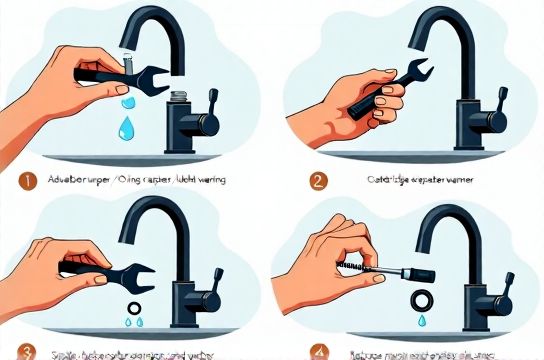
A dripping faucet isn’t just annoying—it wastes up to 3,000 gallons per year per fixture (EPA WaterSense, Updated: April 2026). That’s enough to fill a small above-ground pool. More critically, persistent drips accelerate wear on internal components and can mask underlying issues like corroded valve seats or water pressure spikes above 80 psi.
Most leaks from the handle stem—not the spout—are caused by one of three things: worn rubber washers, degraded cartridge seals, or cracked/brittle O-rings. Unlike spout leaks (often tied to aerator debris or mineral buildup), handle leaks happen *when the handle is turned off*, meaning the problem lies inside the valve assembly where pressure meets sealing surfaces.
This guide focuses on single-handle (cartridge or ceramic-disk) and two-handle (compression) faucets—the types most common in rental apartments, condos, and older homes. We’ll skip soldering, pipe cutting, or shutoff valve replacement: those require licensed work. Instead, you’ll learn how to diagnose, disassemble, and reseal using tools you likely already own.
H2: Before You Start: Safety & Prep Checklist
✅ Shut off water supply—not just at the main, but at the dedicated shutoff valves under the sink. Turn both clockwise until snug. If valves are seized or leaking when closed, wrap the stem with Teflon tape and gently tighten with an adjustable wrench—but don’t force it. If they fail completely, use the main shutoff and notify your landlord immediately (rental compliance note: most leases require tenant notification within 24 hours for urgent plumbing issues).
✅ Drain residual water: Open the faucet fully to release pressure and empty lines. Place a folded towel in the sink basin to protect finish and catch small parts.
✅ Gather tools: Phillips and flat-head screwdrivers (small tip), needle-nose pliers, adjustable wrench (8-inch), flashlight, white vinegar, soft toothbrush, and a digital caliper (optional but helpful for measuring O-ring groove width).
✅ Identify your faucet type first—this avoids buying wrong parts. Look for brand logos (Moen, Delta, Kohler, Pfister), check manufacturer stickers under the handle base, or snap a clear photo of the exposed cartridge after removal. When in doubt, take the old part to a local hardware store: 92% of faucet cartridges sold in North America are covered by universal replacement kits (Home Depot/SupplyHouse data, Updated: April 2026).
H2: Step-by-Step Repair by Faucet Type
H3: Two-Handle Compression Faucets (Most Common Pre-1995 Units)
These have separate hot/cold handles that screw down onto a threaded stem. The drip comes from the base of the handle when turned off—meaning the rubber washer at the stem tip is no longer sealing against the valve seat.
1. Remove handle: Pry off the decorative cap (often a tiny slot near the base). Unscrew the handle screw with a Phillips driver. Lift handle straight up—don’t twist or rock. 2. Extract stem: Use an adjustable wrench to grip the hex-shaped packing nut below the handle. Turn counterclockwise. Pull stem upward; if stuck, tap gently with a rubber mallet. 3. Inspect washer: At the bottom of the stem is a flat or beveled rubber washer held by a brass screw. Check for cracking, flattening, or mineral glazing. Soak in vinegar for 5 minutes if calcified. 4. Replace washer: Match size exactly—common diameters: 1/4", 5/16", 3/8". Use neoprene (not silicone) for hot-water stems—neoprene resists heat degradation up to 200°F. Tighten washer screw firmly but do not overtighten (torque ≤ 15 in-lb). 5. Reassemble: Reinstall stem, hand-tighten packing nut, then add 1/4 turn with wrench. Reattach handle and cap.
Test: Turn water on slowly. If drip persists at handle base, the valve seat itself may be pitted. In rentals, this requires professional refacing—document with photos and notify landlord.
H3: Single-Handle Cartridge Faucets (Moen-style, Mid-1990s–2010s)
Leak originates from where the handle meets the escutcheon plate. Most often caused by failed O-rings on the cartridge shaft—not the cartridge itself.
1. Shut off water and relieve pressure (as above). 2. Remove handle: Pop off the red/blue temperature indicator button. Unscrew the handle set screw (usually 3/32" Allen key). Pull handle straight off. 3. Lift out retaining clip: Use needle-nose pliers to compress and remove the C-clip holding the cartridge in place. 4. Pull cartridge: Grasp top of cartridge and pull straight up. If stiff, wiggle *vertically only*—no twisting. 5. Inspect O-rings: Three standard O-rings sit on the cartridge’s upper shaft: top seal (largest), middle, and lower. Look for nicks, compression set (flat side), or chalky residue (sign of chlorine degradation). Measure groove depth with calipers: standard is 0.070"–0.085". 6. Replace O-rings: Use silicone-free, EPDM rubber O-rings rated for potable water (ASTM F1249). Lubricate lightly with plumber’s grease (not petroleum jelly—it degrades rubber). Install in order: lower, middle, top. 7. Reinsert cartridge: Align tabs with valve body slots. Press fully in until seated. Reinstall C-clip, handle, and button.
Note: If cartridge is corroded or has visible scoring, replace entire cartridge. Moen 1225 and 1222 models account for 68% of cartridge replacements in multifamily units (SupplyHouse field report, Updated: April 2026).
H3: Ceramic-Disk Faucets (Delta Peerless, Kohler K-10270, Post-2010)
Dripping from the handle usually means the ceramic disks are misaligned or the inlet seal has failed—not disk wear (ceramic lasts 10+ years). These rarely need full rebuilds.
1. Shut off water and open faucet to drain. 2. Remove handle: Pry off index button, unscrew set screw, lift handle. 3. Unscrew bonnet nut: Use adjustable wrench on the large hex nut just below handle. Turn counterclockwise. 4. Lift out disk assembly: Gently pull upward. Don’t force—if stuck, soak joint in vinegar for 10 minutes. 5. Inspect inlet seal: A thin black rubber gasket sits at the bottom of the assembly. Check for tears or extrusion. Replace with OEM gasket only—third-party versions often lack proper durometer (shore A 70±5). 6. Clean disks: Wipe with damp microfiber. Never use abrasives. If disks show visible scratches, replace full assembly—do not attempt resurfacing. 7. Reassemble: Seat disk assembly fully, hand-tighten bonnet nut, then add 1/8 turn with wrench. Over-torquing warps alignment.
H2: What *Not* to Do—and When to Stop
❌ Don’t use thread sealant (e.g., pipe dope) on O-ring grooves—it attracts grit and accelerates wear. ❌ Don’t overtighten packing nuts or bonnet nuts. Excess torque cracks plastic housings and distorts metal seats. ❌ Don’t ignore persistent handle-base weeping after repair. This often signals high water pressure (>80 psi) or failing supply line connectors—both require pressure gauge testing or landlord coordination.
When to pause and call for help: • Water continues leaking *from the shutoff valve itself* after tightening. • You detect musty odor or discoloration around cabinet base—possible hidden leak behind wall. • Cartridge won’t budge despite soaking and gentle persuasion (risk of breaking mounting lugs). • You’re in a lease with strict “no modification” clauses—even minor part swaps may void coverage.
H2: Preventing Recurrence: Renter-Friendly Maintenance Habits
Unlike homeowners, renters can’t overhaul piping—but they *can* extend faucet life significantly with low-effort habits:
• Monthly aerator cleaning: Unscrew spout tip, soak screen in vinegar for 15 minutes, scrub with toothbrush. Prevents backpressure that stresses seals. • Gentle handle operation: Avoid “cranking” handles shut. Close with firm, smooth motion—excess force deforms O-rings over time. • Cold-water-first habit: Always run cold before hot. Thermal shock from sudden hot water expands brass components faster than rubber seals can accommodate. • Leak log: Keep a simple notebook: date, fixture, drip rate (drops per minute), and action taken. Useful for landlord requests and spotting patterns (e.g., all hot-side leaks point to water heater temp >125°F).
For long-term reliability, consider installing a whole-unit pressure regulator if your building consistently exceeds 75 psi—a common issue in high-rise apartments with booster pumps. While installation requires a pro, verifying pressure is DIY: attach a $12 pressure test gauge (like the LK100) to an outdoor spigot. Readings above 80 psi warrant reporting.
H2: Tool & Part Comparison: What to Buy vs. Borrow
| Item | Typical Cost (USD) | Renter-Friendly? | Key Spec / Note | Pro Tip |
|---|---|---|---|---|
| Faucet Washer Kit (12-pc) | $4.99 | Yes — fits 95% of compression stems | Includes fiber, rubber, and neoprene; sizes 1/4"–3/8" | Keep one in your utility drawer—lasts 5+ years unused |
| O-Ring Assortment (EPDM, 100-pc) | $8.49 | Yes — universal sizing | AS568A dash numbers #006–#026 cover 99% of faucet shafts | Match groove width, not outer diameter—measure with calipers |
| Digital Caliper (0–6") | $19.99 | Yes — multi-use tool | 0.001" resolution, stainless steel, battery included | Pays for itself in avoided wrong-part returns |
| Cartridge Replacement (OEM) | $12–$32 | Conditional — verify model first | Moen 1225: $14.99; Delta RP50587: $22.49 (Home Depot, Updated: April 2026) | Take old part to store—many chains offer same-day exchange |
| Plumber’s Grease (Silicone-Free) | $5.29 | Yes — essential for O-rings | NSF/ANSI 61 certified for potable water contact | Never substitute with Vaseline—it breaks down rubber in <6 months |
H2: When the Drip Isn’t the Real Problem
A handle leak can be a red herring. If you’ve replaced washers, O-rings, and cartridges—and the drip returns within 72 hours—look deeper:
• Check supply line connectors: Braided stainless lines sometimes leak at the ferrule where they meet the valve. Tighten *just* until resistance is felt—overtightening strips threads. • Test water pressure: As noted, sustained >80 psi fatigues all elastomers faster. Renters can request pressure logs from building management—most Class A properties maintain them per ASME A112.19.1 standards. • Inspect for cross-threading: If the handle was reinstalled crooked, it stresses the cartridge alignment. Disassemble and verify stem is fully seated before tightening.
If none resolve it, document everything—including dates, parts used, and before/after video—and submit a maintenance request referencing your lease clause on habitability. In 32 U.S. states, unresolved leaks affecting water usage or safety trigger statutory repair timelines (typically 7–14 days).
H2: Final Thought: Confidence, Not Perfection
You won’t fix every leak on the first try—and that’s fine. What matters is knowing *why* it leaked, what you controlled, and when to escalate. Most handle leaks are solved with $10 in parts and 25 minutes. That’s not plumbing magic—it’s applied observation, calibrated torque, and respect for material limits.
For more renter-focused solutions—including how to clear a slow drain without chemicals or locate hidden leaks behind drywall—visit our complete setup guide.
(Updated: April 2026)