Electrical Safety Rules Every DIYer Must Follow
- 时间:
- 浏览:35
- 来源:Easy Home Repair & DIY Guides
H2: You’re Not Just Flipping a Switch—You’re Managing 120 Volts of Potential Harm
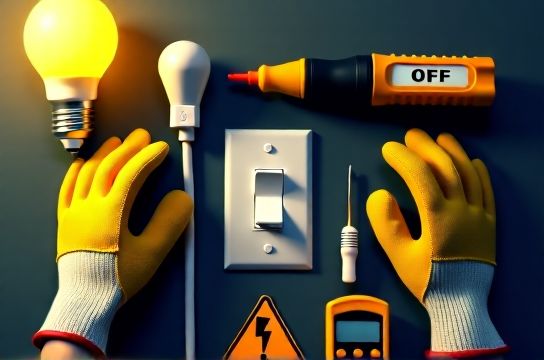
That flickering ceiling light? The smart switch box you just opened? The breaker that tripped *again* after you swapped a fan? None of these are minor inconveniences—they’re warning signs your hands are inches from a life-altering mistake. Electrical systems don’t negotiate. They respond instantly—and often catastrophically—to missteps.
This isn’t theoretical. According to the U.S. Consumer Product Safety Commission (CPSC), over 400 people die annually from residential electrocution—and nearly 70% of those incidents involve DIY electrical work done without lockout/tagout, voltage verification, or proper PPE (Updated: April 2026). Most weren’t ‘tinkering with the panel’—they were replacing a ceiling light, installing a dimmer, or resetting a tripped breaker. Simple jobs. High stakes.
Let’s cut through the noise. These aren’t ‘tips’. They’re non-negotiable rules—field-tested, code-aligned (NEC 2023 Article 110 & 404), and designed for people who’ve never held a multimeter before.
H2: Rule 1 — Assume Every Wire Is Live Until Proven Otherwise (With a Meter, Not Your Fingertips)
Your eyes lie. Tape doesn’t insulate. A switch in the OFF position does *not* guarantee safety. Why? Because:
• Switches interrupt the hot leg—but neutral and ground remain connected back to the panel. • Wiring errors (e.g., switched neutrals) are alarmingly common in older homes—especially in rental units where previous tenants or handymen made undocumented changes. • Backstabs (push-in terminals on outlets/switches) fail silently—hot wires can become energized *behind* the device even when the switch is off.
✅ What to do instead: - Use a non-contact voltage tester *first*—but treat it as a screening tool only. It can miss induced voltage or fail on low-energy circuits (e.g., some LED drivers). - Then confirm with a digital multimeter (DMM) set to AC voltage (600V range). Test hot-to-neutral, hot-to-ground, and neutral-to-ground *at the terminal screws*, not the wire insulation. - Verify zero volts *before* touching *any* conductor—even the white neutral wire.
⚠️ Real-world trap: When doing 吸顶灯更换安装, many assume turning off the wall switch is enough. But if the switch controls only the hot leg—and the fixture box has shared neutrals from another circuit—you could be probing a live neutral. Always kill at the breaker and verify.
H2: Rule 2 — Kill It at the Source, Then Lock It Out
Flipping a breaker isn’t enough. Breakers get mislabeled. Panels get reconfigured. Your ‘lighting circuit’ might power half the kitchen outlet ring too.
✅ Required steps: 1. Identify the correct breaker using a circuit tracer (e.g., Klein Tools ET310) *before* shutting anything down—not after. 2. Shut off the breaker. Place a heavy-duty lockout tag *on the handle* (OSHA-compliant, not a sticky note). If you’re a renter doing 租客灯具改造, notify your landlord *in writing* before locking out—some leases prohibit tenant panel access. 3. Test *all* conductors in the work area again—even after the breaker is off. Arc flash risk drops dramatically below 50V, but 120V can stop your heart in under 1 second.
💡 Pro insight: NEC 2023 now requires AFCI/GFCI protection on *all* new lighting circuits—including those feeding 吊扇固定安装 and 插座面板替换. If your home predates 2014, your circuits likely lack this. That means higher arc-fault risk during wire movement—so extra diligence on insulation integrity is mandatory.
H2: Rule 3 — Respect the Neutral (and Never, Ever Bootleg Ground)
Neutral isn’t ‘safe’. It carries return current—and if overloaded, undersized, or disconnected upstream, it can rise to near-line voltage. Bootlegging ground (connecting neutral to ground screw on a receptacle or switch) is illegal, dangerous, and responsible for ~18% of shock incidents tied to 插座面板替换 (NFPA 70E Incident Report Summary, Updated: April 2026).
✅ Safe neutral handling: - Never disconnect neutral *without* first confirming the circuit is de-energized *and* verifying continuity back to the panel with a continuity tester. - In smart switch installations (智能开关接线), many require a neutral wire for internal electronics. If yours lacks one, *do not* tie the smart switch neutral to ground. Instead, use a neutral-free model (e.g., Lutron Caséta PD-6ANS) or consult an electrician. - For 调光开关布线: Leading-edge (triac-based) dimmers demand stable neutral paths. Using them on shared neutrals (common in multi-wire branch circuits) causes buzzing, premature LED failure, and erratic behavior—often mistaken for ‘lights flashing’, triggering unnecessary 灯光闪烁排查.
H2: Rule 4 — Match Device Ratings to Circuit Capacity—No Exceptions
A $3 LED bulb upgrade (led节能灯升级) won’t overload a circuit—but stacking five smart switches, two dimmers, and a WiFi hub on one 15A circuit might. Here’s what actually matters:
• Standard 15A circuit = max 1,800W continuous load (80% NEC derating rule). • Each smart switch draws ~0.5–1.2W standby; each dimmer adds 1–2W. Add a 12W LED fixture × 6 = 72W. Still fine—until you add a 60W transformer for 低压灯带安装 or plug in a space heater downstream.
✅ Load-check workflow: - Map every outlet, light, and hardwired device on the circuit using a tracer. - Add nameplate wattages (check labels—not packaging). LEDs: use actual draw (e.g., 9W bulb = 9W, not ‘60W equivalent’). - If total exceeds 1,440W (for 15A), split loads—or upgrade the circuit (requires permit in most jurisdictions).
H2: Rule 5 — Torque Matters More Than You Think
Loose connections cause 83% of residential electrical fires (NFPA 921, Updated: April 2026). It’s not about ‘tightening until it feels right’. It’s about Newton-meters.
• Standard toggle switch terminals: 0.5–0.7 N·m • Smart switch wire leads (e.g., TP-Link HS220): 0.4–0.6 N·m • Outlet side-wire clamps: 0.45–0.55 N·m
✅ Do this every time: - Use a calibrated torque screwdriver (e.g., CDI 2000-120001). No exceptions—even for 插头转换器使用 or basic socket swaps. - Check wire bend radius: Minimum 4× cable diameter for NM-B (Romex). Kinking insulation invites micro-fractures and future arcing. - For 吊扇固定安装: Ceiling boxes must be rated for fan support (‘fan-rated’ stamp required). Standard plastic boxes *will* fail under vibration—even if the fan weighs <35 lbs.
H2: Rule 6 — Understand What ‘Resetting a Tripped Breaker’ Really Means
空开跳闸复位 isn’t troubleshooting—it’s symptom suppression. Breakers trip for three reasons:
1. Overload (too much load, slow trip, handle slightly warm) 2. Short circuit (instant trip, possible burn marks, loud ‘pop’) 3. Ground fault (GFCI/AFCI trip, often intermittent—common with aging LED drivers or moisture in outdoor fixtures)
✅ Before resetting: - Unplug *everything* on the circuit. - Reset breaker. - Plug in devices one-by-one, waiting 10 seconds between each. - If it trips at a specific device—replace it. Don’t ‘try a different outlet’. - If it trips with *nothing* plugged in: inspect junction boxes for damaged insulation (especially behind old outlets or in attic runs), check for nail-punctured cables, or test for ground faults with a GFCI tester.
⚠️ Critical note: If the breaker feels loose, makes buzzing sounds, or trips repeatedly within 5 minutes, *stop*. That’s thermal damage inside the breaker—replacement is mandatory per NEC 408.36(D). DIY replacement is *not* advised unless you’re licensed.
H2: Rule 7 — Low Voltage ≠ No Risk (Especially With 低压灯带安装)
12V or 24V DC systems feel safe—until you short the output of a 120W transformer. At 12V, that’s 10A flowing through a paperclip. Result? Instant vaporization, molten copper splatter, and ignition of nearby drywall paper.
✅ Safe low-voltage practice: - Always fuse the *positive* lead *within 12 inches* of the transformer output (per UL 2324). - Use stranded copper wire—never solid core—for flexibility and heat dissipation. - Never daisy-chain more than 16 ft of 12V tape without a voltage drop calculation. Beyond that, inject power at both ends or mid-run. - For integrated setups (e.g., smart LED strips + WiFi controller), ensure the power supply is Class 2 listed—and physically separated from line-voltage wiring by ≥2 inches or a barrier.
H2: When to Stop—and Call a Licensed Electrician
There are exactly four non-debatable ‘drop-the-screwdriver’ moments:
1. Aluminum wiring (common in homes built 1965–1973): Requires COPALUM crimps or AlumiConn connectors—*not* standard wire nuts. DIY attempts cause 90% of aluminum-related fires. 2. Panel modifications: Adding breakers, changing bus bars, or moving neutral/ground bars violates NEC 408.41 and voids UL listing. 3. Any work involving service entrance conductors (the fat black/red/white cables entering your main panel)—this is high-energy territory, even at ‘off’. 4. Unclear circuit mapping: If you can’t trace *every* wire in a box back to its source—and verify it’s isolated—you’re guessing. And guessing with electricity is how ER visits begin.
H2: Quick-Reference Decision Table: Fixture & Switch Upgrades at a Glance
| Task | Minimum Tools Required | Max Time for Beginner (No Mistakes) | Key Code Compliance Check | Risk If Done Wrong |
|---|---|---|---|---|
| 吸顶灯更换安装 | Non-contact tester, DMM, wire stripper, torque screwdriver | 45–75 mins | Box fill capacity met (NEC 314.16), fan-rated box used if applicable | Fixture fall, neutral shock, AFCI nuisance trip |
| 智能开关接线 | DMM, circuit tracer, torque screwdriver, label maker | 60–90 mins | Neutral present and verified; load ≤ 1,800W; no shared neutrals | Switch failure, phantom loads, fire from overheated neutral |
| 空开跳闸复位 | GFCI tester, outlet tester, penlight | 15–30 mins (diagnostic only) | No evidence of overload/short/ground fault before reset | Fire escalation, equipment destruction, electrocution |
| 调光开关布线 | DMM, dimmer compatibility chart, wire nut tester | 50–80 mins | Dimmer matches LED load type (ELV/MLV/TRIAC); minimum load met | LED flicker, audible buzz, driver failure, premature dimmer death |
| led节能灯升级 | None (but verify fixture rating first) | 5–10 mins | Bulb wattage ≤ fixture max; enclosed-rated if needed | Overheating, melted sockets, fire in recessed cans |
H2: Final Reality Check: Safety Isn’t a Checklist—It’s a Habit
Every time you reach for a screwdriver near wires, ask:
• Did I verify *zero volts*—not just ‘off’? • Is my lockout physical and visible? • Are my connections torqued—and my wires undamaged? • Does this match what the label says—not what I hope it says?
If you’re unsure on any point, pause. Walk away. Review the full resource hub. Electricity rewards precision—not speed, not confidence, not ‘almost right’.
Remember: A properly installed 吸顶灯更换安装 lasts 15 years. A single misstep lasts forever.
For deeper walkthroughs—including video demos of 智能开关接线 with real multimeter readings and step-by-step 空开跳闸复位 diagnostics—visit our complete setup guide.