Drywall Anchor Types Pick the Right One Every Time
- 时间:
- 浏览:41
- 来源:Easy Home Repair & DIY Guides
H2: Why Most Drywall Anchors Fail (Before You Even Hang the Shelf)
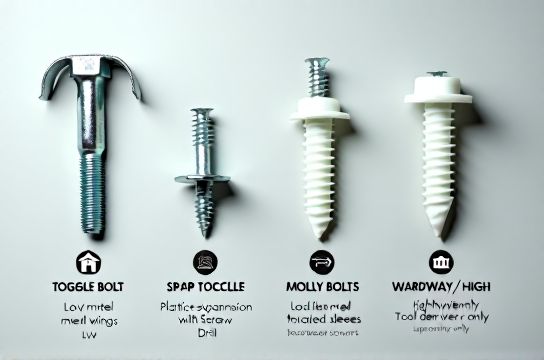
You drill the hole. Tap in the anchor. Drive the screw—and hear that hollow *thunk* as the anchor spins or pulls through. Or worse: the shelf sags after three days. That’s not bad luck. It’s mismatched anchor type + load + drywall condition.
Drywall isn’t structural. It’s a 1/2" (12.7 mm) gypsum sandwich wrapped in paper—rated for ~40–60 psi compressive strength (Updated: April 2026). Its holding power comes entirely from how well the anchor *spreads load behind the face*, not how deep it goes. And because most residential walls have only 3/4"–1" of air or insulation behind them—not solid stud—you can’t rely on screw threads alone.
That’s why anchor selection isn’t about "stronger = better." It’s about matching geometry, deployment method, and material to your exact scenario: weight, wall thickness, access (single-sided vs. double-sided), and whether you’ll ever need to remove it.
H2: The 5 Anchor Families You’ll Actually Use
Forget niche industrial fasteners. These five cover >95% of home projects—from hanging a picture frame to mounting a 32" TV bracket (with proper stud backup).
H3: 1. Plastic Expansion Sleeves (The Budget Staple)
What they are: Hollow, fluted polypropylene or nylon cylinders that expand radially when the screw is driven in.
Best for: Light loads ≤20 lbs (9 kg) — picture frames, small hooks, towel bars.
How they work: Screw threads force the sleeve outward against the drywall cavity. Minimal clamping force; relies on friction and paper face integrity.
Reality check: They’re cheap (~$0.12/unit in bulk), but fail fast if over-torqued or used in old, crumbly drywall. Not reusable. Requires precise hole size (e.g., 1/4" drill bit for a 8 screw anchor). Avoid in bathrooms or humid areas unless rated for moisture (most aren’t).
H3: 2. Self-Drilling Anchors (The No-Prep Shortcut)
What they are: Combination drill-bit-and-anchor units (e.g., EZ Ancor, GripIt Mini). A pointed tip drills its own pilot hole; flanges grip behind the surface.
Best for: Quick jobs where you don’t want to measure or swap bits—rental apartments, temporary setups, low-clearance spots.
How they work: Twist-in action compresses a spring-loaded collar that expands behind the drywall face. Some models include integrated washers to prevent face tear-out.
Reality check: Max load ~35 lbs (16 kg) in standard 1/2" drywall—but drops 40% in 5/8" fire-rated board (Updated: April 2026). Torque-sensitive: too little = loose; too much = collapsed collar. Not ideal for plaster or lath.
H3: 3. Threaded Steel Anchors (Molly Bolts & E-Z Ancor Heavy-Duty)
What they are: Zinc-plated steel sleeves with internal threads and a slotted or hex head. As the screw drives in, the sleeve expands via a split design.
Best for: Medium loads 30–75 lbs (14–34 kg) — floating shelves (light), cabinet hardware, heavier mirrors.
How they work: The screw pulls the sleeve upward, forcing its split ends outward into the drywall cavity. Requires pre-drilled hole (size varies by model—check packaging).
Reality check: More durable than plastic, but installation is fiddly. Over-tightening cracks the drywall face. Removal damages the hole. Not recommended for repeated reuse in same location. Performance degrades in damp environments unless stainless-steel versions are used (rare under $2/unit).
H3: 4. Snap-Toggle Anchors (The Renters’ Secret Weapon)
What they are: Two-piece systems: a breakaway bolt with spring-loaded wings and a receiving nut. Wings snap open behind the drywall when tension is applied.
Best for: Medium-to-heavy loads 50–100+ lbs (23–45+ kg) — flat-panel TVs (up to 55" with stud backup), wall-mounted desks, heavy coat racks.
How they work: Bolt is inserted through drywall, wings deploy behind, then nut is tightened to pull wings flush against the backside. Creates true clamping force—not just friction.
Reality check: Requires ≥1/2" clearance behind drywall (no insulation baffle or conduit in the way). Installation takes longer (3–5 mins per anchor), but holds reliably—even in brittle or patched drywall. Reusable if wings aren’t bent. Top-tier value for long-term rentals: one set handles dozens of future hangs.
H3: 5. Toggle Bolts (The Gold Standard for Heavy Loads)
What they are: Bolt + pivoting metal wings (usually steel or nylon) that fold flat for insertion, then swing open behind the wall.
Best for: Heavy-duty loads 75–150+ lbs (34–68+ kg) — ceiling-mounted bike racks, large whiteboards, built-in shelving brackets.
How they work: Bolt passes through drywall, wings pivot open behind, then tightening draws the bolt head flush and clamps the wall between head and wings.
Reality check: Needs ≥1.5" clearance behind drywall. Nylon wings resist corrosion but flex under high torque; steel wings hold more but risk cutting through drywall if overtightened. Not for thin walls or tight cavities. Overkill for anything under 50 lbs.
H2: How to Choose—Without Guessing
Follow this decision tree:
• Step 1: What’s the *actual* load? Don’t guess. Weigh the item + contents. Add 25% safety margin. A 20-lb bookshelf with books easily hits 30 lbs.
• Step 2: What’s behind the drywall? Use a stud finder with depth mode—or tap and listen. Hollow = plastic/snap-toggle/molly. Solid obstruction <1" deep = avoid toggles. Stud present? Skip anchors entirely—use 2" coarse-thread drywall screws directly into wood.
• Step 3: Do you have access to the backside? If yes (e.g., attic, crawl space), skip anchors—use a furring strip or backing plate screwed to studs, then mount to that.
• Step 4: Will you move it later? Renters: prioritize snap-toggles or self-drilling anchors—they leave smaller, more repairable holes. Avoid molly bolts—they mushroom the backside and require patching.
• Step 5: What tools do you have? Plastic sleeves need only a drill/driver. Snap-toggles need a ratchet or adjustable wrench for the nut. Toggle bolts often need a second person or extension bar to hold the wing while tightening.
H2: Real-World Anchor Comparison
| Anchor Type | Max Load (1/2" Drywall) | Hole Size Required | Installation Time (per unit) | Removable? | Best For Rentals? | Price Range (per unit) |
|---|---|---|---|---|---|---|
| Plastic Expansion Sleeve | 20 lbs | 1/4" | 30 sec | No | Low (damages face on removal) | $0.08–$0.15 |
| Self-Drilling Anchor | 35 lbs | None (self-drills) | 45 sec | Limited (often strips) | Medium (small entry hole) | $0.25–$0.60 |
| Threaded Steel Molly | 60 lbs | 3/16"–1/4" (varies) | 2 min | No (permanent deformation) | Low (bulky backside damage) | $0.35–$0.95 |
| Snap-Toggle | 90 lbs | 3/8" | 3–4 min | Yes (if wings intact) | High (clean exit, minimal patch) | $1.10–$2.40 |
| Metal Toggle Bolt | 130 lbs | 3/8"–1/2" | 5–7 min | Yes (with care) | Medium (larger hole, but repairable) | $1.50–$3.80 |
H2: Pro Tips You Won’t Find on Packaging
• Always test first: Drill one hole in an inconspicuous spot (e.g., inside a closet). Insert anchor, tighten fully, then hang a known weight (e.g., full gallon of water = ~8.3 lbs) for 24 hours. Watch for creep or face dimpling.
• Hole size is non-negotiable: Too small = anchor won’t seat. Too large = no expansion. Use a drill bit gauge—not the anchor’s printed diameter. Many plastic anchors list "8 screw" but require a 1/4" hole, not a 9/64" pilot.
• Avoid vibration traps: Don’t mount ceiling fans, door stoppers, or pet gates with drywall-only anchors. These induce cyclic stress. Either hit a stud or add blocking.
• Humidity matters: In bathrooms or laundry rooms, skip standard zinc-plated mollys. Opt for stainless steel toggles or polymer-based snap-toggles (e.g., WingIts HD). Standard plastic sleeves absorb moisture and weaken over time (Updated: April 2026).
• Patching is part of the plan: Keep spackle, mesh tape, and a 2" putty knife in your complete setup guide. Even the cleanest anchor removal leaves a void. Sand smooth, prime, then paint—don’t just dab on touch-up.
H2: When Anchors Aren’t the Answer
Sometimes the right move is *not* using an anchor at all:
• Hit the stud: A stud finder with AC detection (like the Zircon MultiScanner) finds wood and metal studs—and avoids live wires. One 2" 8 coarse-thread screw into solid pine holds ~100 lbs—no anchor needed.
• Use adhesive alternatives: For lightweight items (<5 lbs), consider high-bond double-sided tape (3M VHB) or construction-grade mounting squares (e.g., Command Large Picture Hanging Strips). They leave zero holes—but require clean, dry, painted surfaces and 1-hour cure time.
• Backing plates: For shelves or racks, cut a 6"×6" scrap of 3/4" plywood. Attach it across two studs with four 3" screws. Then mount your hardware to the plate. Distributes load, eliminates anchor fatigue, and survives multiple relocations.
H2: Final Call—Which Anchor Should You Buy *Today*?
If you’re building a starter toolkit: Get a mixed pack—20 plastic sleeves (for frames), 10 self-drilling anchors (for quick hooks), and 4 snap-toggles (for anything over 40 lbs). Pair them with a basic lithium-ion drill/driver (see our complete setup guide for budget drill kit recommendations that include clutch control—critical for avoiding anchor blowout).
If you rent: Prioritize snap-toggles and self-drillers. Skip mollys and standard toggles—they’re harder to remove cleanly and increase deposit-risk repairs.
If you’re mounting something critical (TV, child’s swing set, shelving): Verify cavity depth first. If less than 1", use a backing plate or stud-mount. If ≥1", go with snap-toggles—and always pair with at least one stud-mounted anchor for redundancy.
Anchors aren’t magic. They’re engineered compromises. But when you match type to physics—not marketing copy—you stop fighting the wall and start building with confidence.