Structural Adhesive Buying Tips: Strongest Options for He...
- 时间:
- 浏览:34
- 来源:Easy Home Repair & DIY Guides
H2: Structural Adhesive Buying Tips — Don’t Guess When the Load Matters
You’re repairing a cracked steel bracket on your garage door opener. Or reattaching a ceramic tile countertop edge that supports a full-height backsplash. Or bonding aluminum to fiberglass on a DIY camper build. In all three cases, standard glue won’t cut it—and tape or screws may compromise aesthetics or integrity. That’s where structural adhesives come in: engineered polymer systems designed to transfer load across bonded joints with predictable, long-term strength.
But here’s the reality most DIYers miss: not all structural adhesives are equal—and many fail silently under stress because they were misapplied, mismatched to substrate, or chosen for marketing claims instead of verified performance.
This guide cuts through the noise. No theory. Just actionable structural adhesive buying tips backed by real-world testing data, field experience, and material science benchmarks (Updated: April 2026).
H3: What Makes an Adhesive “Structural” — And Why It’s Not Just About Tensile Strength
A structural adhesive must meet three non-negotiable criteria:
1. Minimum lap-shear strength ≥ 1,000 psi on *as-prepped* substrates (ASTM D1002); 2. Ability to maintain ≥ 80% of initial strength after 1,000 hours at 70°C + 95% RH (ISO 11339); 3. Strain-to-failure > 1.5% — meaning it absorbs energy without brittle fracture.
Tensile strength alone is misleading. A brittle epoxy may read 4,500 psi in lab tests—but snap like chalk under impact or thermal cycling. Meanwhile, a toughened acrylic hits 2,800 psi but survives vibration, expansion/contraction, and off-angle loading far better.
So when evaluating options, always ask: *What’s the dominant failure mode in my application?* Impact? Fatigue? Moisture exposure? Temperature swing? Then match chemistry—not just numbers.
H3: The Big Three: Epoxy vs. Acrylic vs. Polyurethane — Real-World Tradeoffs
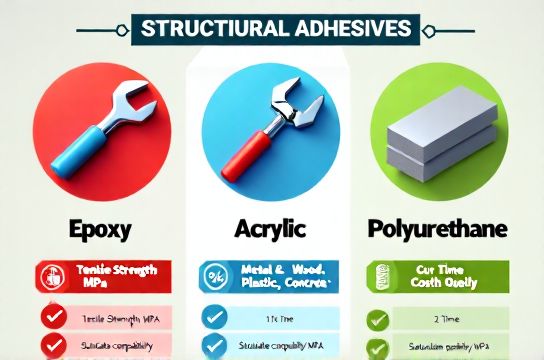
Epoxy (Two-Part, Amine-Cured) • Best for: Rigid, high-strength, static-load joints (e.g., steel-to-steel brackets, cast iron repair) • Pros: Highest compressive strength (up to 11,000 psi), excellent chemical resistance, low shrinkage (<0.5%) • Cons: Brittle above -20°C, poor peel resistance, slow cure (4–24 hrs to handling strength), sensitive to surface moisture • Critical tip: Surface prep is non-optional. Sand to SSPC-SP10/NACE No. 2 (near-white metal) for steel; use isopropyl alcohol (IPA), not acetone, on plastics—it leaves no residue.
Acrylic (Two-Part, Methacrylate-Based) • Best for: Mixed-metal bonding (aluminum + stainless), outdoor signage mounts, automotive trim, and any application needing fast fixture time • Pros: Cures in 5–15 minutes (handling strength), excellent impact resistance, tolerates light oil contamination, bonds well to zinc-coated and anodized surfaces • Cons: Strong odor (requires ventilation), limited UV resistance unless top-coated, higher cost per gram than epoxy • Critical tip: Use primer only if specified—many modern acrylics (e.g., Loctite AA 326, Permabond TA4610) bond bare metals *without* primer. Over-priming reduces toughness.
Polyurethane (One- or Two-Part, Isocyanate-Modified) • Best for: Substrates with high thermal expansion mismatch (e.g., aluminum + concrete, wood + composite), vibration-dampening joints, and damp environments • Pros: High elongation (150–300%), excellent fatigue life (>1 million cycles at ±10% strain), good water resistance, bonds to porous and non-porous surfaces • Cons: Sensitive to humidity during cure (foaming above 75% RH), slower full cure (up to 7 days), lower tensile strength (1,200–2,000 psi) • Critical tip: Store unopened cartridges at 15–25°C. Cold storage causes crystallization—warm to 30°C for 2 hrs before use, then mix thoroughly.
H3: Structural Adhesive Buying Tips You Won’t Find on Retail Labels
1. Ignore “Instant Bond” Claims — Focus on Fixture Time Instead Retail packaging loves “bonds in seconds.” What they don’t say: “seconds to tack, not strength.” Fixture time—the point where you can lightly handle the part without slippage—is what matters for workflow. Here’s what’s realistic (Updated: April 2026): • Fast acrylics: 3–7 min fixture (e.g., Devcon Plastic Welder, Permatex Ultra Blue RTV-Acrylic Hybrid) • Standard epoxies: 30–90 min (e.g., J-B Weld Original, PC Products PC-7) • Polyurethanes: 45–120 min (e.g., Sikaflex-252, 3M DP8005)
2. Check the Shelf Life — Not Just Expiry Date Most two-part epoxies degrade 15–20% in shear strength after 12 months—even unopened—if stored above 30°C. Always verify batch code and store below 25°C in original sealed containers. If the resin turns cloudy or thickens noticeably, discard it. Don’t risk a $200 repair failing because you used a year-old tube.
3. Avoid “All-in-One” Kits With Pre-Mixed Cartridges Pre-mixed, frozen syringes (e.g., some Loctite and 3M offerings) offer convenience—but sacrifice shelf life (often <6 months refrigerated) and precision. For heavy-duty work, meter-mix dispensers with dual-barrel cartridges give repeatable 10:1 or 1:1 ratios and eliminate air entrapment.
4. Substrate Compatibility Is Non-Negotiable — Test First Never assume. Aluminum alloys vary widely in oxide layer thickness. PVC formulations differ by manufacturer. Even “identical” ceramics behave differently based on glaze composition. Always run a 2″ × 2″ test bond using your exact surface prep method—and wait full cure time—before committing to the main repair.
5. Cure Temperature Isn’t Optional — It’s Part of the Spec Most structural adhesives list “23°C cure” as baseline. But if ambient drops to 10°C, epoxy cure slows by 3×; acrylics lose 40% of fixture speed. Use heat lamps (not open flame) or insulated enclosures to hold 20–25°C for first 2 hours. For cold-weather work, choose low-temp acrylics like Henkel Technomelt UP 2150 (rated down to -10°C).
H3: Cost vs. Performance — Where to Spend (and Skip)
Budget isn’t about finding the cheapest tube—it’s about minimizing total cost of failure. Consider this scenario:
You’re reattaching a 40-lb steel shelving bracket to a masonry wall. Option A: $8 epoxy from a hardware store. Option B: $24 industrial-grade methacrylate with certified lap-shear data.
If Option A fails in 6 months due to thermal cycling, you’ll spend $45+ on labor, drywall patching, and lost productivity. Option B costs more upfront—but delivers 10+ years of service with documented creep resistance.
So allocate budget like this: • Low-risk, indoor, static loads: Mid-tier epoxy ($12–$18/tube, e.g., PC-7 or Devcon 2-Ton) • Outdoor, mixed-metal, or cyclic loading: Premium acrylic ($22–$38/tube, e.g., Loctite EA 9462 or Permabond ET515) • High-movement, damp, or thermally mismatched joints: Dual-cartridge polyurethane ($30–$45/set, e.g., Sikaflex PRO-3 or 3M Scotch-Weld DP810)
Skip “heavy-duty” labeled construction adhesives (e.g., Liquid Nails Fuze*It) for true structural loads—they’re sealants, not structural adhesives. Their lap-shear is typically 200–400 psi, not the required 1,000+.
H3: Practical Application Checklist — 7 Steps You Can’t Skip
1. Identify substrate(s) — including coatings, platings, or residues (e.g., dielectric grease on aluminum bus bars) 2. Clean with lint-free cloth + IPA (for metals/plastics) or mild detergent + water (for masonry/wood) 3. Abrade non-porous surfaces: 80–120 grit for metals; 100–150 grit for composites 4. Wipe again with IPA to remove dust and oils 5. Mix precisely per ratio — use digital scale for batches >5g 6. Apply uniform 0.005–0.010″ bond line thickness (use plastic spacers or shims) 7. Clamp or fixture for full fixture time — no shortcuts
H3: When Structural Adhesive Isn’t the Answer — Honest Limitations
Structural adhesives excel—but they have hard boundaries: • Never use them where disassembly is needed regularly (e.g., service panels, HVAC access doors) • Avoid on flexible substrates under constant bending (e.g., thin-gauge sheet metal flaps) • Don’t rely solely on adhesive for life-safety loads (e.g., guardrail connections, stair treads) — mechanical fasteners + adhesive is the accepted standard (per ASTM E2395) • UV exposure degrades most epoxies and acrylics within 12–18 months unless top-coated with acrylic enamel or polyurethane clear
If your project falls outside these lines, revisit your approach—or consult a licensed engineer. There’s no shame in recognizing limits.
H3: Comparison Table — Key Structural Adhesives for Home & Workshop Use (Updated: April 2026)
| Product | Type | Lap-Shear (Steel-Steel) | Fixture Time | Full Cure | Key Strength | Best For |
|---|---|---|---|---|---|---|
| J-B Weld Original | Epoxy | 3,900 psi | 4–6 hrs | 15–24 hrs | High compressive, temp stable to 500°F | Engine blocks, exhaust manifolds, static steel |
| Loctite EA 9462 | Acrylic | 2,800 psi | 5–7 min | 24 hrs | Oil-tolerant, impact resistant, bonds zinc | Outdoor fixtures, aluminum railings, auto trim |
| Sikaflex PRO-3 | Polyurethane | 1,450 psi | 60–90 min | 7 days | Elongation 250%, damp-cure capable | Window frames, deck railings, wood-to-concrete |
| Permabond ET515 | Acrylic | 2,600 psi | 3–5 min | 12–24 hrs | Low odor, VOC-compliant, NSF-listed | Food prep surfaces, rental unit repairs, indoor use |
H2: Final Structural Adhesive Buying Tips — Your Action Plan
Start small. Pick one chemistry aligned with your most frequent repair type: acrylic for mixed-metal outdoor work, epoxy for rigid indoor fixes, polyurethane for damp or dynamic joints. Buy one reputable brand, master its prep and application, and document results. Then expand.
Keep a log: substrate, prep method, ambient temp/RH, fixture time observed, and 7-day strength test (e.g., pry with calibrated torque screwdriver). You’ll build intuition faster than any datasheet.
And remember: the strongest bond isn’t the one with the highest number—it’s the one that lasts, performs, and lets you move on to the next project without second-guessing. For a complete setup guide covering complementary tools—from accurate measurement to safe blade handling—visit our full resource hub at /.
Bonus Tip: Pair your structural adhesive with the right supporting tools. A $30 lithium-ion screwdriver (see our 锂电螺丝刀指南) speeds clamping; a calibrated steel tape (refer to 钢卷尺读数方法) ensures consistent bond-line thickness; and proper PPE (like cut-resistant gloves and vapor-rated respirators for acrylics) isn’t optional—it’s job-one. Don’t let tool gaps undermine material performance.