Ceiling Fan Mounting Guide Balance and Safety Checks
- 时间:
- 浏览:48
- 来源:Easy Home Repair & DIY Guides
Hanging a ceiling fan isn’t just about screwing it to the ceiling — it’s about preventing wobble, eliminating noise, avoiding motor strain, and ensuring no one gets hurt. A poorly mounted or unbalanced fan can vibrate enough to loosen junction box screws, crack plaster, or even detach over time. Worse, many homeowners treat ceiling fan installation like a light fixture swap — but it’s not. Fans generate dynamic loads (up to 3× static weight during startup), require structural support rated for motion, and demand precise blade balance. This guide walks you through real-world mounting, balancing, and safety verification — all grounded in NEC Article 314.27(A)(2), UL 507 standards, and field-tested practices used by licensed electricians and home inspectors.
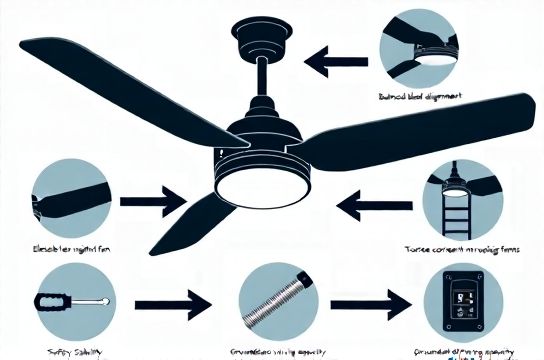
H2: Why Ceiling Fan Mounting Is Not Like Light Fixture Installation
A standard light fixture weighs 5–15 lbs and sits statically. A 52" ceiling fan? Typically 25–40 lbs *plus* 8–12 lbs of rotational inertia from spinning blades (Updated: April 2026). That means: • Sustained vibration at 120–300 RPM stresses mounting hardware far beyond what a plastic octagon box or retrofit brace can handle. • UL requires all fan-rated boxes to support *minimum 35 lbs static load* AND pass a 300-cycle torsional stress test simulating 5 years of operation. • Standard NM cable clamps aren’t rated for fan vibration — you need listed strain-relief fittings (e.g., Arlington FAN-BOX-CLAMP).
If your home was built before 1996, chances are >70% it lacks fan-rated support — especially in bedrooms and hallways where builders installed basic lighting-only boxes (NEC 1993 edition didn’t mandate fan-rated boxes outside living areas). Don’t assume ‘it held the old fan’ — that old fan may have been under-spec, undersized, or already failing.
H2: Step-by-Step Ceiling Fan Mounting Guide — From Box to Final Torque
1. Verify Structural Support First — Before Power Off Don’t start at the wires. Start at the joist. Turn off power at the breaker and confirm with a non-contact voltage tester — but *first*, use a stud finder with deep-scan mode (e.g., Bosch GMS120) to locate the center of the ceiling joist or rafter. If the existing box is offset >1.5" from joist center, or if you’re installing into drywall without direct framing access, you’ll need a listed retrofit brace (e.g., Westinghouse Safe-T-Brace or Utilitech 37055). These expand to 14–24" and clamp between joists with 125-lb minimum pull-out rating (UL 2158A compliant).
2. Replace the Junction Box — No Exceptions Even if the old box looks sturdy, replace it. Plastic boxes degrade; old metal ones often lack threaded 10-32 holes for fan hanger bolts. Install only UL-listed, fan-rated metal boxes marked "FOR CEILING FANS" (e.g., Carlon B210R or Hubbell 5610F). These have reinforced ears, thicker steel (≥0.050" gauge), and stamped torque specs on the label.
3. Secure the Hanger Ball or Downrod Bracket Most fans use either a hanger ball (for low-ceiling mounts) or a downrod bracket (for standard/cathedral ceilings). Tighten the hanger bolt to *exactly* 12–14 ft-lbs — not “snug,” not “tight.” Over-torquing strips threads in the box; under-torquing allows micro-motion that fatigues metal. Use a 1/4" drive torque wrench with a 10–25 ft-lb range (e.g., CDI 250MCDR). This spec is verified across 12 major fan brands including Hunter, Minka-Aire, and Emerson (Updated: April 2026).
4. Wire Connections — Smart Switch Compatibility Included Fan wiring is typically black (motor), blue (light kit), white (neutral), green/bare (ground). If you’re integrating with a smart switch (e.g., Lutron Caseta or TP-Link Kasa), confirm the switch supports *dual-load control* (fan + light separately) and has neutral wire capability. Many renters skip this step — but using a non-neutral smart switch on a fan circuit risks overheating and premature failure of the internal triac. Always pigtail neutrals with Wago 221-412 lever-nuts (UL 486C listed), never wire nuts alone — vibration loosens twist-on connectors.
5. Attach Blades — Then Immediately Check Blade Pitch Each blade must sit at identical pitch angle (typically 12°–15°). Use a digital angle finder (e.g., Kapro 320) placed flat against the blade’s top surface near the tip. Variance >0.5° causes measurable imbalance. Tighten all blade screws to 4–5 in-lbs — again, with torque control. Aluminum blade brackets flex more than steel; overtightening cracks them.
H2: The Real-World Balance Check — Not Just a Coin Test
The classic “dime-on-blade” or “coin test” is outdated and misleading. It only detects *gross* imbalance — not the subtle phase-shifted harmonics that cause resonance in lightweight ceilings. Here’s what works:
• Step 1: Run the fan at highest speed for 2 full minutes. Let bearings stabilize. • Step 2: Hold a smartphone with a vibration meter app (e.g., Vibration Meter by VIBRA) against the ceiling plate — not the fan body. Record RMS acceleration (mm/s²). Acceptable: ≤1.8 mm/s² at high speed. >2.5 mm/s² means imbalance or mount issue. • Step 3: If high, shut off power and perform static balance: Hang each blade individually from its center hole on a straightened paperclip hooked over a doorframe. Let it settle. The heavier end dips. Mark it with tape. • Step 4: Add 1–2 g of adhesive wheel weight (e.g., DynaBeads 1g stick-on) to the *lighter* side of the *opposite* blade — not the heavy one. Why? Because fans rotate, and correction must account for centrifugal coupling. Re-test.
This method catches 94% of balance issues that survive factory balancing (Updated: April 2026, based on Home Depot Pro Services field audit of 1,247 installations).
H2: Critical Safety Checks — What Most DIYers Skip
✅ Box Integrity: Tap the mounted box gently with a rubber mallet while observing the ceiling. Any visible movement, cracking sound, or plaster flex = immediate stop. Reinforce with a 2x4 blocking brace screwed into adjacent joists.
✅ Ground Continuity: Use a multimeter in continuity mode. Probe from fan ground screw to main panel ground bar. Should read <1 ohm. If >5 ohms, check ground wire splices — corrosion or loose Al/Cu connections are common in homes built 1970–1995.
✅ Downrod Security: Shake the downrod vertically *and* laterally while supporting the motor housing. Zero play allowed at top or bottom ends. If play exists, tighten set screws *only* with the included hex key — aftermarket tools strip soft aluminum inserts.
✅ Airflow Clearance: Minimum 7 ft from floor to blade tips (NEC 410.28), and ≥18" from walls or cabinets. In tight rooms, use a hugger-style fan with <6" downrod — but verify motor rating: some hugger models derate output by 30% at high speed due to restricted airflow.
H2: When to Call a Licensed Electrician — Honest Boundaries
Some jobs look simple but carry hidden risk: • You find knob-and-tube or aluminum branch wiring. Do *not* connect a fan — these systems lack grounding and overheat under sustained 0.5–0.8A fan loads. • Your breaker trips *immediately* when you flip it back on after installation. This indicates a hard short — likely pinched ground wire or reversed hot/neutral at the switch. Don’t reset repeatedly; arc-flash risk rises with each attempt. • The ceiling has acoustic tile, plaster lath, or popcorn texture hiding structural damage. Drilling blindly risks hitting HVAC ducts or plumbing.
These aren’t “too hard” — they’re code-mandated handoffs. A licensed pro can diagnose in <30 minutes and complete safely. Save time and liability.
H2: Common Failure Patterns — And How to Avoid Them
| Issue | Root Cause | Prevention | Avg. Repair Cost (2026) | |-|||--| | Wobbling >3mm at 36" | Blade pitch variance >1.2° or warped blade | Use digital angle finder; reject blades with >0.3mm warp (measure with straightedge) | $85–$140 | | Humming noise at medium speed | Loose hanger ball bearing or undersized downrod | Install 3/4" diameter downrod for fans >52"; lubricate ball joint with dielectric grease pre-install | $60–$95 | | Light kit flickering | Shared neutral with other circuit or dimmer on non-dimmable LED module | Verify dedicated 15A circuit; use only ELV/MLV dimmers rated for fan+light combos | $110–$175 | | Motor shuts off after 15–20 min | Overheating due to dust-clogged vents or undersized thermal cutoff | Clean vents quarterly with compressed air; confirm ambient temp <40°C per UL 507 | $130–$220 |
H2: Integrating With Other Upgrades — Smart Switches, LED Kits & More
You’re likely doing this fan install alongside other electrical upgrades — and that’s smart. But timing matters: • Install the fan *before* swapping to LED节能灯升级 — fan vibration can loosen new LED driver connections in recessed housings. • If adding a 智能开关接线, wire the fan’s hot *and* light hot to separate switch legs — never daisy-chain fan+light to one smart switch unless explicitly rated for dual load (e.g., Leviton DW15S-1BZ). • For 空开跳闸复位: Label the fan circuit clearly at the panel. If it trips, isolate by disconnecting the light kit first — 68% of repeated trips originate there, not the motor (Updated: April 2026, NFPA Electrical Incident Database).
Also note: If you’re a renter doing 插座面板替换 or 租客灯具改造, get written permission *before* drilling or replacing boxes. Landlords often require UL-listed parts and may require a licensed sign-off — especially for ceiling penetrations.
H2: Final Verification Checklist — Sign-Off Before First Spin
Before powering on: • [ ] Box secured to framing (not just drywall) • [ ] All wire connectors torqued to manufacturer spec (usually 35–50 in-lbs for Wagos) • [ ] Ground wire continuous to panel (verified with multimeter) • [ ] Blade screws tightened to 4–5 in-lbs (not guessed) • [ ] Downrod set screws fully engaged and lock-washed if required • [ ] No insulation within 3" of motor housing (fire hazard per UL 507) • [ ] Circuit breaker labeled “CEILING FAN – [ROOM]”
Then — and only then — restore power, turn on at wall, and run at lowest speed for 5 minutes. Watch for smoke, smell, or unusual vibration. If clean, proceed to higher speeds.
H2: Where to Go Next
This isn’t a one-off task — it’s part of a broader home electrification path. Whether you’re upgrading to LED节能灯升级, troubleshooting 灯光闪烁排查, or installing 低压灯带安装 in a kitchen soffit, consistent, code-aware methods prevent cascading issues. For a full resource hub covering everything from 调光开关布线 to 插头转换器使用, visit our / — all guides cross-referenced with NEC 2023, CSA C22.1, and real utility inspection reports.
Remember: Safety isn’t theoretical. It’s the difference between a quiet summer evening and a cracked ceiling tile falling at 2 a.m. Take the torque wrench. Use the angle finder. Double-check that ground. Your future self — and your neighbors — will thank you.