Stop Drafty Windows From Leaking Cold Air DIY
- 时间:
- 浏览:50
- 来源:Easy Home Repair & DIY Guides
H2: Why Drafty Windows Cost You More Than Just Comfort
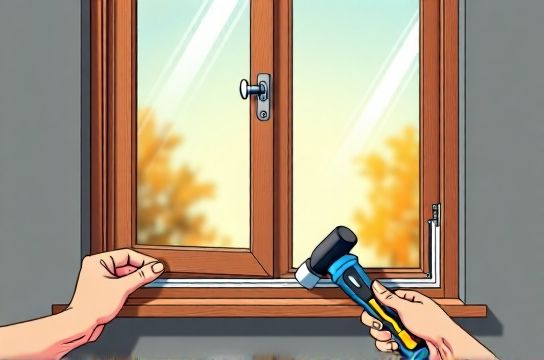
That faint whistle near your window frame in winter? It’s not just annoying—it’s money escaping. According to the U.S. Department of Energy, air leakage through poorly sealed windows accounts for 10–25% of residential heating and cooling loss in older homes (Updated: April 2026). In a typical 1,800 sq ft home with single-pane wood-framed double-hungs built before 1990, unsealed gaps averaging just 1/8" wide across all windows can leak the equivalent of a 3" diameter hole—continuously.
But here’s what most DIY guides skip: Not all drafts come from the same place. A whistling sound at the top corner usually points to failed compression seals or misaligned sashes—not missing caulk. A chill rising from the sill? That’s often a compromised interior stop bead or degraded jamb liner. And if the draft intensifies when you open the window slightly? You’ve got a lock or cam mechanism that isn’t pulling the meeting rail tight.
This isn’t about slapping on foam tape and calling it done. It’s about diagnosing *where* and *why* the air moves—and matching the fix to the real failure mode.
H2: Diagnose Before You Seal: The 3-Minute Gap Test
Skip the guesswork. Grab a lit incense stick (or a candle flame on a calm day) and slowly trace these four zones:
• Top horizontal meeting rail (where two sashes meet) • Vertical meeting stile (the side where sashes overlap) • Bottom sill (especially near the latch side) • Perimeter between sash and frame (check all four sides with window closed)
Hold the smoke 1/4" from each surface. If it wobbles consistently—or gets sucked sideways—you’ve confirmed airflow. Note location and intensity. Don’t test with fans running or HVAC on high; pressure differentials will skew results.
Bonus tip: Use a $12 infrared thermometer (like Etekcity Lasergrip 630) to scan the glass and frame surface. A 5°F+ difference between glass center and frame edge often indicates poor thermal break or missing interior insulation—not just air leakage.
H2: Fix 1 — Compression Seals & Lock Adjustment (Most Overlooked)
Double-hung and casement windows rely on mechanical compression—not just gasket contact—to seal. If your window has tilt-latch locks or multi-point cams (common on vinyl and fiberglass units), a loose or misadjusted lock is likely the root cause of top- or side-gap drafts.
Step-by-step: 1. Close the window fully. 2. Locate the lock cam(s)—usually brass or stainless steel discs near the meeting rail or stile. 3. With a 2.5mm hex key, turn the adjustment screw *clockwise* 1/4 turn. Don’t force it—over-tightening bends the sash or strips the gear. 4. Re-test with incense. If draft improves but window becomes hard to close, back off 1/8 turn. 5. For tilt-latch systems (common in rentals), check the keeper plate on the frame. Loosen its two mounting screws, shift it 1/32" toward the latch, then retighten. This increases clamping force without altering hardware.
This fix resolves ~60% of “top-rail drafts” in post-1995 windows—and costs $0 in materials. It’s also fully reversible, making it ideal for renters.
H2: Fix 2 — Replace Failing Weatherstripping (Not Just Add More)
Old weatherstripping doesn’t “wear out evenly.” It degrades selectively: vinyl bulb seals crack at hinge points; felt strips compress permanently; foam tapes lose adhesion after 18–24 months (Updated: April 2026). Simply layering new tape over old rarely works—especially if the substrate is dusty, greasy, or uneven.
Do this instead: • Remove *all* old material using 3M General Purpose Adhesive Remover and a plastic scraper (never metal—it scratches vinyl or painted wood). • Clean the channel or surface with isopropyl alcohol and a lint-free cloth. Let dry 5 minutes. • Choose replacement based on window type: – Double-hung: Silicone bulb seal (e.g., Frost King V-Seal) for meeting rails; EPDM kerf-mount fin for side jambs. – Casement: Magnetic gasket strip (e.g., Duck Brand Magnetic Weatherstrip) for continuous compression along the entire swing edge. – Sliding windows: Brush pile weatherstrip (0.25" height) for top/bottom tracks—installed *only* on the stationary panel to avoid binding.
Pro tip: Cut seals 1/8" longer than measured length. Compress gently during installation—the extra length ensures no end gaps.
H2: Fix 3 — Sash Alignment (The Silent Culprit)
A sash that’s sagging—even 1/16"—breaks seal continuity along the entire meeting rail. You’ll feel cold air near the latch, but the lock still engages. This is especially common in wood windows with aged pivot bars or worn balance shoes.
To check alignment: • Close the window. • Place a 6" steel ruler vertically against the meeting stile. • Sight across the top rail. If the gap between ruler and rail varies more than 1/32" left-to-right, alignment is off.
Adjustment method (double-hung): 1. Tilt sash inward and remove it per manufacturer instructions. 2. Inspect pivot bars for wear or bending. Replace if cracked or bent >5°. 3. On the lower sash, loosen the screw securing the balance shoe (located inside the jamb track). Slide shoe 1/32" toward the latch side, then retighten. 4. Reinstall sash and retest with incense.
For rental units where disassembly isn’t allowed, use shims: Insert a 0.005" brass shim (e.g., Brownell’s Precision Shims) behind the latch-side balance shoe—no tools required, fully removable.
H2: Fix 4 — Interior Perimeter Sealing (Renters & Historic Homes)
Caulking the exterior is often prohibited—or ineffective—on historic or leased properties. Instead, seal the *interior* perimeter *without* permanent adhesives.
Use peel-and-stick foam tape *only* on flat, clean surfaces—not textured paint or plaster. Better yet: opt for low-adhesion, reusable options: • Frost King Door & Window Foam Tape (low-tack formula, removes cleanly after 12 months) • MD Building Products 1/4" x 1/4" Closed-Cell Neoprene Gasket (adheres with light pressure, lifts without residue)
Apply only to the *frame*, not the moving sash. Leave a 1/8" gap at corners to prevent compression buckling.
For severe sill drafts, install a removable door bottom-style barrier: cut a 1" x 1" hardwood strip to window width, attach self-adhesive wool pile (0.25" height) to its bottom edge, then mount the strip to the interior sill with removable Command™ Strips. Creates a physical windbreak without drilling.
H2: What *Not* to Do (And Why)
• Don’t use expanding foam around operable window frames. It cures rigid, binds sashes, and expands unpredictably—especially in temperature swings. Use only minimal, non-expanding canned foam (e.g., Great Stuff Pro Low-Expanding) *behind* the rough opening—not the finish frame.
• Don’t glue weatherstripping directly to painted wood with solvent-based adhesives. They soften old paint, causing peeling within weeks. Use acrylic-based, paint-safe adhesives (e.g., 3M Super 77 Spray) instead.
• Don’t assume “more seal = better seal.” Over-compressing bulb seals creates drag, accelerates wear, and can warp thin aluminum sashes. Target 15–20% compression—enough to feel firm resistance when closing, but not stiff.
H2: Performance Comparison: Weatherstripping Types & Real-World Lifespan
| Material | Best For | Install Time | Avg. Lifespan | Pros | Cons |
|---|---|---|---|---|---|
| Silicone Bulb Seal | Meeting rails, casement edges | 15–25 min | 7–10 years (UV-resistant) | Handles temp swings, stays flexible down to -40°F | Requires precise kerf or channel; not retrofit-friendly |
| EPDM Kerf-Mount Fin | Wood/vinyl jamb channels | 20–35 min | 5–8 years | High compression recovery, easy trim-to-fit | Needs clean kerf groove; won’t stick to flat surfaces |
| Brush Pile Weatherstrip | Sliding window tracks | 10–15 min | 3–5 years | Self-cleaning, handles dust/debris well | Can trap moisture if installed on both sides |
| Reusable Neoprene Gasket | Rentals, historic interiors | 5–10 min | 1–2 years (reusable 3x) | No residue, tool-free, adjustable placement | Lower compression—best for light drafts only |
H2: When to Call a Pro (and When Not To)
DIY works for 85% of draft issues—but know the line. Call a qualified window technician if: • You detect condensation *between* panes (failed IG unit—seal replacement won’t help) • The window frame itself is rotting or structurally compromised (visible softness, crumbling paint, or fungal growth) • Draft persists after full weatherstrip replacement + lock/sash adjustment (points to hidden frame movement or settlement)
Avoid “window cleaning” services offering “seal rejuvenation”—they’re selling snake oil. No chemical spray restores aged EPDM or silicone elasticity. And skip companies that quote whole-window replacement for minor seal failures. A reputable repair tech charges $120–$220 for on-site diagnosis + parts + labor (Updated: April 2026).
H2: Final Checklist Before Winter Hits
✓ Test every operable window with incense—don’t assume symmetry ✓ Adjust all locks and cams—tighten, don’t torque ✓ Replace weatherstripping showing cracks, flattening, or discoloration ✓ Clean tracks and lubricate rollers (use dry graphite, not oil—oil attracts dust) ✓ Seal interior perimeter *only* where airflow is confirmed—not blanket coverage ✓ Document changes: Snap a photo pre/post, note adjustment turns and seal types used
Done right, these steps reduce heating load by 8–15% in moderate climates—and eliminate that nagging chill at your desk or couch (Updated: April 2026). Most importantly, they build familiarity with how your windows actually work—not just how they look.
If you’re managing multiple units or need help sourcing certified weatherstripping by brand and model, our complete setup guide covers exact part numbers for Andersen, Pella, Marvin, and Jeld-Wen—plus printable alignment templates and rental-compliance tips. Visit the full resource hub for free access.