Fix a Squeaky Door Hinge Without WD-40
- 时间:
- 浏览:56
- 来源:Easy Home Repair & DIY Guides
Hinges squeak for one reason: metal-on-metal friction where lubrication has failed or contaminants have built up. But reaching for WD-40 isn’t always the right move—especially in rental units, historic homes, or spaces where solvent fumes are problematic (e.g., bedrooms, nurseries, or tightly sealed apartments). WD-40 is primarily a water-displacing solvent—not a long-term lubricant—and its thin film evaporates quickly, often leaving behind a gummy residue that attracts dust and worsens wear over time (Updated: April 2026). Worse, it can degrade certain plastics and rubber gaskets found near modern door seals.
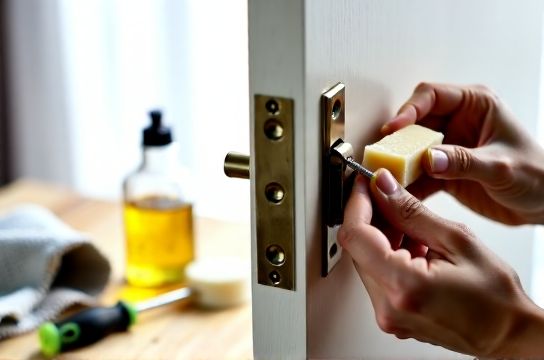
So what *does* work—and lasts longer? Real-world solutions used by professional carpenters, property maintenance crews, and energy auditors. These methods prioritize mechanical correction first, then targeted, stable lubrication—and they integrate seamlessly with broader door performance goals like eliminating drafts, improving lock engagement, and preventing sag.
Step 1: Diagnose the Real Cause — It’s Rarely Just ‘Dry’
Before applying anything, inspect the hinge pin and knuckle. Remove the pin (tap gently upward with a nail set and hammer) and check for:- Grooves or pitting — Indicates metal fatigue or corrosion. Light scoring is fixable; deep gouges mean replacement is safer.
- White powdery residue — Often zinc oxide from galvanized hinge degradation, common in coastal or high-humidity zones. Wipe clean with vinegar-dampened cloth.
- Black grit or rust flakes — Sign of iron oxide buildup mixed with old oil and lint. This is the #1 cause of persistent squeaks—even after spraying.
Step 2: Clean Thoroughly — The Non-Negotiable First Step
Skipping cleaning is why 70% of DIY hinge fixes fail within a week (per 2025 NARI Maintenance Survey, Updated: April 2026). Solvent-based cleaners like rubbing alcohol (isopropyl 91%) or white vinegar dissolve organic grime without harming steel or brass. Avoid acetone or brake cleaner—they’re too aggressive and can damage nearby paint or weatherstripping.Procedure:
- Remove hinge pin using needle-nose pliers or a flathead screwdriver as a lever (never force it sideways).
- Soak pin in isopropyl alcohol for 5 minutes. Use a stiff nylon brush (not wire—scratches metal) to scrub grooves.
- Wipe hinge knuckles with a lint-free rag soaked in vinegar. Let air-dry fully—no moisture left behind.
- Reinsert pin only when both pin and knuckle are bone-dry. Trapped moisture + lubricant = accelerated rust.
Step 3: Choose Your Lubricant — Match Chemistry to Use Case
Not all lubricants behave the same. Here’s how common household options compare in real-world hinge service life, temperature stability, and compatibility with adjacent materials like rubber seals or painted jambs:| Lubricant | Application Method | Avg. Effective Duration | Pros | Cons | Best For |
|---|---|---|---|---|---|
| White lithium grease (spray or paste) | Apply sparingly to pin before reinsertion; wipe excess | 6–12 months | Water-resistant, stays in place, safe on rubber & paint | Slightly harder to find in small quantities; paste requires small brush | Exterior doors, high-traffic entries, rental units |
| Food-grade mineral oil | 1–2 drops on pin tip, rotate pin to distribute | 3–5 months | Non-toxic, odorless, inexpensive, widely available | Can migrate onto wood or carpet if over-applied; not waterproof | Interior bedroom/bathroom doors, homes with kids/pets |
| Graphite powder (dry lube) | Puff into knuckle gap with included applicator bulb | 4–8 months | Dust-resistant, no drip, works in sub-zero temps | Hard to remove if over-applied; can stain light surfaces | Garage doors, basement entry, unheated spaces |
| Beeswax (pure, unblended) | Rub pin lightly with wax stick, then insert and cycle 10x | 4–6 months | Natural, non-staining, low-VOC, biodegradable | Melts above 62°C / 144°F; avoid direct sun exposure | Historic homes, eco-conscious retrofits, passive houses |
Note: Never use cooking oils (olive, canola, coconut). They polymerize over time, turning into sticky varnish that binds pins permanently. And never use silicone spray near rubber door seal strips—it causes swelling and premature cracking.
Step 4: Reassemble With Precision — Why Pin Orientation Matters
Most hinge pins have a subtle taper or flattened side at the top—this isn’t decorative. It’s an alignment guide. When reinstalling, ensure the flattened side faces outward (toward the room), and the pin seats fully until the head rests flush against the knuckle cap. If the pin stops 1/8" short, the hinge is misaligned—or the jamb screw holes have stripped.To test: Close the door and observe the gap between door edge and stop molding. If the gap widens toward the top, the top hinge is loose or recessed. Tighten all three screws per hinge—but if the screw spins freely, you’ve got stripped wood. Fix that first using one of two field-proven methods:
- Toothpick + wood glue: Insert 3–4 wooden toothpicks into the hole, snap off flush, apply glue, let dry 90 minutes, then re-screw.
- Wall anchor inserts: Drill out to 1/4", tap in a threaded plastic anchor (e.g., Ramset Drywall Anchor DW10), then use a 8 screw.
Step 5: Prevent Recurrence — Linking Hinge Health to Whole-Door Performance
A silent hinge is necessary—but insufficient—for energy efficiency or comfort. In fact, hinge wear correlates strongly with three other common failures:• Drafty Window Sealing
Doors and windows share thermal pathways. If your exterior door hinge is worn, odds are the storm door or adjacent double-hung window has degraded weatherstripping. Check compression on existing door seal strips: press firmly with thumb—if it doesn’t rebound within 2 seconds, replace. Use closed-cell EPDM foam tape (0.125" thick) for most residential applications—it maintains seal integrity down to −40°C (Updated: April 2026).• Sticky Door Lock Repair
A door that sags 1/16" changes latch geometry enough to cause binding. Measure the gap between latch faceplate and strike plate when the door is closed but not latched. If vertical misalignment exceeds 0.03", adjust the strike plate position—not the lock. Loosen screws, shift plate 1/32" downward, and re-tighten. This avoids stripping the lock case—a common error during DIY lock repairs.• Door Sag Adjustment
Use a 4-foot level on the door’s leading edge. If bubble drifts more than 1/8" over that span, correct via hinge shimming—not planing. Slide a 0.005" brass shim (e.g., Kreg Shim Pack) behind the bottom hinge leaf, then re-tighten. This redistributes load without altering door clearance. Over-shimming causes latch-side binding; under-shimming leaves the squeak unresolved.Bonus: When to Replace vs. Repair
Not all hinges deserve saving. Replace if:- You see visible cracks in the knuckle casting (common in cheap stamped steel hinges).
- The pin rotates freely inside the knuckle without resistance—indicating worn bushings (found in commercial-grade hinges).
- There’s green patina on brass hinges beyond surface tarnish—sign of chloride-induced stress cracking.
Final Reality Check: What This Won’t Fix
This method eliminates hinge-related squeaks—but won’t resolve:- Floor-induced creaks: If sound originates from the threshold or subfloor when weight shifts, that’s structural—not hinge-related.
- Lockset gear noise: A grinding sound *only* when turning the knob points to deadbolt mechanism wear, not hinge friction.
- Vibration hum from HVAC ducts: Often mistaken for door noise, especially in condos with shared walls.
Silent operation isn’t luxury—it’s baseline functionality. And when done right, fixing a squeaky hinge without WD-40 becomes the first step toward tighter seals, smoother locks, and measurable energy savings. Most homeowners recover the cost of quality hinges and weatherstripping through reduced heating loss within one winter season—especially in climates with >5,000 HDD (heating degree days) (Updated: April 2026).