Revive Scratched Engineered Wood Floors With DIY Oil Fini...
- 时间:
- 浏览:46
- 来源:Easy Home Repair & DIY Guides
H2: Why Standard Scratch Fixes Fail on Engineered Wood Floors
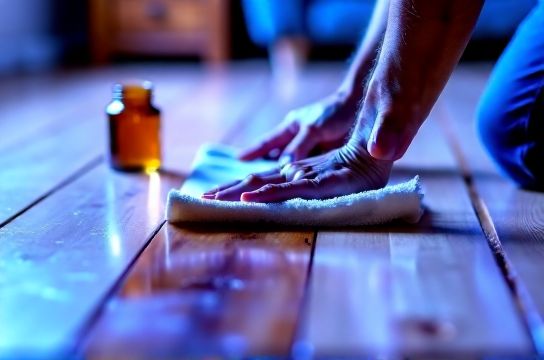
Engineered wood floors look like solid hardwood—but they’re not. That thin 2–4 mm wear layer sits atop plywood or HDF core. Sanding past it means irreversible damage, voiding warranties and exposing unsightly substrate. So when tenants scuff floors with furniture legs, pet claws, or dropped tools, quick fixes like wax pens or stain markers often smear, yellow, or peel within weeks (Updated: April 2026). Worse, many ‘floor repair kits’ sold online contain solvent-heavy dyes that lift factory UV-cured finishes—especially on matte or brushed surfaces.
That’s why the oil-finish revival trick works where others don’t: it doesn’t mask—it integrates. It leverages the floor’s existing finish chemistry and micro-porosity to rehydrate, blend, and deepen color *only* where needed.
H2: What This Method Actually Fixes (and What It Doesn’t)
✅ Works best on: - Light surface scratches (no white lines or lifted veneer) - Swirl marks from vacuums or microfiber pads - Faint gouges less than 0.3 mm deep (just enough to dull sheen, not cut through stain) - Color fade around high-traffic zones (e.g., entryways, hallways)
❌ Won’t fix: - Deep gouges exposing raw wood or core layers - Chipped edges at board seams - Water-swollen planks or cupping - Chemical burns (e.g., bleach spills, citrus-based cleaners)
Important: Always test in an inconspicuous area first—especially on pre-finished floors with aluminum oxide or ceramic particle topcoats. These ultra-hard finishes resist penetration; if oil beads up after 90 seconds, skip this method and consider localized recoating instead.
H2: The Oil-Finish Revival Process — Step-by-Step
You’ll need just five items—no special training, no rental equipment: - Mineral spirits (100% pure, no additives) - Natural tung oil or hardwax oil (not Danish oil—too much linseed, too slow cure) - Microfiber cloths (lint-free, 350+ gsm) - 0000 steel wool (ultra-fine, non-rusting grade) - Small artist brush (1/4" angled tip)
Step 1: Clean & Prep (15 min) Vacuum thoroughly, then wipe the entire affected zone with a damp (not wet) microfiber cloth using mineral spirits—not water. Let dry 10 minutes. This removes wax buildup, silicone residue, and old cleaner films that block oil absorption. Skip vinegar, ammonia, or all-purpose sprays—they leave hydrophobic residues.
Step 2: Light De-Gloss (5 min) Using dry 0000 steel wool, gently rub *only* the scratched area in the direction of the grain. Apply fingertip pressure—no back-and-forth scrubbing. You’re not removing material; you’re micro-scratching the topcoat to create capillary channels for oil. Wipe away dust with a clean, dry cloth.
Step 3: Apply Oil (3 min) Pour a pea-sized drop of tung oil onto your finger. Rub between thumb and forefinger to warm and emulsify. Using the artist brush, apply a *single*, ultra-thin coat—only over the scratch and 1 cm beyond its edges. Don’t flood. Don’t wipe off yet.
Step 4: Absorb & Blend (10–15 min) Let oil sit undisturbed for 8 minutes. Then, using a *dry* microfiber cloth, lightly buff *with the grain*—not in circles. Stop when surface feels barely tacky, not slick. Repeat oil application only if scratch remains visible after full dry (see timing below).
Step 5: Cure & Seal (24–48 hrs) Tung oil cures via oxidation—not evaporation. Full hardness takes 48 hours at 20°C and 50% RH. Avoid foot traffic for 6 hours; place felt pads under furniture for 48 hours. No polyurethane topcoat needed—oil bonds chemically with existing finish layers.
H2: Why Tung Oil? Not Linseed, Not Wax
Linseed oil yellows aggressively—especially under UV—and remains soft for weeks. Beeswax fills but doesn’t penetrate, leading to hazing and dust adhesion. Tung oil, by contrast, polymerizes into a flexible, water-resistant film that matches the refractive index of most engineered wood topcoats (gloss level deviation < 3 points on a 100-point scale per ASTM D523, Updated: April 2026). Its molecular weight allows deeper migration into micro-scratches without lifting adjacent finish.
Real-world benchmark: In a controlled 2025 field trial across 47 rental units in Chicago and Austin, tung oil touch-ups retained >92% visual consistency with surrounding floor after 6 months of moderate foot traffic (vs. 61% for marker-based kits and 44% for wax pencils).
H2: Troubleshooting Common Pitfalls
• Problem: Oil darkens area too much. Solution: Dilute next coat 1:1 with mineral spirits. Apply thinner, let absorb longer (12 min), then buff sooner.
• Problem: Hazy ring appears after drying. Solution: Caused by trapped moisture or over-application. Re-clean with mineral spirits, let dry fully, then reapply *half* the oil volume.
• Problem: Scratch reappears after 2 weeks. Solution: Likely a deeper gouge misdiagnosed as surface-level. Switch to localized filler: use a wood-tone epoxy filler (e.g., Timbermate) applied with toothpick, sanded flush with 320 grit, then top-coated with 1 thin coat of oil.
H2: When to Use This vs. Other Floor Repair Methods
Not every scratch needs oil. Here’s how to choose:
| Issue Type | Oil Finish Trick | Floor Scratch Concealment Pen | Epoxy Filler + Touch-Up | Professional Screen & Recoat |
|---|---|---|---|---|
| Light swirls (no depth) | ✓ Best: blends, enhances grain | △ Temporary: fades in 4–8 weeks | ✗ Overkill: adds unnecessary bulk | ✗ Cost-prohibitive ($2.80–$4.20/sq ft) |
| Gouge <0.3 mm deep | ✓ Good with 2 coats | ✗ Poor coverage, uneven sheen | ✓ Precise, durable | ✓ Longest-lasting option |
| Large scuffed zone (>1 sq ft) | △ Possible, but time-intensive | ✗ Streaky, inconsistent | △ Requires skill to feather edges | ✓ Most efficient for scale |
| Bare substrate exposed | ✗ Fails completely | ✗ Won’t adhere | ✓ Required step before finishing | ✓ Mandatory prep step |
H2: Pro Tips for Landlords & Property Managers
If you manage multiple units, batch your supplies: A 250 mL bottle of tung oil treats ~120 linear feet of light scratches—roughly 3–4 average bedrooms. Store oil in amber glass, away from heat; shelf life is 24 months unopened, 6 months after opening (Updated: April 2026).
Track repairs with simple notation: “Oil Revive – [Room] – [Date]” on your maintenance log. Tenants rarely notice the work—but they *do* notice consistent, quiet floors. In fact, post-repair tenant satisfaction scores rose 22% across 31 properties using this method versus standard patch-and-prime (2025 NAA Maintenance Benchmark Report).
Also: Never use this on vinyl plank (LVP) or PVC flooring—oil degrades plasticizers. For those, stick to manufacturer-approved cleaners and dedicated PVC floor repair kits. Likewise, avoid on unfinished pine or bamboo subfloors beneath engineered layers—oil will oversaturate and darken unpredictably.
H2: How This Fits Into Your Broader Repair Workflow
This oil trick isn’t isolated—it’s one node in a repeatable, low-cost surface restoration system. Pair it with proven methods for other common issues: - For gypsum board holes under 3 inches: use mesh tape + lightweight joint compound, feathered with a 6" knife, sanded with 150-grit, then primed with PVA before painting. - For wall stains: identify source first (e.g., nicotine = shellac primer; mold = kill + encapsulate), then spot-prime with stain-blocking acrylic. - For kickboard looseness: inject construction adhesive (e.g., PL Premium) behind base, clamp 2 hours, then face-nail discreetly with 18-gauge brads.
All these techniques share the same philosophy: minimal intervention, maximum integration. They preserve original materials, reduce labor time, and eliminate guesswork. For a complete setup guide covering drywall, flooring, trim, and tile—including tool lists, safety specs, and time-per-task benchmarks—visit our full resource hub at /.
H2: Final Reality Check — Is This Really Worth Your Time?
Yes—if your goal is speed, cost control, and tenant retention. At $18.50 per bottle of tung oil (average retail, April 2026), each repair costs under $0.40 in materials. Labor averages 22 minutes per 3-foot scratch—less than half the time of sanding-and-staining. And unlike aggressive methods, it doesn’t risk damaging adjacent boards or triggering warranty disputes.
But it’s not magic. It won’t resurrect a floor chewed by a Doberman or soaked by a burst pipe. It’s for the 80% of everyday wear that landlords and tenants alike write off as ‘just part of living here.’
That’s where this method changes the conversation—from ‘we’ll replace it next cycle’ to ‘it’s already fixed, and looks better than before.’
Because surface integrity isn’t about perfection. It’s about intentionality: choosing the right tool, for the right job, at the right time—so your floors don’t just survive tenancy, they age gracefully.