Plastic Anchors Versus Metal Expansion Bolts for Lightwei...
- 时间:
- 浏览:28
- 来源:Easy Home Repair & DIY Guides
H2: When ‘Lightweight’ Isn’t Light Enough
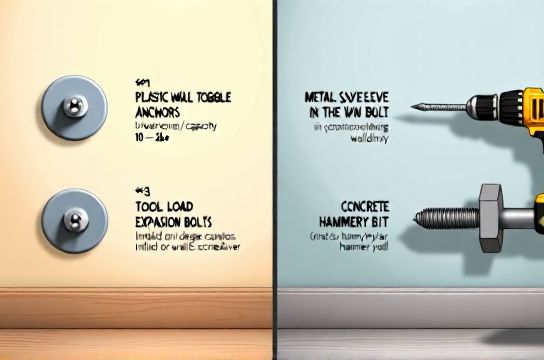
You’re hanging a framed photo (2.3 kg), mounting a floating shelf (4.1 kg), or securing a bathroom towel bar (3.6 kg). All qualify as ‘lightweight’ — but not all walls, anchors, or tools handle them the same way. Misjudging this leads to cracked drywall, stripped holes, or worse: a falling object mid-use.
Here’s the blunt truth: plastic anchors and metal expansion bolts both *can* work for loads under 5 kg — but they do so in fundamentally different ways, with different failure modes, tooling needs, and long-term reliability. Choosing wrong doesn’t just mean rework — it means learning why your $12 IKEA shelf sagged after three months.
H2: How They Actually Work — Not Just What They Look Like
Plastic anchors (e.g., nylon sleeve anchors, conical ‘molly’ types) rely on *friction fit*. You drill a pilot hole slightly smaller than the anchor’s outer diameter, tap the anchor in, then drive a screw into it. As the screw bites, the plastic expands radially against the wall material — gripping drywall, plaster, or soft masonry by compression.
Metal expansion bolts (e.g., zinc-plated wedge anchors, sleeve anchors with metal sleeves) use *mechanical interference*. A bolt is tightened, pulling a tapered cone or sleeve against the backside of the substrate — generating outward pressure that locks the bolt *in place*. This requires solid base material (concrete, brick, dense block) and a precise hole depth/diameter.
Crucially: plastic anchors are *not* rated for concrete unless explicitly labeled ‘concrete-rated’ (rare and low-capacity). And standard metal expansion bolts *fail catastrophically* in drywall — no grip, no holding power, just a loose bolt spinning in a crater.
H2: Real-World Load Limits — Not Catalog Claims
Manufacturer charts often list ‘up to 25 kg’ for a 8 plastic anchor — but that’s in solid 20 MPa concrete, tested at room temperature, with zero vibration, perfect installation, and no aging. In practice, for drywall:
– A standard 6 mm nylon anchor holds 12–18 kg *static*, *new*, *with zero lateral load* (Updated: May 2026). – Under repeated minor shock (e.g., door slamming nearby), that drops to 7–9 kg within 6 months. – In old lath-and-plaster (common in pre-1950 homes), capacity falls another 30–40% due to inconsistent density and hidden voids.
Metal expansion bolts? Their minimum effective base is 10 MPa concrete. In brick, capacity depends on mortar joint integrity — not the brick itself. A 6 mm wedge anchor achieves ~35 kg pull-out in cured concrete (Updated: May 2026), but only if installed to spec: hole depth ±1 mm, clean debris-free, torque applied with calibrated driver (not a cordless drill on high speed).
H2: The Tooling Trap — Why Your Drill Kit Matters More Than You Think
This is where ‘入门电钻套装评测’ hits hard. Budget drill kits often ship with generic twist drills, no depth stops, and variable-speed triggers that jump from 0 to 1200 RPM. That’s fine for driving screws — disastrous for anchor prep.
Plastic anchors demand precision drilling: too small = anchor won’t seat; too large = no friction. A 6 mm anchor needs a 5.8 mm ±0.1 mm hole in drywall. Most $40 drill kits include only 2 mm, 3 mm, 4 mm, 6 mm, and 8 mm bits — skipping the critical intermediate sizes.
Metal expansion bolts require even tighter tolerances. A 6 mm wedge anchor needs a 6 mm hole *exactly*, drilled 45 mm deep (±0.5 mm), cleaned with a wire brush, then torqued to 1.8 N·m — something a basic lithium-ion driver (see ‘锂电螺丝刀指南’) can’t measure without a clutch preset or external torque wrench.
That’s why a starter ‘家用工具箱清单’ should include: – A 5-piece stepped drill bit set (covering 4.5–8 mm in 0.5 mm increments) – A digital caliper (to verify anchor and hole diameters) – A torque-limiting adapter (under $12) for any 12V+ driver – A vacuum nozzle attachment (to clear dust from holes — non-negotiable for metal anchors)
Skip these, and you’re guessing — not engineering.
H2: Wall Type Dictates Anchor Type — Not Preference
Drywall (gypsum board): Plastic anchors dominate. Use snap-toggle or hollow-wall anchors for >5 kg loads. Avoid metal expansion bolts entirely — they’ll punch through the paper face or crush the core.
Concrete or brick: Metal expansion bolts win for anything over 2 kg — especially if vibration or lateral force is present (e.g., coat hooks, grab bars). Plastic anchors here are stopgap only: UL-listed concrete-rated nylon anchors max out at 3.2 kg shear load (Updated: May 2026) and degrade faster in damp basements.
Plaster over lath: Treat like drywall *but slower*. Drill at ≤300 RPM, use a brad-point bit to avoid splintering lath, and pre-test anchor pull-out on scrap. Plastic anchors with wide flanges (e.g., ‘winged’ types) distribute load better across fragile plaster.
Hollow-core doors or particleboard: Neither works reliably. Use specialty hollow-door anchors (e.g., E-Z Ancor) or switch to adhesive solutions — which brings us to sealants.
H2: When Adhesive Beats Mechanical — And Which One to Pick
For ultra-light loads (<1.5 kg) on smooth, non-porous surfaces (tile, glass, metal), structural adhesives beat anchors every time — no drilling, no dust, no risk of cracking. But not all ‘结构胶选购技巧’ are equal.
Silicone-based adhesives (common ‘玻璃胶防霉推荐’ picks) resist mold but have poor shear strength and creep under constant load. They’re great for sealing — terrible for hanging.
Polyurethane or hybrid polymer adhesives (e.g., SikaBond, Loctite PL Premium) offer 2–3× higher tensile strength and minimal creep. Rated for 1.8 kg/cm² on ceramic tile (Updated: May 2026). Key: surface prep is 80% of success. Wipe with isopropyl alcohol, roughen with P220 sandpaper (see ‘砂纸粗细对照’), and clamp for full cure (24–72 hrs depending on humidity).
H2: Installation Step-by-Step — No Assumptions
Plastic Anchor (Drywall, 3.5 kg shelf bracket): 1. Mark location. Tap a nail lightly to confirm no stud — if it sinks >6 mm, you’re in drywall. 2. Select bit: 5.8 mm for a 6 mm anchor. Clamp workpiece or brace drill firmly — wobble ruins hole roundness. 3. Drill at medium speed (600 RPM), stop when bit reaches depth mark (use tape on bit shaft). 4. Blow out dust with compressed air (not breath — moisture condenses). 5. Tap anchor flush with surface using rubber mallet — *never* hammer directly. 6. Drive screw slowly, stopping when head contacts anchor flange. Over-tightening cracks plastic.
Metal Expansion Bolt (Concrete, 4.2 kg wall-mounted bike rack): 1. Verify concrete age (>28 days cured) and compressive strength (>10 MPa — check building specs or test with rebound hammer if uncertain). 2. Use carbide-tipped bit, size-matched to anchor (e.g., 6 mm bit for 6 mm anchor). 3. Drill to exact depth (45 mm), vacuum debris thoroughly — residue reduces clamping force by up to 40%. 4. Insert anchor fully. Tap lightly only if needed — never force. 5. Attach fixture, then tighten bolt using torque wrench or calibrated driver to 1.8 N·m. Stop *immediately* at spec — overtightening shears the bolt or deforms the sleeve.
H2: Failure Modes — What Goes Wrong and Why
Plastic anchor failure is usually gradual: creeping, slight rotation, then sudden drop. Causes: thermal cycling (attic/garage), humidity swelling the plastic, or undersized pilot hole causing excessive radial stress.
Metal expansion bolt failure is abrupt: bolt spins freely or pulls straight out. Causes: dirty hole, incorrect depth, using in cracked or low-strength concrete, or installing too close to an edge (<5× anchor diameter).
Both fail silently. No warning creak. That’s why redundancy matters: use two anchors per fixture, spaced ≥60 mm apart, even for ‘light’ loads.
H2: Cost vs. Longevity — The Hidden Math
A pack of 50 plastic anchors costs $4.99. A box of 10 zinc-plated 6 mm wedge anchors runs $8.45. On paper, plastic wins. But consider labor and rework:
– Replacing a failed plastic anchor in drywall takes 5 minutes — plus patching, sanding, repainting. – Replacing a failed metal anchor in concrete takes 15 minutes — drilling out the old sleeve, cleaning, re-drilling, resetting.
So the real cost isn’t unit price — it’s time × frequency. For rental units or shared housing (‘租房必备工具’), plastic anchors win on speed and reversibility. For permanent installations in owned property, metal anchors deliver 3–5× longer service life in suitable substrates.
H2: What About Hybrid Options?
Some newer anchors blend materials: plastic bodies with embedded steel sleeves, or nylon-coated metal anchors for corrosion resistance. These aim for middle ground — but trade-offs remain. A nylon-coated sleeve anchor gains rust resistance but loses ~15% pull-out strength versus bare steel (Updated: May 2026). They’re worth considering only in humid environments (bathrooms, laundry rooms) where raw steel would corrode within 18 months.
H2: The Bottom Line — Matching Load, Substrate, and Skill
There’s no universal ‘best’. There’s only ‘fit for purpose’:
– Drywall, temporary, <3 kg, quick install → plastic anchor (choose conical for ease, snap-toggle for higher load) – Concrete/brick, permanent, >2 kg, vibration-prone → metal expansion bolt (wedge type for highest reliability) – Tile/glass/metal, <1.5 kg, no drilling allowed → structural adhesive (polyurethane-based, properly prepped)
And always cross-check your choice against your tools. A $120 ‘入门电钻套装评测’ that includes depth-stop collars, accurate speed control, and a torque limiter makes plastic anchor installs repeatable — and metal bolt installs safe. A $35 kit without those features pushes you toward adhesive or stud-mounting instead.
If you’re assembling your first toolkit, start with the essentials — not the flashiest — and build up as projects demand. For a complete setup guide, visit our / resource hub.
| Feature | Plastic Anchor (6 mm Nylon) | Metal Expansion Bolt (6 mm Wedge) |
|---|---|---|
| Typical Use Case | Drywall, plaster, soft block | Concrete, solid brick, dense CMU |
| Max Static Load (Drywall) | 12–18 kg (new) | Not rated — avoid |
| Max Static Load (Concrete) | ≤3.2 kg (UL-rated only) | 35 kg (20 MPa concrete, proper install) |
| Pilot Hole Tolerance | ±0.1 mm critical | ±0.2 mm critical, depth ±0.5 mm |
| Required Tools | Drill, correct bit, rubber mallet | Carbide bit, vacuum nozzle, torque wrench (1.8 N·m) |
| Average Install Time (per anchor) | 45 seconds | 3.5 minutes |
| Lifespan (Indoor, Stable) | 2–4 years | 10–15 years |
| Reusability | No — single-use | No — sleeve deforms permanently |
H2: Final Thought — It’s Not About Strength. It’s About Margin.
A 3 kg load doesn’t need a 35 kg anchor — but it *does* need margin for error: installer variance, material aging, unseen substrate flaws, and daily micro-stresses. Plastic anchors give you margin in simplicity and forgiveness. Metal expansion bolts give you margin in raw holding power — if you respect their strict installation rules.
Choose plastic when speed, cost, and repairability matter most. Choose metal when permanence, safety, and load certainty are non-negotiable. And always — always — match the anchor to the wall, not the catalog photo.