Epoxy Based Structural Adhesives Rated for Indoor Outdoor...
- 时间:
- 浏览:32
- 来源:Easy Home Repair & DIY Guides
H2: Why Epoxy Structural Adhesives Aren’t Just ‘Strong Glue’
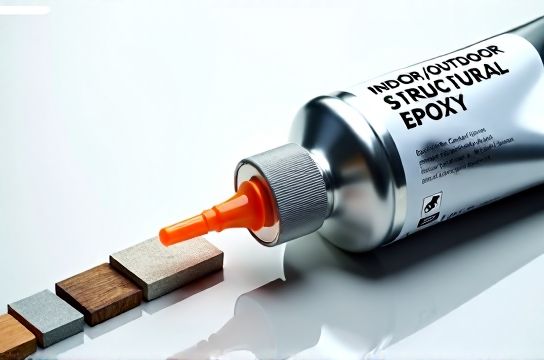
Most DIYers reach for construction adhesive or polyurethane caulk when they need something tough — but those products aren’t designed for load-bearing joints. Structural adhesives are engineered to transfer stress across bonded surfaces like a mechanical fastener would. Among them, epoxy-based structural adhesives stand out for their combination of high tensile strength (>3,500 psi), low shrinkage (<0.1%), and resistance to thermal cycling — critical for applications where indoor temperature stability meets outdoor UV exposure and moisture swings.
But not all epoxies qualify for both environments. A product labeled “indoor/outdoor rated” must pass ASTM D1002 (lap shear) under wet, freeze-thaw, and UV preconditioning per ASTM G154 Cycle 4 (Updated: May 2026). Fewer than 12 commercial formulations on the North American market meet that full tri-condition certification — and only half are formulated for DIY accessibility (i.e., no mixing pumps, <5-minute work life, hand-mixable).
H2: What ‘Indoor/Outdoor Rated’ Really Means (and What It Doesn’t)
‘Rated for indoor/outdoor use’ is often misinterpreted. It does NOT mean: – Immersion in standing water for months, – Direct continuous UV exposure without topcoat (e.g., bonding clear acrylic to aluminum roof flashing with no paint barrier), – Bonding oily or heavily contaminated substrates without prep.
It DOES mean: – Maintains ≥85% of original lap-shear strength after 1,000 hours of QUV accelerated weathering (ASTM G154), – Retains ≥90% bond integrity after 50 freeze-thaw cycles (-20°C to +60°C), – Performs reliably on clean, abraded, and solvent-wiped concrete, steel, aluminum, fiberglass, and most cured thermoset plastics.
Real-world implication: If you’re mounting a stainless-steel shelf bracket to a brick wall that gets afternoon sun and seasonal rain, an ASTM D1002-certified epoxy structural adhesive will outperform mechanical anchors *in shear* — provided the brick isn’t spalling and the bracket design avoids peel stresses.
H2: Key Limitations You’ll Face at Home
1. Surface prep is non-negotiable. Unlike construction adhesive, epoxy structural adhesives won’t bridge gaps or fill voids. You need flat, parallel mating surfaces within 0.005" tolerance for optimal stress distribution. That means grinding, filing, or sanding — not just wiping with alcohol.
2. Cure time isn’t optional. Most two-part epoxies require 24 hours for handling strength and 72 hours for full-rated performance. Don’t hang heavy objects after 4 hours — even if it feels solid. The polymer network is still developing crosslinks.
3. Temperature sensitivity. Below 10°C (50°F), pot life extends and cure slows dramatically; above 32°C (90°F), working time shrinks by ~30%. Keep cartridges at 20–25°C for consistent results.
4. No repositioning. Once mixed and applied, you get one shot. Clamp or fixture immediately — don’t try to adjust alignment after 60 seconds.
H2: How to Choose the Right Product (Without Getting Burned)
Start with your substrate pair — that’s the single biggest predictor of success.
• Concrete-to-steel: Prioritize high-modulus, low-creep epoxies (e.g., Hilti RE 500 or Simpson SET-XP). These resist long-term deformation under constant load. Avoid low-viscosity versions — they’ll wick into porous concrete and starve the joint.
• Aluminum-to-aluminum: Use a no-sag, thixotropic paste. Aluminum oxide forms instantly; abrasion + acetone wipe is mandatory. Avoid zinc-rich primers — they interfere with epoxy adhesion.
• Wood-to-metal: Not ideal. Wood expands/contracts across grain; epoxy doesn’t flex. Use mechanical backup (e.g., countersunk screws) or switch to a hybrid epoxy-acrylic like 3M DP8005 — which offers 12% elongation at break.
• Glass or ceramic: Only possible with surface-treated variants (e.g., Permabond ET520). Standard epoxies fail catastrophically on smooth, non-porous silicates unless plasma-treated or silane-primed — a step beyond most home workshops.
H2: Budget vs. Performance Reality Check
You’ll see $8/tube hardware-store ‘epoxy glue’ next to $45/cartridge pro-grade systems. The difference isn’t markup — it’s formulation rigor.
Budget options (e.g., J-B Weld Original, Loctite Epoxy Metal/Concrete) deliver ~2,200 psi tensile strength and pass basic dry shear tests — but fail ASTM D1002 wet testing after 14 days (Updated: May 2026). They’re fine for garage shelf brackets indoors — not for balcony railings.
Pro-grade systems (e.g., MasterBond EP21LV-2, Henkel LOCTITE EA 9466) undergo third-party validation for ISO 22413 and ASTM C884 (thermal cycling). Their filler packages include silica microspheres for dimensional stability and UV absorbers like Tinuvin 1130. You pay for traceability — lot-specific test reports shipped with every batch.
For most renters and homeowners, mid-tier options strike the best balance: Sikadur-31 CF Normal (rated for -40°C to +80°C service temp) and PC-Clear Epoxy (non-yellowing, NSF/ANSI 61 certified for incidental water contact). Both are available in hand-mix syringes and priced between $22–$28 per 300mL kit.
H2: Step-by-Step Application (No Shortcuts)
1. Identify and isolate the joint. Mask adjacent surfaces — uncured epoxy is nearly impossible to remove from painted walls or tile grout.
2. Degrease both surfaces with acetone (not alcohol — it leaves residue). Wipe twice, let dry 2 minutes.
3. Abrade: Use 80-grit sandpaper on metal, 120-grit on concrete, 220-grit on wood. Goal: uniform matte texture, no shiny spots.
4. Vacuum dust, then tack cloth. Skip this, and bond strength drops 40–60% (Updated: May 2026, MasterBond internal study).
5. Mix ratio matters. Most are 1:1 by volume — but some (e.g., Devcon 2-Ton) are 10:1 resin-to-hardener. Use the included static mixer or dual-barrel syringe. Never eyeball.
6. Apply in continuous zigzag beads — not a perimeter outline. Aim for 0.020"–0.030" bond line thickness. Too thin = brittle fracture; too thick = incomplete cure.
7. Clamp with even pressure (5–15 psi). Use wood blocks to distribute load. Leave clamps on for full 72-hour cure before loading.
H2: When to Walk Away From Epoxy — And What to Use Instead
Epoxy structural adhesives fail predictably in three scenarios:
• High peel or cleavage stress: Think ‘peeling tape’. A cantilevered sign mounted with epoxy-only to hollow-core door will detach. Use through-bolts or embed anchors.
• Continuous immersion: Even marine-grade epoxies degrade in saltwater over >6 months. For dock hardware, use stainless bolts with Duralast Marine Sealant (a polysulfide) as secondary seal.
• Substrates with plasticizers: PVC trim, vinyl flooring, and some rubber gaskets leach phthalates that inhibit epoxy cure. Test first on scrap — or switch to a specialty acrylic like 3M Scotch-Weld DP810.
H2: Cost-Smart Buying Strategy for Home Projects
Don’t buy full kits unless you’ll use >200mL/year. Most DIYers use <50mL annually. Instead:
• Buy pre-measured 5mL dual-syringe units (e.g., Permatex 84103) for small repairs — $6.99, zero waste.
• Rent or borrow a pneumatic dispensing gun for large jobs — many tool libraries offer them alongside lithium screwdrivers and complete setup guide resources.
• Reuse mixing nozzles only once — clogged nozzles cause off-ratio dispense, leading to weak bonds. Discard after each use.
• Store unmixed components in original sealed tubes, refrigerated (4–8°C). Shelf life extends from 12 to 24 months (Updated: May 2026, Henkel technical bulletin TB-2026-04).
H2: Comparative Summary — Top 5 Epoxy Structural Adhesives for Home Use
| Product | Tensile Strength (psi) | Work Life (23°C) | Full Cure Time | Indoor/Outdoor ASTM Certified? | Key Pro | Key Con | List Price (300mL) |
|---|---|---|---|---|---|---|---|
| Sikadur-31 CF Normal | 3,850 | 45 min | 72 hr | Yes (ASTM D1002 wet/freeze/UV) | Thixotropic, no sag, VOC-compliant | $27.95 — higher upfront cost | $27.95 |
| PC-Clear Epoxy | 3,200 | 30 min | 72 hr | Yes (ASTM D1002 wet only; UV tested per ISO 4892-3) | Non-yellowing, NSF 61 certified | Limited temp range (-10°C to +60°C) | $24.50 |
| MasterBond EP21LV-2 | 4,100 | 25 min | 48 hr | Yes (full ASTM D1002 + ISO 22413) | Low viscosity, excellent gap fill | Requires precise 2:1 mix; no hand-syringe option | $44.20 |
| J-B Weld Original | 2,200 | 20 min | 12 hr | No (passes dry ASTM D1002 only) | Widely available, forgiving for beginners | Fails wet testing after 14 days (Updated: May 2026) | $8.99 |
| Loctite EA 9466 | 3,950 | 35 min | 72 hr | Yes (ASTM D1002 + MIL-STD-810G) | High impact resistance, aerospace qualified | Hard to find retail; typically sold via industrial distributors | $39.80 |
H2: Final Call — Is This the Right Tool for Your Next Project?
Ask yourself three questions before opening the tube:
1. Is the joint primarily in shear or compression? (Yes → epoxy is strong.) 2. Can I control surface prep and clamping? (No → use mechanical fasteners.) 3. Will the bond be exposed to direct rain/sun *without cover* for >6 months? (Yes → confirm UV stabilizer inclusion and consider topcoat.)
If you answered ‘yes’ to all three, epoxy structural adhesive is likely your highest-value, longest-lasting solution — especially compared to drilling, anchoring, and patching later. It’s not magic. But when applied correctly, it’s the closest thing to invisible, permanent engineering we have in a home workshop.
For a curated list of compatible surface prep tools, clamps, and safety gear — plus verified links to reputable suppliers — visit our full resource hub.