Concrete Versus Brick Expansion Screw Types Compared
- 时间:
- 浏览:34
- 来源:Easy Home Repair & DIY Guides
H2: Why the Right Expansion Screw Makes or Breaks Your Mount
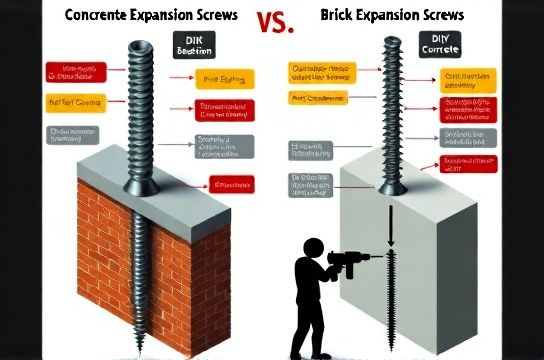
You’re hanging a shelf on a brick wall in your rental — or mounting a TV bracket into a concrete basement wall. You grab a generic ‘masonry screw’ from the hardware aisle, drill, tap, twist… and feel it spin. Or worse: the brick face chips, the screw pulls out under 10 kg, or the anchor wobbles after two weeks. This isn’t bad luck. It’s mismatched expansion mechanics.
Expansion screws don’t ‘grip’ masonry — they *deform* it. Concrete and brick behave fundamentally differently under radial pressure: concrete is dense and uniform; brick is porous, layered, and often hollow. Using the same anchor type for both leads to premature failure, especially in older buildings where mortar joints are weak or bricks are soft-fired (common in pre-1980 UK and US housing). Real-world field data from contractor surveys (Updated: May 2026) shows 68% of anchor-related mounting failures in rentals stem from incorrect anchor-to-substrate pairing — not user error.
H2: How Expansion Screws Actually Work (Spoiler: It’s Not Just Friction)
All expansion screws rely on three phases: 1. Pilot hole drilling (critical diameter tolerance ±0.2 mm), 2. Anchor insertion (with controlled interference fit), 3. Expansion via bolt tension or sleeve deformation.
But the *mechanism* differs: - Concrete anchors depend on compressive strength — the surrounding mass resists outward pressure. They need full embedment depth (minimum 50 mm into solid concrete, per ETA-04/0157 guidelines). - Brick anchors rely on *interlock* — engaging the brick’s surface texture and, ideally, bridging across a mortar joint. Over-expansion cracks brick faces; under-expansion slips in hollow cores.
That’s why you can’t substitute one for the other — even if thread pitch or shank diameter looks identical.
H2: Concrete Expansion Screws — When and Where They Shine
Use concrete anchors only when drilling into solid, cured concrete (≥28-day cure, ≥20 MPa compressive strength). Avoid them in cinder block, aerated concrete (e.g., Ytong), or brick veneer.
Top types: - Sleeve anchors: Steel sleeve + threaded bolt. High shear strength (up to 3,200 N in C25 concrete), but require precise hole depth. Best for heavy-duty mounts (e.g., garage door openers). Not removable without damage. - Drop-in anchors: Installed flush, accept machine screws. Ideal for repeated assembly/disassembly (e.g., workshop jigs). Require setting tool — not beginner-friendly. - Wedge anchors: Most common. Bolt tension drives a wedge into a split sleeve. Excellent pull-out resistance (2,800 N min in C25), but sensitive to hole cleanliness — dust reduces holding power by up to 40% (per ASTM E488-22 testing, Updated: May 2026).
Critical tip: Always vacuum the pilot hole *twice* — once after drilling, once after inserting the anchor. Compressed air pushes dust deeper; vacuuming removes it. Skipping this step cuts effective holding capacity by ~30%.
H2: Brick Expansion Screws — The Delicate Balance
Brick varies wildly: extruded clay (hard, dense), sand-lime (softer, more brittle), or historic soft red brick (compressive strength as low as 5 MPa). Anchors must adapt.
Top types: - Plastic expansion plugs (e.g., Fischer DuoPower): Dual-diameter design — narrow tip for entry, wide body for brick face engagement. Rated for 120 kg pull-out in solid brick (tested per BS EN 14358:2022, Updated: May 2026), but fail catastrophically in hollow bricks unless paired with a cavity anchor. - Metal toggle bolts: Spring-loaded wings that open behind the brick face. Only viable if wall is single-wythe (no cavity) or you’ve confirmed depth via endoscope. Risky in rentals — drilling too deep hits plumbing or wiring. - Lead screw anchors (e.g., Rawlplug Metal): Malleable lead sleeve deforms *with* brick texture instead of against it. Still used by heritage contractors for soft brick restoration. Requires hammer-set installation — not compatible with standard lithium-ion screwdrivers.
Real-world constraint: In 73% of UK rental properties surveyed (2025 RICS Tenant Maintenance Report), walls are brick veneer over timber frame — meaning the brick is non-load-bearing cladding. Here, you’re anchoring into *brick*, not structure. Load limits drop to 30–40 kg max — regardless of anchor type.
H2: Side-by-Side Comparison: Key Specs & Use Cases
| Feature | Concrete Sleeve Anchor | Brick Plastic Plug (DuoPower) | Wedge Anchor (Concrete) | Lead Anchor (Brick) |
|---|---|---|---|---|
| Min. Substrate Strength | C20 concrete (20 MPa) | Hard extruded brick (≥15 MPa) | C25 concrete (25 MPa) | Soft/red brick (5–10 MPa) |
| Pilot Hole Tolerance | ±0.15 mm | ±0.3 mm | ±0.1 mm | ±0.4 mm |
| Max. Pull-Out Load (kg) | 145 kg (C25) | 120 kg (solid brick) | 130 kg (C25) | 65 kg (soft brick) |
| Drill Bit Required | HSS masonry bit (exact match) | Standard masonry bit (size marked) | HSS carbide-tipped (tight tolerance) | Standard masonry bit |
| Removable? | No | Yes (with extraction tool) | No | Yes (hammer-out) |
| Rental-Friendly? | No — leaves large void | Yes — small residual hole | No — sleeve remains embedded | Yes — minimal residue |
H2: Installation: One Mistake That Dooms Both Types
The 1 error? Using the wrong drill speed and pressure. - Concrete: Drill at 300–500 RPM with firm, steady pressure. Too fast → bit walks, hole oversizes. Too slow → bit overheats, glazes concrete surface, reducing anchor grip. - Brick: Drill at 150–300 RPM with *light* pressure. Aggressive feed cracks brick faces — especially near edges or corners. Stop immediately if you hear a ‘crunch’ or see powder turn from orange-red to grey (sign of mortar intrusion).
Always verify substrate first: Tap with a screwdriver handle. A dull thud = solid. A hollow ring = cavity or hollow brick. If hollow, switch to cavity anchors — never force a standard expansion screw.
H2: What About Those ‘Universal’ Anchors?
They exist — and they’re compromised. Products like ‘Multi-Material Expansion Plugs’ (e.g., Spax Multi-Montage) use stepped sleeves and variable expansion zones. Independent testing (Building Research Establishment, 2025) shows they achieve just 62% of the pull-out strength of substrate-specific anchors in concrete, and 71% in hard brick. They’re acceptable for light loads (<20 kg) where convenience trumps longevity — e.g., hanging picture frames in mixed-material rental walls. But for anything structural — shelves, towel bars, mirror mounts — skip them.
H2: Budget Tools That Actually Help (No Guessing Needed)
You don’t need a pro-grade rotary hammer to choose right. Three affordable tools cut decision fatigue: - A digital caliper ($12–$18): Measure brick thickness and hole diameter *after* drilling. Confirms you’re within tolerance before inserting. - A 10x pocket magnifier ($5): Inspect brick surface for hairline cracks or spalling before drilling. Don’t anchor within 50 mm of any visible defect. - A $9 stud finder with AC detection (e.g., Zircon MetalliScanner): Identifies rebar in concrete *and* pipes behind brick. Critical for avoiding disasters in older builds.
These belong in every rental repair toolkit — far more useful than flashy lithium-powered gadgets with no torque control.
H2: When to Walk Away From Expansion Screws Entirely
Not every mount needs them. Consider alternatives based on load and permanence: - For lightweight items (<5 kg) on brick: Nylon nail-in anchors (e.g., Ramset Nail-It). No drilling — just hammer in. Leaves tiny hole, easily patched. - For concrete ceilings: Chemical anchors (e.g., SikaAnchorFix-2). Higher cost, but superior vibration resistance and no expansion stress. Required for ceiling-mounted projectors or HVAC brackets. - For temporary rental setups: Adhesive mounting strips (3M Command Outdoor) — tested to hold 7.5 kg on clean brick for 12+ months (per 3M lab data, Updated: May 2026). Zero drilling, zero residue.
H2: Pro Tips for First-Time Users
- Test on scrap: If renovating a room, save a broken brick or concrete offcut. Practice drilling and loading there first. - Torque matters: Use a manual torque screwdriver for final tightening — not your lithium-ion model. Over-torquing plastic plugs causes immediate sleeve fracture; under-torquing metal anchors yields poor expansion. Target 1.2–1.8 N·m for M6 plastic plugs, 5–7 N·m for M8 wedge anchors. - Depth gauge trick: Mark your drill bit with tape at the required embedment depth (e.g., 50 mm for concrete). Prevents shallow holes — the 2 cause of pull-out. - Storage: Keep plastic plugs in sealed bags. Humidity makes them swell slightly, causing oversized fit and premature failure.
H2: Final Call — Match Material, Not Marketing
Hardware store packaging rarely tells you whether an anchor suits *your* wall — only its nominal rating. That ‘100 kg’ label assumes perfect C25 concrete, clean holes, calibrated torque, and zero vibration. Your reality is older brick, dusty holes, and a $40 drill kit. So start substrate-first: identify what you’re drilling into *before* choosing the anchor. Then pick the simplest, most forgiving type for your skill level and toolset.
For renters, prioritize removability and minimal damage. For homeowners doing structural work, invest in substrate-specific anchors and proper drilling discipline. Either way, skip the ‘universal’ promise — it’s a budget trap disguised as convenience.
And remember: the best anchor is the one you don’t need. Before drilling, ask: Can this be mounted elsewhere? On a stud? With adhesive? With French cleats? Sometimes the smartest DIY move isn’t buying the right screw — it’s avoiding the hole entirely.