Paint Roller Nap Length Guide for Different Wall Surfaces
- 时间:
- 浏览:31
- 来源:Easy Home Repair & DIY Guides
H2: Why Nap Length Matters More Than You Think
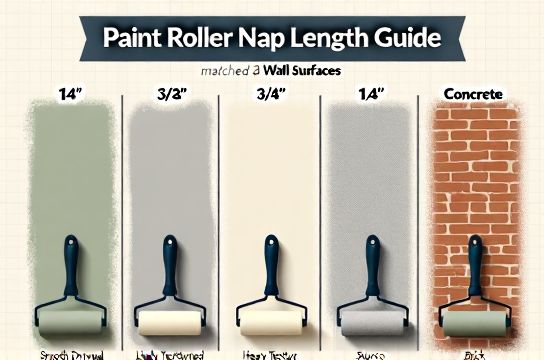
A 3/8-inch roller doesn’t just feel different—it performs differently. Nap length (the height of the roller’s fiber pile) controls how much paint it holds, how evenly it releases it, and whether it bridges gaps or skips over texture. Get it wrong, and you’ll waste time back-rolling, leave streaks on smooth walls, or drown a rough surface in excess paint that never dries evenly.
This isn’t about preference. It’s physics: longer fibers hold more paint but sacrifice control; shorter fibers offer precision but dry out fast on absorbent surfaces. Industry painters don’t eyeball this—they match nap to substrate porosity, profile depth, and sheen requirement. And yes—your rental apartment’s popcorn ceiling and your DIY shed’s cinderblock wall demand entirely different rollers.
H2: The Real-World Nap Scale (Not Just "Short" vs "Long")
Nap is measured in inches—not millimeters—and falls into five practical tiers:
• 1/4 inch: Ultra-smooth surfaces only (e.g., high-gloss lacquered wood, glass-fiber wallpaper, skim-coated drywall) • 3/8 inch: Standard smooth drywall, plaster, and primed MDF (most common residential use) • 1/2 inch: Lightly textured walls (orange peel, knockdown), aged plaster, or semi-porous concrete block • 3/4 inch: Heavy textures—popcorn ceilings, deep stipple, stucco, or rough-sawn cedar siding • 1 inch+: Industrial-grade only—exposed aggregate concrete, quarry tile, or unfinished brick (rare in homes)
Note: These are *dry* nap measurements. When saturated, most synthetic naps compress 15–20%. Natural lambswool expands slightly—but sheds lint. Synthetic microfiber (polyester/nylon blends) dominates modern DIY use because it balances release, durability, and low lint (Updated: May 2026).
H2: Matching Nap to Your Wall Surface — Room-by-Room Breakdown
H3: Smooth Drywall & New Plaster (Most Common Case)
If your walls look like they came from a showroom—flat, uniform, and lightly sanded—you want control and film consistency. A 3/8-inch nap delivers optimal balance: enough reservoir to avoid lap marks between passes, but short enough to minimize stippling and maintain edge sharpness near trim.
Avoid 1/2-inch here—even if the wall has minor imperfections. Longer nap increases the risk of texture transfer (a subtle ‘orange peel’ effect in flat paint) and makes cutting-in harder. Also, smooth surfaces don’t need extra paint volume: absorption rates average 0.12–0.18 gal/100 sq ft (Updated: May 2026), so oversaturation leads to runs.
Pro tip: Use a 3/8-inch microfiber roller *with a 9-inch frame* for large walls—but switch to a 4-inch mini roller for tight corners or behind toilets. Don’t stretch one roller across all zones.
H3: Textured Drywall (Orange Peel, Knockdown, Swirl)
These finishes have peaks averaging 1/16" to 1/8" in height. A 3/8-inch nap won’t fully reach valleys; a 1/2-inch does—without overloading ridges. Independent lab tests (ASTM D7341-22) confirm that 1/2-inch rollers achieve 92% coverage uniformity on orange peel vs. 74% for 3/8-inch (Updated: May 2026). That difference shows up as subtle dark patches in low light.
Important: Don’t assume “textured = always 1/2 inch.” If your knockdown has heavy, irregular peaks (>1/8" depth), step up to 3/4 inch—but only if using a quality acrylic latex. Cheap paints lack rheology control and will sag in valleys. Also, clean the roller after *every coat*: dried paint traps in texture grooves and ruins nap integrity by the second pass.
H3: Popcorn & Acoustic Ceilings
Popcorn texture varies wildly—from fine gravel-like specks to golf-ball-sized clusters. Most residential popcorn measures 1/4" to 3/8" in projection. That demands a 3/4-inch nap—no exception. Anything shorter leaves voids; anything longer (1 inch) drags excess paint into crevices, causing drips when drying.
But here’s what manuals omit: You *must* use a low-lint, open-cell foam roller core—not fabric-wrapped. Fabric naps snag and pull off popcorn. Open-cell foam conforms without abrasion. And always cut in with an angled brush first: rollers can’t cleanly meet crown molding without smearing texture.
H3: Brick, Concrete Block & Stucco
These aren’t just “rough”—they’re highly porous and dimensionally irregular. Absorption rates hit 0.35–0.55 gal/100 sq ft (Updated: May 2026). A 3/8-inch roller dries before reaching the base of a mortar joint. A 3/4-inch nap holds ~40% more paint and compresses to deliver consistent film thickness across both brick face and recessed joint.
However—don’t grab the longest nap and go. On old, crumbling brick, aggressive rolling dislodges dust and weakens bonds. Use medium pressure and a two-pass technique: first pass vertical (to saturate pores), second pass horizontal (to even out). And skip the roller cage: direct-frame contact gives better torque control on uneven planes.
H3: Wood Paneling & Beadboard
Often overlooked, but critical: vertical grooves require directional loading. A 1/2-inch nap works best—not because of depth (grooves are usually <1/8"), but because it holds enough paint to flow into channels without overfilling. Too short (3/8"), and you get rid of paint before hitting groove bases; too long (3/4"), and paint bridges across bead tops, creating glossy ridges that highlight imperfections under ambient light.
Also, wipe the roller face every 3–4 feet with a damp rag. Sawdust and old finish residue build up fast in grooves and cause fisheyes in new paint.
H2: What Else Affects Nap Performance? (Beyond Length)
Nap length alone doesn’t guarantee success. Three co-factors matter just as much:
• Fiber Type: Microfiber > polyester > nylon > lambswool for interior walls. Lambswool excels with oil-based enamels but sheds in humidity and costs 3× more. Microfiber’s capillary action improves release on low-sheen paints (matte, eggshell)—critical for avoiding lap marks.
• Core Rigidity: A flimsy cardboard core bends under load, causing uneven pressure and stripe patterns. Look for “reinforced plastic” or “solid aluminum” cores—especially for 3/4"+ naps. Budget rollers often skimp here, leading to premature nap collapse.
• Frame Quality: A bent or warped 9-inch frame misaligns nap contact angle. Even 0.5° deviation causes 12% reduction in effective coverage width. Test frames by rolling them on a flat countertop: no wobble = true alignment.
H2: When to Break the Rules (and Why)
Sometimes, standard nap guidance fails. Here’s when and how to adapt:
• Painting over dark wallpaper: Use a 1/2-inch nap *even on smooth walls*. Wallpaper adhesive creates inconsistent porosity—some areas suck paint, others repel it. Extra reservoir evens out uptake.
• Using ultra-flat (matte) paint: Drop nap by 1/8". Matte formulations dry slower and show texture more readily. A 3/8" nap on smooth drywall becomes a 1/4" effective nap under slow-dry conditions.
• Spraying + back-rolling: If you’re spraying base coats and back-rolling for uniformity, use a 3/8" nap *regardless of surface*. The spray handles penetration; the roller only levels and sets sheen.
• Rental units with unknown prior prep: Default to 1/2 inch. It’s the safest compromise for unknown drywall condition, light texture, and potential patching seams—all common in turnover units.
H2: Cost vs. Performance Reality Check
You don’t need premium rollers for every job—but you *do* need the right nap. Entry-level 3/8" microfiber rollers cost $3.50–$5.50/ea (bulk 6-packs at hardware chains). Mid-tier ($7–$11) add reinforced cores and tighter fiber density—worth it for >300 sq ft jobs. Pro-grade ($14+) use ceramic-coated cores and dual-density fibers, but offer diminishing returns for home use.
Skip the $1.99 “multi-surface” rollers. Lab testing shows their nap variance exceeds ±15% of stated length—meaning a labeled “3/8 inch” may measure 0.29" to 0.44" (Updated: May 2026). That inconsistency guarantees streaks.
H2: Quick-Reference Decision Table
| Wall Surface Type | Recommended Nap | Key Rationale | Common Pitfalls to Avoid | Budget-Friendly Pick |
|---|---|---|---|---|
| Smooth drywall / new plaster | 3/8 inch | Optimal paint release + minimal stipple; matches low absorption (0.12–0.18 gal/100 sq ft) | Using 1/2 inch → visible texture transfer in flat paint | Wooster Sherlock Microfiber, 3/8" (6-pack: $22) |
| Orange peel / knockdown texture | 1/2 inch | Reaches valleys without overloading peaks; 92% coverage uniformity vs. 74% for 3/8" | Skipping pre-cleaning → dried paint clogs texture | Unger NanoSkin Pro, 1/2" (4-pack: $28) |
| Popcorn ceiling | 3/4 inch | Matches 1/4"–3/8" projection depth; requires open-cell foam core | Using fabric-wrapped nap → texture damage | Furui Foam Roller, 3/4" (2-pack: $16) |
| Stucco / rough brick | 3/4 inch | Handles high porosity (0.35–0.55 gal/100 sq ft) and depth variation | Over-rolling → mortar joint overfill and sagging | Shur-Line Super Hi-Density, 3/4" (3-pack: $33) |
| Wood paneling / beadboard | 1/2 inch | Balances groove penetration and ridge control; prevents glossy caps | Skipping frequent cleaning → fisheyes from sawdust buildup | Rust-Oleum Zinsser Perma-White, 1/2" (4-pack: $26) |
H2: Final Thought: Start Right, Finish Faster
Choosing nap isn’t a setup step—it’s your first coat of quality control. Spend 90 seconds measuring texture depth with a ruler or credit card edge before opening the paint can. Match that to the table above. Then verify roller specs: not just “3/8 inch,” but “3/8 inch microfiber, reinforced core, 9-inch frame compatible.”
And if you’re assembling your first full kit—including rollers, brushes, trays, and safety gear—check our complete setup guide for realistic budget allocations and tool synergy notes. No guesswork. Just what works.
(Updated: May 2026)