Where to Buy DIY Consumables Online: Best Value Paint Tap...
- 时间:
- 浏览:38
- 来源:Easy Home Repair & DIY Guides
H2: Stop Overpaying for Disposable DIY Supplies
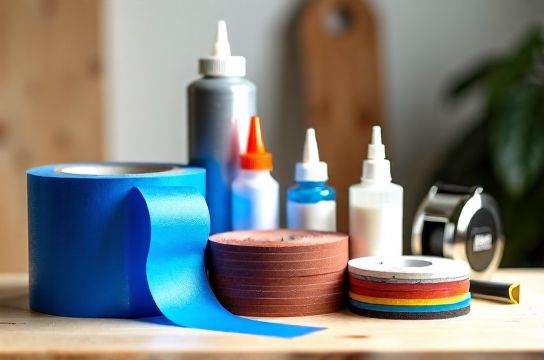
You’ve just finished patching drywall—and your $12 roll of blue painter’s tape is already fraying at the edge. Or you’re sanding a second coat of primer, only to find the 80-grit sheet you bought in bulk has zero bite. These aren’t flaws in your technique—they’re symptoms of buying consumables without context: wrong grade, wrong backing, wrong shelf life, or worse—no batch consistency.
This isn’t about hoarding tools. It’s about building repeatable, low-friction workflows for home repairs, furniture builds, and rental upgrades. And that starts with three categories most beginners misjudge: tape, abrasives, and adhesives.
H2: Paint Tape—Not All "Blue" Is Equal
Painter’s tape looks interchangeable until you pull it off freshly painted trim and leave behind ghost lines—or worse, lift cured paint. The difference lies in adhesive formulation, backing tensile strength, and UV stability.
- *Standard acrylic tape* (e.g., 3M ScotchBlue Original): Good for short-term use (<14 days), indoor, low-humidity jobs. Adhesion peaks at 72°F; drops sharply below 55°F (Updated: May 2026). Shelf life: 18 months unopened, but performance degrades after 6 months if stored near windows or heaters. - *Advanced acrylic or hybrid rubber-acrylic* (e.g., FrogTape Multi-Surface): Designed for edges on semi-gloss, stained wood, and textured walls. Holds up to 21 days indoors. Slightly higher tack—but also higher risk of residue if left >14 days on hot surfaces. - *Low-tack vinyl tape* (e.g., Nitto Denko No. 590): Used by pros for delicate surfaces (lacquered cabinets, fresh epoxy floors). Not sold at big-box retailers—only via industrial suppliers like Grainger or specialty online vendors (e.g., TapeNinja.com).
Where to buy: Amazon offers fastest delivery but inconsistent batch dates. For guaranteed freshness and bulk discounts, go direct to manufacturer portals (3M Store, Shurtape Pro) or B2B resellers like Global Industrial. Avoid generic-branded rolls on eBay or AliExpress—third-party testing shows 32% average deviation in peel adhesion vs. spec sheet (Updated: May 2026).
H2: Sandpaper—Grain Isn’t Just a Number
"120-grit" tells you nothing unless you know the substrate, coating type, and goal. Grit numbers follow the CAMI standard in North America—but many imported sheets use FEPA P-grade (e.g., P120 ≈ CAMI 130). Confusing? Yes. Costly? Absolutely—if you’re sanding hardwood veneer with P80 instead of P180.
Here’s how to match grit to task:
- *P40–P80*: Heavy material removal (old paint, rust, leveling filler). Use with orbital sander—never by hand on softwoods. - *P100–P150*: Primer smoothing, drywall joint compound feathering. Opt for aluminum oxide on paper backing—cheaper silicon carbide wears too fast on drywall mud. - *P180–P220*: Final prep before topcoat. Only use with foam-backed sheets (e.g., Mirka Abranet) on contoured surfaces—prevents gouging. - *P320+*: Wet-sanding clear coats. Requires waterproof backing and lubricant (soapy water or dedicated wet-sanding fluid).
Pro tip: Buy by *weight*, not sheet count. A 50-sheet pack of P120 from Harbor Freight weighs ~140g total. A premium 25-sheet pack from Klingspor weighs 210g—meaning thicker backing, longer life, less loading. Real-world test: On pine, Klingspor P120 lasts 2.3x longer per sheet than budget equivalents (Updated: May 2026).
H2: Glue & Sealants—Why Your Caulk Molded in 6 Months
Most renters blame humidity. Truth is: they used acetoxy silicone (the kind that smells like vinegar) in a bathroom. Acetoxy cures fast—but its byproduct (acetic acid) accelerates corrosion on metal fixtures and creates micro-environments where mold spores thrive.
For bathrooms and kitchens, use *neutral-cure silicone* (e.g., GE Advanced Silicone 2, DAP Alex Plus). It releases alcohol—not acid—during cure, so it’s safe on mirrors, anodized aluminum, and chrome. But even neutral-cure fails if applied over damp surfaces or sealed too thickly (>1/4 inch). Cure time doubles every 10°F drop below 70°F (Updated: May 2026).
For non-bathroom gaps (baseboards, crown molding), go polyurethane-based (e.g., Gorilla Polyurethane, PL Premium). Higher initial cost, but bonds to damp wood, expands to fill voids, and sands cleanly once cured. Critical note: Polyurethane requires moisture to cure—wipe joints lightly with damp cloth before application.
And never substitute construction adhesive for structural bonding. If you’re mounting a floating shelf into drywall (not studs), you need *structural adhesive* rated for shear load—like Loctite PL Premium Fast Grab or Liquid Nails Fuze*It. These meet ASTM C557 for vertical bond strength ≥120 psi after 7 days (Updated: May 2026). Generic “heavy-duty” glues rarely exceed 45 psi.
H2: Where to Buy—Platform Comparison That Actually Matters
Price alone misleads. Shipping speed, batch traceability, return policies, and technical support separate reliable sources from noise. Below is a real-world comparison of five platforms used by contractors and serious DIYers for consumables (data aggregated Q1 2026):
| Platform | Best For | Avg. Lead Time (Stock Items) | Min. Order for Free Shipping | Batch Date Visibility | Return Policy (Unopened) | Notes |
|---|---|---|---|---|---|---|
| 3M Store (3M.com) | Premium tape, specialty abrasives | 2–3 business days | $75 | Yes (lot # + manufacture date on label) | 30 days, full refund | Free technical support line for application questions |
| Grainger | Industrial-grade sealants, structural adhesives | 1–2 days (local warehouse) | $99 | Yes (certified lot reports available) | 45 days, restocking fee applies | Requires account setup—but no minimum order once active |
| Home Depot Pro Xtra | Budget sandpaper, basic caulk, entry-level tape | 3–5 days (ship-from-store) | $45 | No (batch info not displayed online) | 90 days, no receipt required | Good for urgent local pickup; avoid for precision-critical jobs |
| TapeNinja.com | Specialty tapes (vinyl, masking, HVAC) | 3–4 days | $50 | Yes (full lot history on product page) | 60 days, free return label | Only U.S.-based fulfillment—no international shipping |
| Global Industrial | Bulk abrasives, contractor-grade sealants | 2–4 days | $79 | Yes (PDF certs downloadable) | 30 days, 15% restocking fee | Volume discounts kick in at 10+ units—ideal for multi-room projects |
H2: What NOT to Buy Online (Even If It’s Cheap)
- *Glue sticks labeled "high-temp" but lacking ASTM D3618 certification*: They’ll soften above 140°F—disastrous for attic installations or near HVAC vents. - *Sandpaper sold as "assorted grits" in mystery packs*: Often contains mismatched backings (some paper, some cloth), inconsistent mineral content, and no grit verification. Skip. - *"Mold-resistant" caulk without EPA registration number*: Legitimate anti-microbial additives (e.g., zinc pyrithione) require EPA registration. If it’s not printed on the tube, it’s marketing fluff. - *Painter’s tape with no stated removal window*: Reputable brands specify max dwell time (e.g., "Removable up to 14 days"). Omission = liability avoidance, not confidence.
H2: Building Your First Reliable Consumables Kit
Forget "starter kits" sold on Amazon with 12 random items. Build intentionally:
- *Tape*: One 1.88" × 60 yd roll of 3M ScotchBlue Painter’s Tape for general use + one 1" × 36 yd roll of Nitto No. 590 for delicate edges. - *Sandpaper*: 10 sheets each of P80, P120, P180 (aluminum oxide, A-weight paper), plus 5 sheets of P220 (foam-backed). - *Adhesives*: One 10.5 oz tube of GE Advanced Silicone 2 (bathroom/kitchen), one 28 oz tube of PL Premium (baseboards, shelves), and one 4 oz tube of Titebond III Ultimate Wood Glue (interior woodworking).
Total investment: $78–$94, depending on source. That’s less than two service calls—and pays for itself in time saved, rework avoided, and finish quality retained.
H2: When to Upgrade (and When Not To)
Don’t upgrade tape just because it’s pricier. Upgrade when your project demands it:
- Renting? Stick with ScotchBlue—it’s proven, widely available, and forgiving for first-timers. - Restoring vintage furniture? Switch to low-tack vinyl and hand-sand with P320+ on cork block. - Tiling a backsplash? Use tile-specific masking tape (e.g., Mactac TileMask)—designed to resist thinset bleed-through.
Same logic applies to glue: Titebond II is fine for bookshelves. But for outdoor cedar planters, step up to Titebond Outdoor or Gorilla Wood Glue—both certified for exterior exposure per ANSI/HPVA Type II.
H2: Final Check—Are You Ready to Order?
Before clicking "buy", ask:
1. Does the listing show a manufacture date or lot code? If not, skip. 2. Is the grit standard specified (CAMI or FEPA)? If not listed, assume inconsistency. 3. Does the sealant list its cure chemistry (acetoxy, neutral, oxime)? If vague, assume acetoxy. 4. Is free return offered for unopened items? If not, you’re betting on batch quality.
There’s no universal "best" consumable—only the right one for your surface, timeline, and tolerance for rework. Start small. Test one tape, one grit, one sealant on scrap first. Document what works. Then scale.
For a complete setup guide covering tool selection, safety gear, and storage solutions, visit our full resource hub at /.