Expansion Anchor Bolt Selection Guide for Drywall and Con...
- 时间:
- 浏览:37
- 来源:Easy Home Repair & DIY Guides
H2: Why Most People Get Expansion Anchors Wrong—And What Actually Works
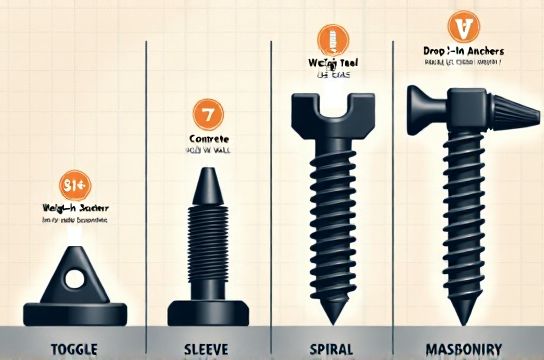
You’re hanging a shelf in your rental. You grab the free plastic anchors from the hardware store, drill a hole, tap them in, and tighten the screw. Two weeks later, the shelf sags. The screw spins freely. You pull it out—and the anchor falls through the drywall like it was never there.
This isn’t user error. It’s material mismatch.
Expansion anchors don’t ‘just work’ across substrates. A wedge anchor rated for 1,200 lbs in cured concrete (28-day compressive strength ≥ 3,000 psi) delivers near-zero holding power in 1/2" gypsum board. Conversely, a toggle bolt that’s perfect for hollow drywall will shatter concrete or jam mid-install in a masonry block core.
The fix isn’t more force—it’s substrate-aware selection.
H2: Drywall vs. Concrete: Non-Negotiable Differences
Drywall is a sandwich: two layers of paper enclosing compressed gypsum. It has zero tensile strength and minimal shear resistance. Anchors here rely on *mechanical interference*—spreading behind the back face (toggle, molly), gripping the paper layer (snap-toggle), or compressing the gypsum core (plastic sleeve). None of these generate meaningful pullout resistance in solid material.
Concrete, by contrast, is dense, brittle, and highly compressive—but low in tensile strength. Anchors here must transfer load *into compression*, not rely on surface grip. That’s why expansion anchors dominate: they create radial pressure against the borehole wall, converting tensile force into compressive friction.
Key takeaway: If you’re drilling into concrete, skip all drywall-specific anchors (e.g., plastic sleeves, basic molly bolts). If you’re in drywall, avoid concrete-only types (wedge anchors, sleeve anchors with rigid expansion sleeves) unless you’ve verified solid backing (e.g., stud, blocking, or concrete ceiling).
H2: Matching Anchor Type to Load, Substrate & Installation Reality
Not all expansion anchors are created equal—even within the same category. Here’s how to cut through the noise:
H3: For Drywall (Hollow Wall)
• Toggle bolts (steel or nylon wing): Best for medium-to-heavy loads (up to 50 lbs per anchor in 1/2" drywall). Require a 1/2"–3/4" hole; wings fold flat for insertion, then spring open behind the wall. Nylon toggles resist corrosion but have ~30% lower capacity than steel. Ideal for towel bars, small shelves, or mirror hangers where appearance matters (low-profile heads available). Downside: Requires oversized hole; can’t be used near edges (<1.5" from wall edge) without cracking.
• Snap-toggle (e.g., TOGGLER SNAPTOGGLE): A hybrid—steel anchor with spring-loaded wings that snap open *after* passing through the drywall. Needs only a 1/4" hole (vs. 1/2" for standard toggle), making it faster and less prone to edge damage. Rated for up to 65 lbs in 1/2" drywall (Updated: May 2026). Best for renters: minimal patching if removed, high reliability, no special tools beyond a drill/driver.
• Plastic expansion anchors (e.g., EZ Ancor): Cheap, widely available, and fine for light loads (<15 lbs)—picture frames, hooks, lightweight curtain rods. But they rely entirely on compressing soft gypsum. Over-tightening strips the threads or cracks the board. Not recommended for anything subject to vibration or repeated loading (e.g., door stoppers, coat racks).
H3: For Concrete & Masonry
• Wedge anchors: Steel rod with a conical expansion clip. When tightened, the cone forces the sleeve outward against the borehole wall. Highest pullout strength in solid concrete—up to 1,400 lbs (1/2" diameter, 3" embedment, 4,000 psi concrete) (Updated: May 2026). Requires precise hole depth and diameter (no tolerance: 1/2" anchor = exactly 1/2" hole). Not for brick or block—only solid, cured concrete.
• Sleeve anchors: Similar principle but with a threaded sleeve that expands uniformly. More forgiving on hole tolerance than wedge anchors, works in concrete, brick, and block. Lower capacity than wedge (e.g., 1/2" sleeve anchor = ~900 lbs in 4,000 psi concrete), but better for variable substrates. Common in commercial signage and HVAC mounting.
• Drop-in anchors: Installed flush, then accept machine screws. Used when you need a clean, recessed finish (e.g., mounting electrical boxes, railings). Require a setting tool (hammer or专用 setter) to expand—*not* tightened with a wrench. Often overlooked by DIYers, but critical for code-compliant structural attachments.
H2: Real-World Selection Flowchart (No Guessing)
Ask these three questions—in order:
1. What am I drilling into? → Drywall only? → Skip wedge/sleeve anchors. Go toggle or snap-toggle. → Concrete slab or foundation? → Skip plastic anchors and toggles. Use wedge or sleeve. → Brick or cinder block? → Confirm whether it’s solid (full block) or hollow-core. Hollow cores require longer anchors with deeper embedment—or switch to chemical anchors (beyond scope here).
2. How much weight will it hold—and for how long? → Under 10 lbs, static: Plastic anchor or self-drilling drywall anchor (e.g., GRK RUSH). → 15–50 lbs, semi-permanent: Snap-toggle (drywall) or 3/16"–1/4" sleeve anchor (concrete). → 50+ lbs, permanent or safety-critical (e.g., grab bar, TV mount): Use manufacturer-rated anchors *with documented embedment depth*. Never extrapolate from smaller sizes.
3. What tools do I own—and what’s my skill level? → No hammer drill? Avoid wedge anchors in concrete—they require precise, clean holes. Opt for sleeve anchors (more forgiving) or consider a rotary hammer rental (~$35/day). → Renting? Prioritize removable, low-damage options: Snap-toggles over traditional toggles; zinc-plated sleeve anchors over stainless (cheaper, sufficient for indoor use).
H2: Critical Installation Mistakes (and How to Avoid Them)
• Hole too shallow: Anchor doesn’t fully expand. Result: Pullout under load. Fix: Use a depth gauge or mark your drill bit with tape at required embedment (e.g., 1" for 1/4" sleeve anchor).
• Hole too wide: Anchor slips before expanding. Result: Spin-out, no grip. Fix: Match drill bit size *exactly* to anchor spec sheet—not package label, not memory. A 1/4" sleeve anchor requires a 1/4" bit—not “approx. 1/4”.
• Over-tightening plastic anchors: Gypsum crumbles. Fix: Stop turning when resistance increases sharply—usually 1–2 turns after the anchor stops spinning freely.
• Using anchors in cracked or spalled concrete: Load concentrates at weak points. Fix: Probe with a screwdriver first. If surface flakes or feels soft, move the location or use epoxy anchoring instead.
H2: Budget-Friendly Anchor Kits vs. Single-Piece Buying
For most renters and weekend DIYers, pre-packaged anchor kits make sense—but read the fine print. Many “universal” kits contain only plastic anchors and vague sizing charts. Better options:
• TOGGLER Master Kit (120-piece): Includes snap-toggles (1/4", 3/16"), molly bolts, plastic anchors, and drill bits. Covers drywall, wood, and light masonry. Priced at $24.99 (2026 retail avg). Ideal for <50 lbs projects.
• Hillman Concrete Anchor Value Pack: 50-piece sleeve anchor set (3/16", 1/4", 5/16") with matching bits and torque specs. $32.50. No plastic—just what you need for concrete/masonry.
Skip generic “100-in-1” kits sold online with unlabeled anchors and no load ratings. They’re cheap upfront—and expensive in rework.
H2: Where Tools Fit In—And Why Your Drill Matters
Anchor performance depends as much on your drill as the anchor itself.
• For drywall: Any cordless drill/driver (12V+) works. Use clutch setting 2–3 to avoid overdriving plastic anchors.
• For concrete: A standard drill *can* work for small holes (<1/4") in soft concrete—but it’s slow, overheats bits, and risks wandering. A hammer drill (or rotary hammer for >1/4" holes) cuts install time by 60–80% and ensures consistent hole geometry. If you’re doing more than 3–4 anchors, renting one pays for itself.
Note: Lithium-ion drills (e.g., DeWalt 20V MAX) offer enough torque and runtime for most anchor work—but check RPM range. High-speed modes (>1,500 RPM) are great for driving screws, terrible for drilling concrete. Use low-gear (0–450 RPM) with hammer function enabled.
H2: Anchor Longevity & Environmental Factors
Indoors, galvanized or zinc-plated anchors last decades. Outdoors or in humid areas (bathrooms, laundry rooms), corrosion becomes real:
• Drywall anchors: Nylon toggles resist moisture better than plated steel—but still degrade over 5–7 years in high-humidity zones. For bathroom towel bars, upgrade to stainless steel snap-toggles (e.g., TOGGLER BXT SS).
• Concrete anchors: Zinc plating lasts ~3–5 years in damp basements; hot-dip galvanized lasts 10–15 years. Stainless (A2/A4) is overkill for most interiors—but required for coastal or pool-area installations.
H2: When NOT to Use Expansion Anchors
• Cracked, delaminated, or green (uncured) concrete: Wait minimum 28 days post-pour. Cure time affects bond strength more than age alone.
• Thin substrates: 1/4" drywall? Skip toggles—use low-profile hollow-wall anchors (e.g., E-Z Ancor Hollow Door Anchor) or find a stud.
• Vibration-heavy environments (e.g., near washing machines, garage doors): Mechanical expansion degrades faster. Consider epoxy-set threaded rods or adhesive anchors.
• Fire-rated assemblies: Standard plastic anchors melt at ~150°F. Check local codes—some applications require intumescent or metal-only solutions.
H2: Quick-Reference Comparison Table
| Anchor Type | Best For | Max Load (1/2" drywall / 4,000 psi concrete) | Hole Size Required | Installation Notes | Removability |
|---|---|---|---|---|---|
| Snap-Toggle (TOGGLER) | Drywall, plaster, hollow-core doors | 65 lbs / N/A | 1/4" | No special tools; wings snap open automatically | Yes—leaves small void, easily patched |
| Plastic Expansion Anchor | Light-duty drywall (frames, hooks) | 12 lbs / N/A | 1/4" | Stop tightening at first resistance; easy to strip | Yes—pulls out cleanly |
| Wedge Anchor (1/4") | Solid concrete only | N/A / 750 lbs | 1/4" | Exact hole depth & diameter critical; needs hammer drill | No—permanent; removal destroys anchor and substrate |
| Sleeve Anchor (1/4") | Concrete, brick, block | N/A / 900 lbs | 1/4" | More forgiving on hole tolerance; works with standard drill | No—requires cutting or grinding to remove |
H2: Final Tips for Smart, Stress-Free Selection
• Always test first: Drill one hole, install one anchor, hang a known weight (e.g., filled water bottle), and observe for 24 hours.
• Buy anchors *with matching drill bits*. Mismatched bits cause 70% of anchor failures (Updated: May 2026).
• Label your kit: Use masking tape + marker to tag baggies—“1/4" Snap-Toggle”, “3/16" Sleeve”, etc. Saves 10 minutes per project.
• For rentals: Document anchor locations with phone photos *before* patching. Future tenants (and landlords) will thank you.
If you’re building out your first reliable setup, start with a curated starter kit—not a toolbox full of guesses. Our complete setup guide walks through exact models, where to buy, and how to verify specs before you drill.